Bangalore & South Zone
Delhi NCR & North Zone
Prefab Mobile Office
Inclusive of all taxes
Product Information
Explore the Range
Related products
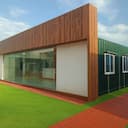
Portable Office
Modular Office Floor
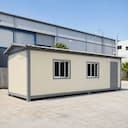
Portable Office
Readymade Office Cabin
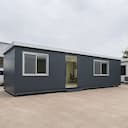
Portable Office
Modern Office Cabin
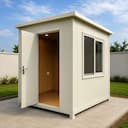
Portable Office
Small Office Cabin
Portable Office
Portable Office Container
Portable Office
Portable Office Cabin
Portable Office
Buy Portable Office Cabin
Portable Office
Prefabricated Portable Office Cabin
Portable Office
Prefabricated Office Cabins
Portable Office
MS Portable Office Cabin
Portable Office
Modular Portable Office Cabin
Product Details
Comprehensive information about Prefab Mobile Office
Product Overview
Detailed information about Prefab Mobile Office
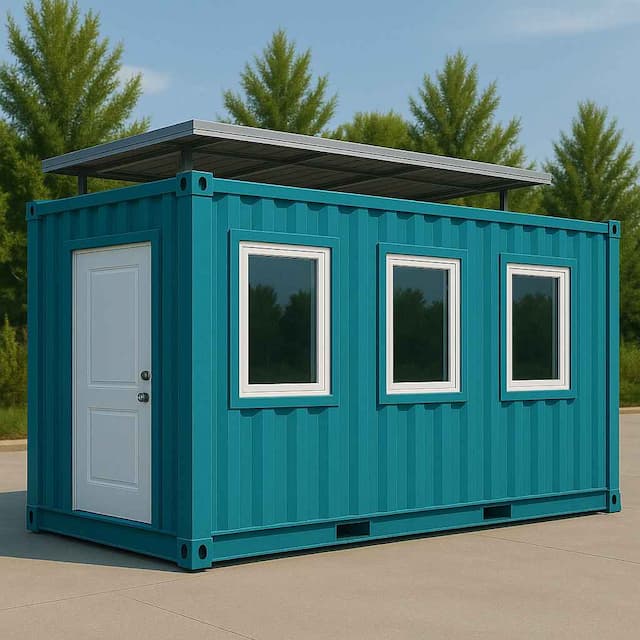
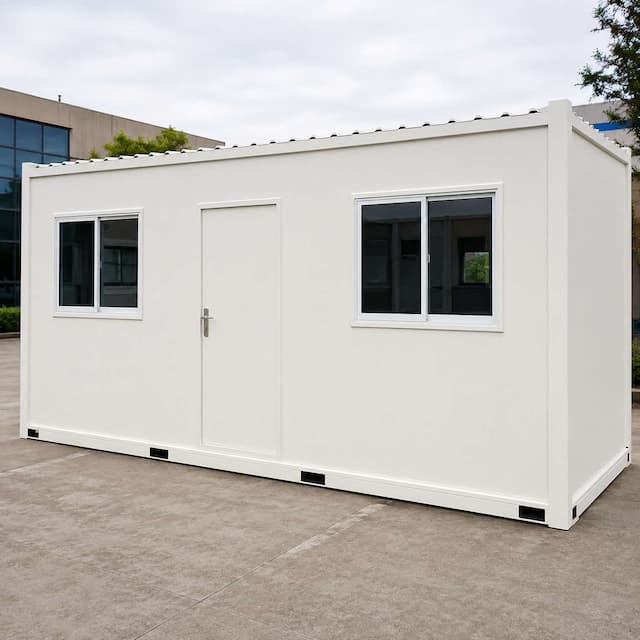
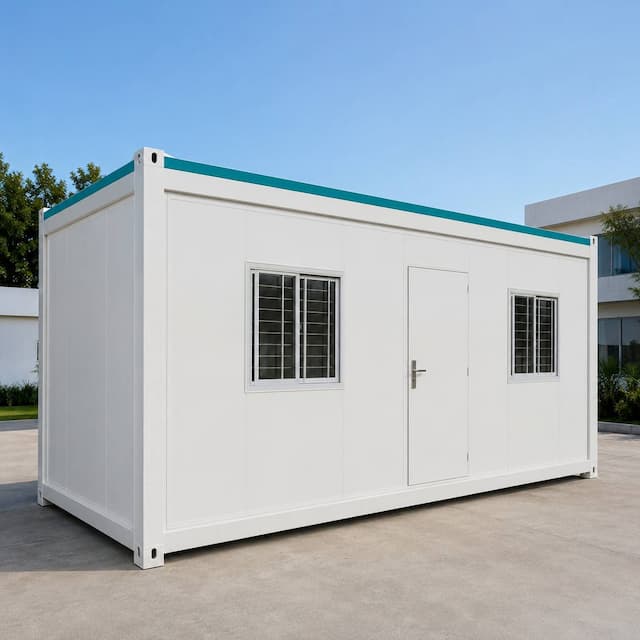
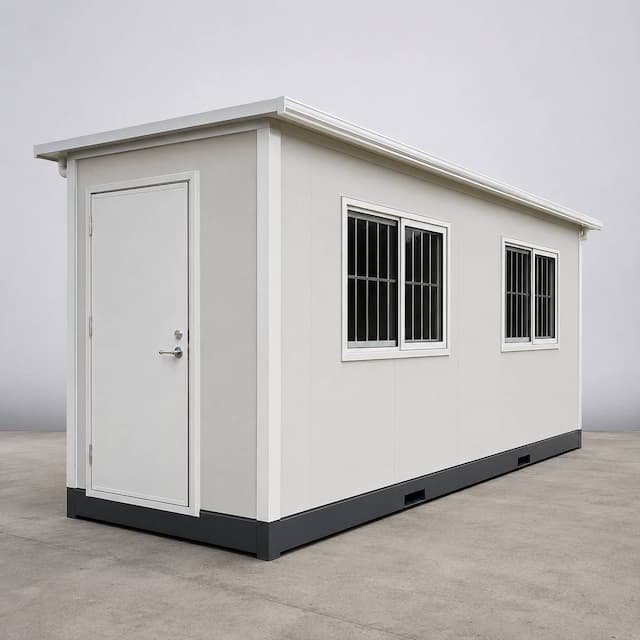
A prefab mobile office is the cabin-form answer to a buyer question that the standard portable office cabin and the heavy-duty container office both leave half-answered: what do I buy when this unit needs to move not once, but four, eight, or twelve times in a year? This page covers the cabin-form mobile office — lighter than a container, designed to survive repeated transit, and specified at the order stage for the relocation pattern of operations that move by calendar, not by project.
What is a prefab mobile office, and what makes a cabin-form unit different from a container?
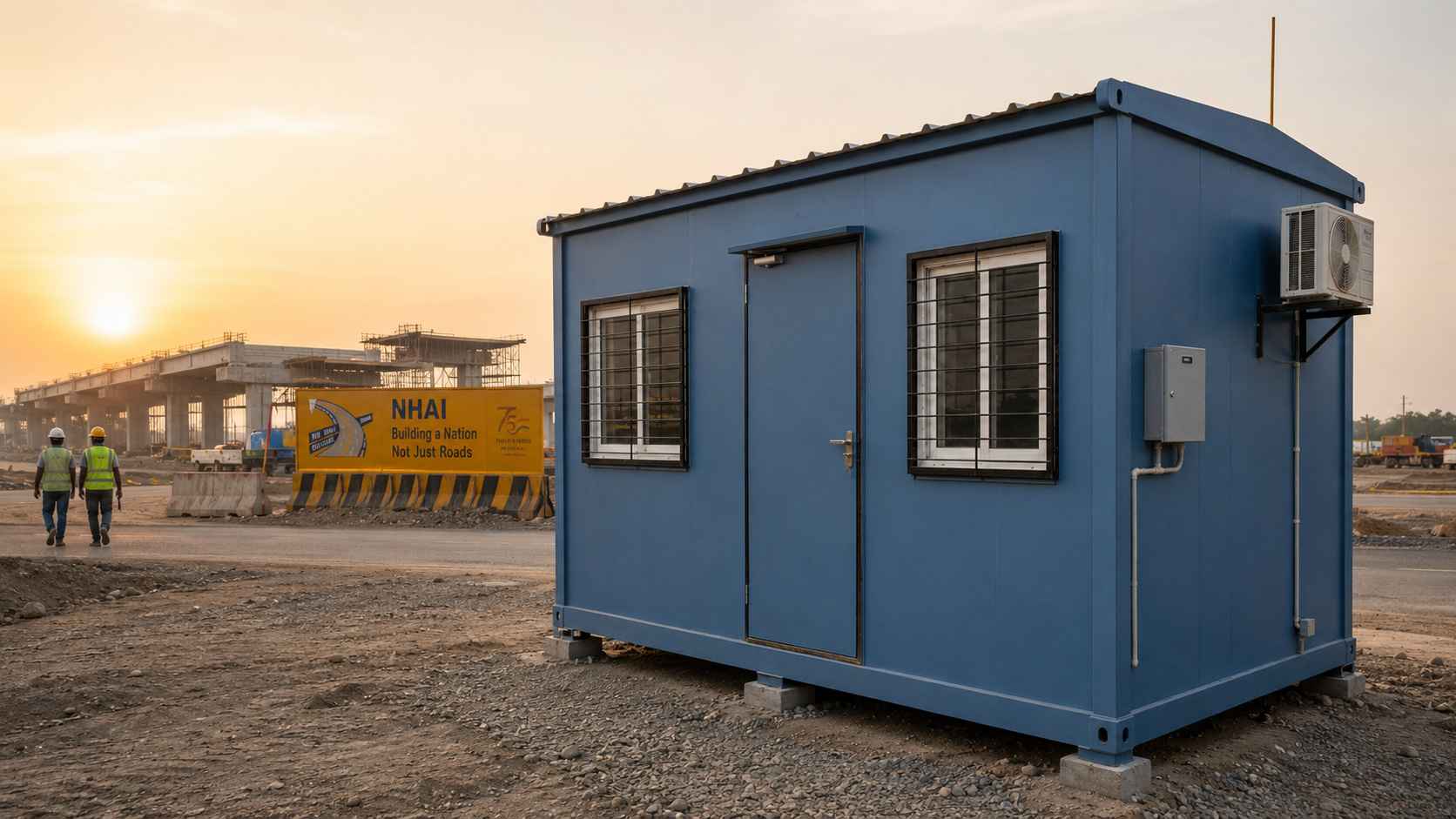
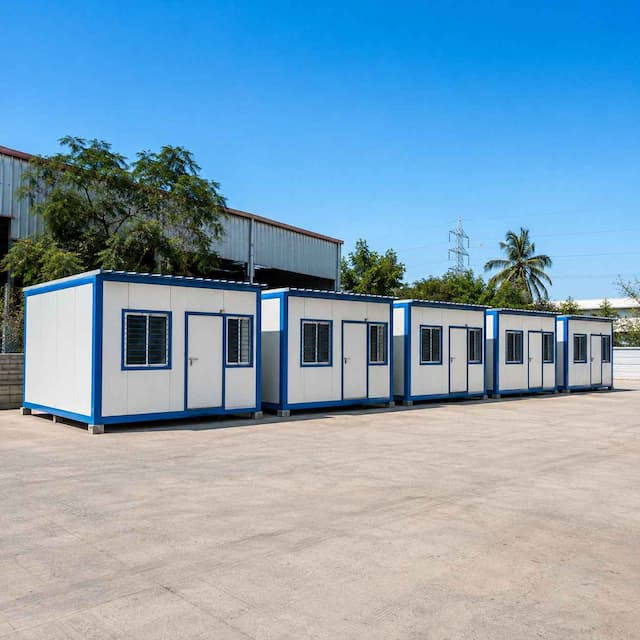
Field administration office on an NHAI highway project — SAMAN cabin-form unit moves with the work front.
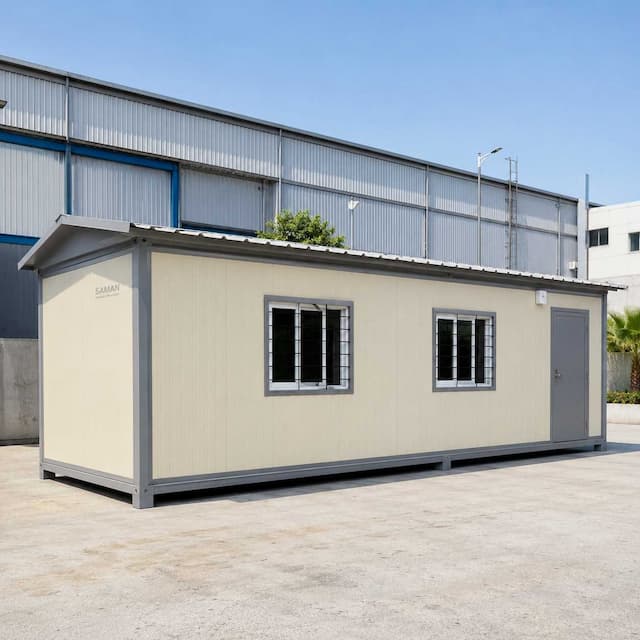
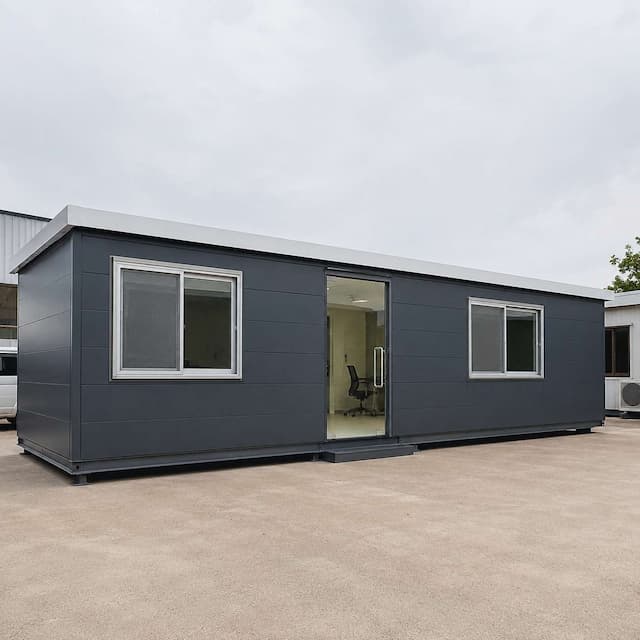
A prefab mobile office is a cabin-form workspace built on an MS frame with PUF sandwich panels, factory-fitted before dispatch and engineered for repeated relocation between project sites. Unlike a one-time-delivery prefab office, the mobile version specifies fitout that survives 4 to 12 annual moves. Unlike a container-form mobile office, the cabin form is lighter, loads on smaller equipment, and costs less per move.
The form-factor distinction is the central design decision. A container-form mobile office is built around an ISO container shell — heavy steel walls, corner-cast lifting points, and roughly 3.5 tonnes of empty weight for a 20-ft footprint. A cabin-form mobile office is built around an MS welded frame with insulated sandwich-panel walls — lighter shell, lower lift mass, and approximately half the empty weight per equivalent footprint.
For a buyer with a 2 to 12 person team and an annual move pattern, this weight difference is not academic. It changes which loading equipment your destination sites need, what the per-move flatbed and crane cost works out to, and how much of the move can be done with site equipment versus specialist riggers. The cabin form trades the container's structural ceiling — stacking, 180+ km/h wind rating, 16+ person capacity — for lower mass, lower logistics cost, and a wider set of sites that can receive the unit without dedicated crane infrastructure. This page covers the variant specified for that trade-off. The wider portable office cabin range covers static-deployment variants in parallel.
Inside a cabin-form mobile office — MS frame, sandwich panels, and how a lighter structure handles repeated lifts
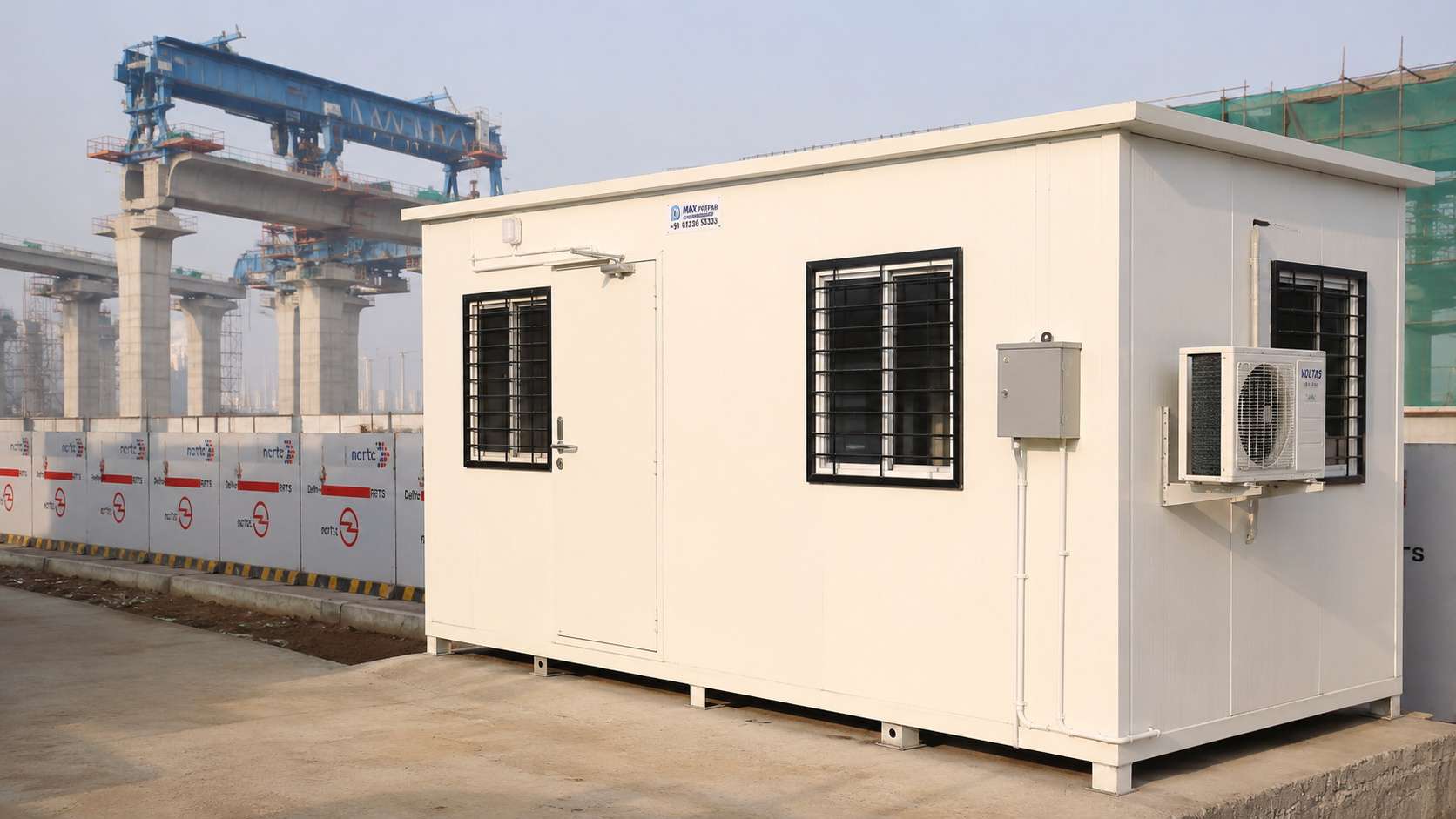
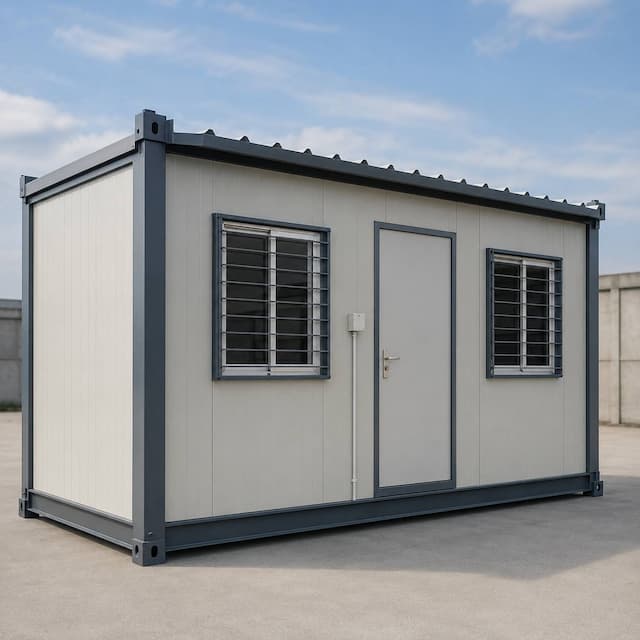
Metro project site office relocating between districts — SAMAN prefab cabin matched to quarterly move cadence.
What survives ten lifts is not the same as what survives one. The cabin-form mobile office uses a welded MS frame built from 80mm to 150mm channel-section steel, sized at the order stage to the unit footprint and the expected lift method (forklift, hydraulic jack, or crane). The frame is the structural element that carries the unit during transit — not the wall panels, not the roof. Get the frame specification wrong and the wall panels show stress at the join lines after the third or fourth move.
The wall assembly is 40mm to 60mm PUF (polyurethane foam) or EPS sandwich panel, locked into the frame using internal channels and silicone sealing at every edge. For a mobile-spec build, the panel-to-frame join is the point most exposed to repeated transit vibration. Standard cabins use silicone-only joints that perform well in static deployment but show degradation after 8 to 10 lift cycles. Mobile-spec uses silicone plus mechanical clip retention at each panel edge, which retains the seal through 25 to 30 lift cycles in normal handling.
The roof construction matters in a way that container shells do not. A container roof is part of the shell — one continuous structural element. A cabin roof is a separate assembly bolted to the frame: PPGI roofing sheet on a steel sub-frame, overlapping at the joints, sealed with butyl tape and PU sealant. For repeated transit, the overlap geometry and sealant grade are the variables that determine how long the unit goes between roof reseals. Mobile-spec uses extended overlap at the sheet joints (110mm versus the standard 75mm) and high-elasticity PU sealant rated for transit-induced flex.
Doors and windows are frame-mounted, not panel-mounted, on a mobile-spec cabin. Mounting hardware to the wall panel is acceptable on a static deployment. On a mobile unit, repeated lift-induced panel flex loosens panel-mounted hardware within 5 to 8 moves. Frame-mounted door jambs and window frames carry their load through the steel structure and stay tight across the operational life of the unit.
When the cabin form is the right answer — and when a container is the better call
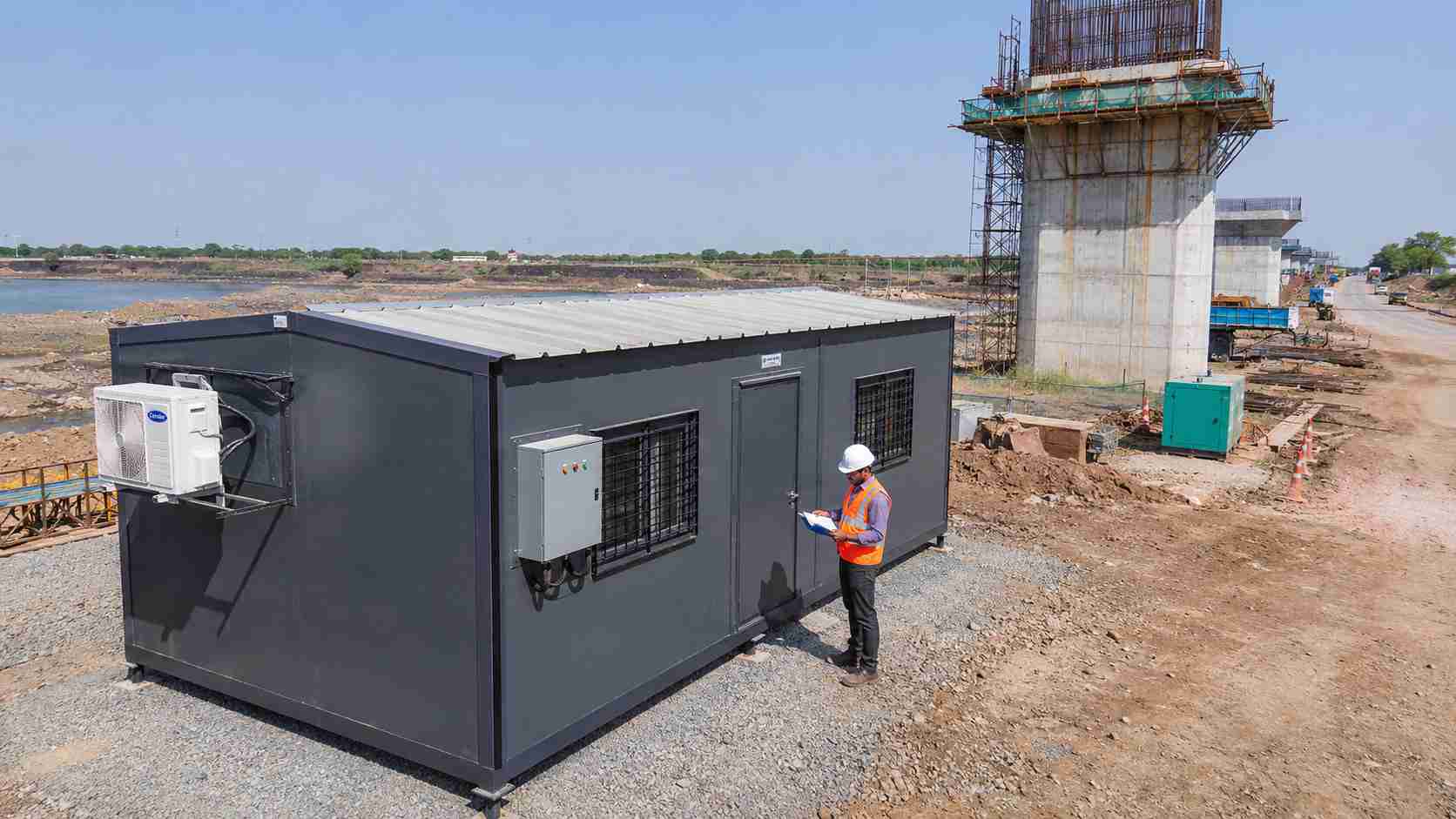
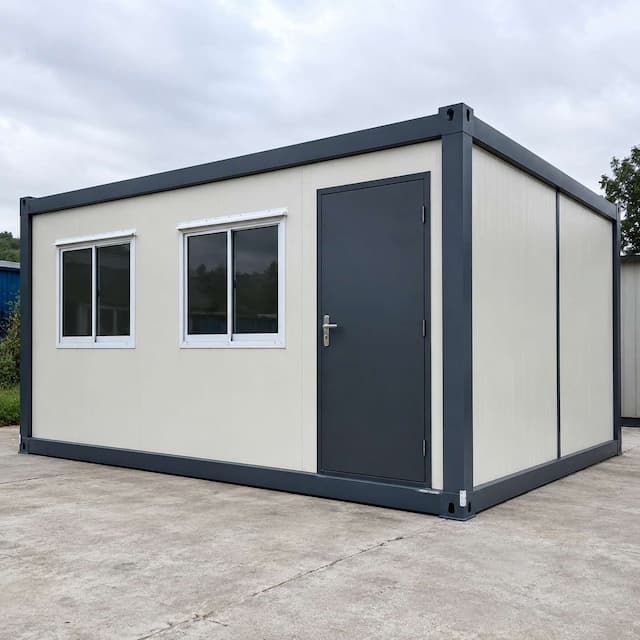
Bridge construction site office — SAMAN cabin-form unit chosen over container for lower per-move logistics cost.
The cabin form is the right answer when three conditions hold together: the team is 2 to 12 people, the move cadence is quarterly to monthly, and destination sites do not all have permanent crane infrastructure. Outside any one of those three, a container-form unit usually wins on lifecycle cost despite the higher unit price.
The decision splits on six specification dimensions. Read the table by the row that matters most for your operation; the form-factor that wins on three or more rows is usually the right buy.
| Specification dimension | Cabin-form (prefab mobile office) | Container-form (mobile office container) |
|---|---|---|
| Base frame | MS welded frame, 80–150mm channel | ISO container shell, 4mm steel walls |
| Empty weight (20-ft equivalent) | 1.8 to 2.4 tonnes | 3.2 to 3.8 tonnes |
| Loading equipment at each site | Forklift or hydraulic jack for sizes up to 12 ft wide; crane for larger | Crane required at origin and destination, every move |
| Per-move logistics (within state) | Rs 25,000 to 55,000 | Rs 35,000 to 75,000 |
| Maximum team size per unit | 12 people, up to 480 sq ft | 16 people, up to 640 sq ft |
| Stacking | Single-storey only | Stackable up to 3 high |
| Cyclonic wind rating | Up to 120 km/h | Up to 180 km/h |
When all six rows lean cabin — quarterly to monthly moves, small team, mixed crane infrastructure at destination sites, single-storey footprint, sub-cyclonic wind zones — the cabin form is the buy. For heavy-duty industrial mobile site offices, port operations, or any deployment where the unit will be stacked, the mobile office container is the better-suited specification.
Cabin fitout choices that earn back over the second, third, and tenth move
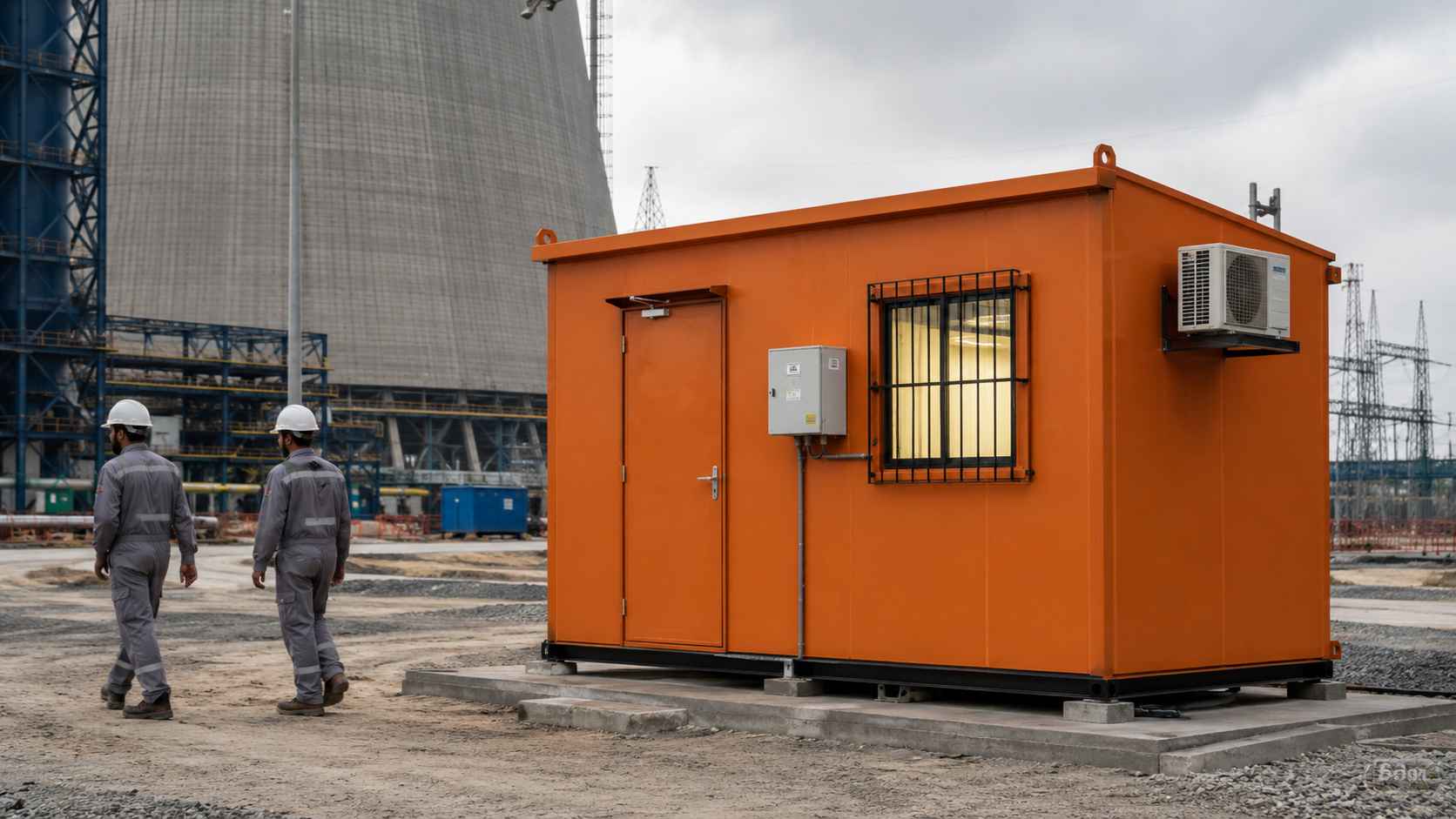
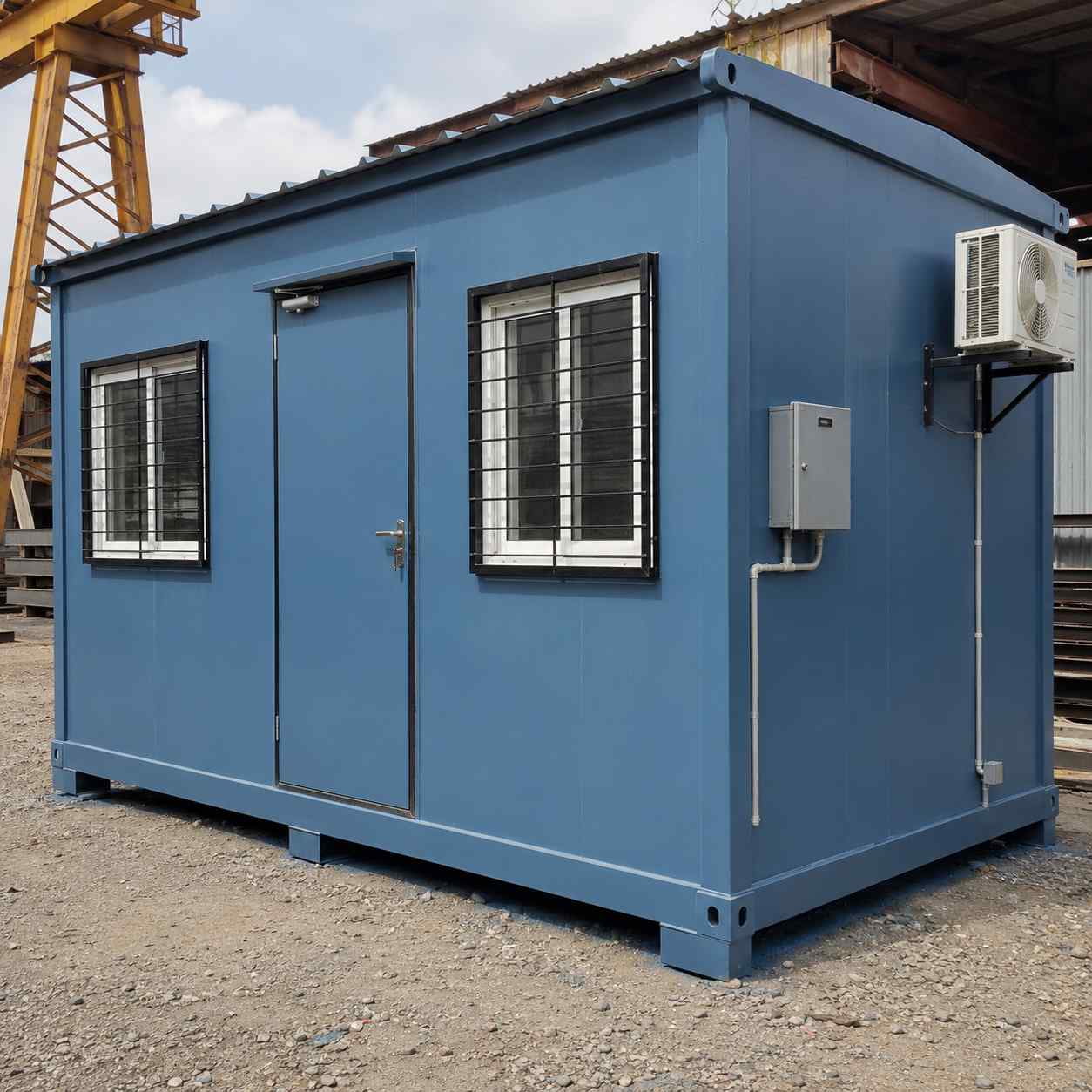
Thermal plant site office serving rotating inspection teams — SAMAN cabin sized for six to ten engineers.
Five interior fitout decisions are cabin-specific — they arise from the MS-frame-and-sandwich-panel construction and do not have container-form equivalents. Each is locked at the order stage.
Panel-edge sealing. A cabin wall is multiple sandwich panels joined edge-to-edge inside the MS frame. Every panel join is a potential ingress point under repeated transit flex. Standard-spec uses silicone sealing at each join — adequate for 1 or 2 moves. Mobile-spec adds a continuous EPDM gasket between adjacent panels behind the silicone bead. The gasket compresses on installation, recovers fully between moves, and holds the seal across 25 to 30 lift cycles. Container shells do not have panel joins; this decision exists only for cabin form.
Frame-channel wiring access. Cabin frames are hollow C-section or rectangular hollow section. Wiring can run inside the frame channels with junction-box access at the floor corners — a routing option not available on a container shell, which is a solid plate. Mobile-spec routes the main electrical loop through frame channels with surface conduit only for branch circuits. This protects the main wiring from transit damage and keeps the visible interior clean while preserving access for inspection.
Roof-overlap maintenance interval. Cabin roofs are multi-piece PPGI sheets sealed at overlaps. After repeated transit-induced flex, the overlap geometry shifts and the original sealant develops micro-gaps within 18 to 24 months on standard spec. Mobile-spec uses 110mm overlaps (versus standard 75mm) and butyl-tape-plus-PU sealant in a two-layer system. The maintenance interval extends to 36 to 48 months. Container roofs are monolithic and do not have this interval at all — a cabin-form-specific decision.
Floor substrate under vinyl. A cabin floor is structural plywood (BWP-grade) on the MS frame; the vinyl finish sits on plywood. A container floor is steel plate; the vinyl sits on steel. Different substrates mean different vinyl adhesion specifications: cabin-form mobile-spec uses moisture-cured PU adhesive (because plywood expands and contracts with humidity); container-form uses solvent-based contact adhesive on steel. Using the wrong adhesive on a cabin floor results in vinyl peeling within 8 to 12 months of repeated transit.
Door and window frame integration. On a cabin, the door and window frames must be integrated into the steel structural frame at fabrication — not bolted to the wall panel post-construction. Panel-mounted door frames loosen within 5 to 8 transit cycles because the sandwich panel flexes under lift load. Frame-integrated mounting carries the door and window load through the steel structure, not through the panel. Containers have rigid steel walls and avoid this decision entirely; for cabin-form units it is the most common source of fitout failure when overlooked.
These five decisions are the cabin-form's specification floor for repeated relocation. Together they add approximately Rs 40,000 to Rs 80,000 to the unit cost over a standard non-mobile fitout — a one-time premium that pays back from move three onward through deferred maintenance and avoided downtime.
Loading and re-siting a cabin-form mobile office without permanent crane infrastructure
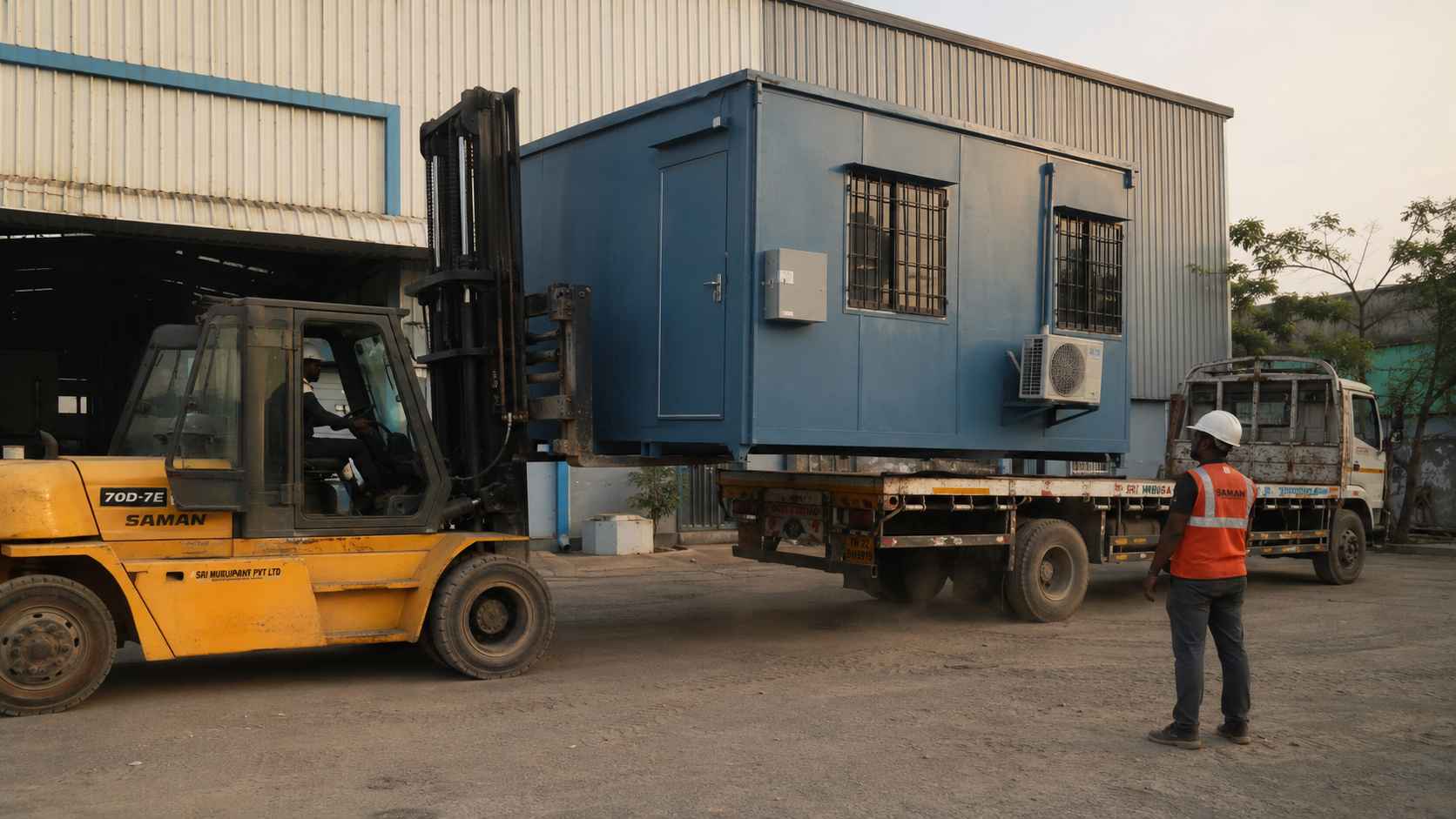
Forklift loading from a SAMAN industrial depot — no crane hire needed for cabin-form sizes up to twelve feet wide.
Three loading methods cover the cabin-form mobile office across all standard sizes. The right method for a given move depends on unit size, site access, and the equipment available at both the origin and destination locations.
Forklift loading is the operational standard for sizes up to 12 ft wide and 24 ft long. A 7-tonne forklift with extended forks (1.8 metre minimum reach) lifts the cabin under its steel frame channel and walks it onto the flatbed at the origin and off at the destination. Total loading time per end: 30 to 45 minutes. Crane hire avoided at both ends. This is the dominant method for quarterly and six-weekly move cadences at cabin scale.
Hydraulic jack and skate is the alternative for sites where a forklift cannot reach the loading position — narrow yard access, soft ground, or overhead clearance below 4.2 metres. Four 5-tonne hydraulic jacks lift the cabin onto skates, which then roll the unit onto a low-bed truck via a ramp. Loading time per end: 90 to 120 minutes. Slower than forklift, but works at sites the forklift cannot enter.
Crane lift is mandatory at sizes above 12 ft wide or for any move where the destination site has neither forklift nor jack-and-skate access. The crane is the most expensive option per move — Rs 8,000 to 18,000 per lift in most Indian states — and is sometimes the only option for the largest cabin sizes such as 16 ft × 30 ft and equivalent footprints.
The destination site needs three things confirmed before the truck dispatches: a level surface within ±25mm across the cabin footprint, clear access for the loading equipment (gate width, overhead clearance, ground bearing capacity), and a 230V electrical inlet point within 15 metres of the placement spot. Sites that meet all three receive the unit, power it on, and re-occupy it in 4 to 6 hours from truck arrival.
The site-prep checklist is the same at every new location. Buyers running annual rotations across 8 to 12 sites build the checklist into their advance reconnaissance — one site visit four weeks before each move confirms readiness. The cost of that visit is consistently lower than the cost of a half-day delay if the receiving site turns out to be unprepared on move day.
Specifying your prefab mobile office — relocation pattern, team size, and what to lock at order stage
Three buyer decisions need to be locked before manufacture begins. None can be cleanly retrofitted to a delivered unit; all are scope of the order-stage discussion.
Relocation pattern. Confirm the move cadence (quarterly, six-weekly, monthly, or denser), the move geography (single state, multi-state, all-India), and the unit's expected operational life (24 months, 60 months, longer). The fitout grade follows from these three numbers. A quarterly-cadence unit on a five-year operational life specifies differently from a monthly-cadence unit on a three-year life — both are mobile, neither is the same product.
Team size and footprint. Confirm seated occupancy at peak, desk count, storage and document-cabinet count, and whether a meeting area or supervisor enclosure is needed inside the unit. Footprint follows; standard mobile-cabin sizes range from 8 × 10 ft (single occupant, field-officer use) to 16 × 30 ft (12-person team with internal partitions).
Crane assumptions. Confirm whether all destination sites will have crane access or whether the build needs to optimise for forklift and hydraulic-jack loading. Units intended for forklift loading need the frame channels positioned for fork access at specific points along the underside; this is a factory-stage decision, not a field modification.
For buyers whose office will be delivered once and used on a single site across its full operational life, the prefab portable office is the right specification — built as one finished piece, powered on the day it arrives, no mobile-spec premium. This page is specifically for the buyer whose unit will move repeatedly.
To request a quotation, share three pieces of information: unit size and team count, planned annual move pattern, and the locations or states the unit will operate across. SAMAN's Bangalore facility responds with a complete specification and a priced quotation within 24 hours. Standard delivery is 7 to 21 working days from order confirmation, depending on customization and the destination site. Browse the full portable office family for static-deployment variants.
Call or WhatsApp: +91 97089 89937
Frequently Asked Questions
Can a prefab mobile office handle inter-state moves, or is it built only for intra-state circuits?
Yes, inter-state moves are within scope. The fitout grade is the variable, not the geographic range. Intra-state moves at quarterly cadence run on standard or relocation-grade fitout. Inter-state moves at six-weekly or monthly cadence specify full mobile-spec — welded vinyl seams, dampened AC brackets, frame-mounted hardware throughout. Confirm both the cadence and the geographic span at order stage.
How many moves before a prefab mobile office needs major refurbishment?
On full mobile-spec fitout with normal handling, expect 25 to 30 lift cycles before any panel-edge resealing or major fitout refurbishment is needed. Standard-spec cabins reach the same refurbishment point at 8 to 10 lift cycles. The difference is the order-stage fitout choice — not the cabin shell itself.
What's the largest prefab mobile office that still loads on a forklift, no crane needed?
12 ft wide by 24 ft long — approximately 288 sq ft of internal area — is the practical ceiling for forklift loading with a 7-tonne forklift and extended forks. Anything above that footprint moves to hydraulic-jack-and-skate at slower sites or to crane lift at sites without skate access. The cabin's frame channels are positioned for fork access at order stage.
Does the per-move logistics cost include the unit itself, or is that separate from the unit price?
Separate. The unit price covers manufacture, factory fitout, and delivery to your first site. Per-move logistics — flatbed, loading equipment, recommissioning labour — are quoted per move once the unit is in operation. SAMAN can quote logistics on a per-move basis or as an annual contract for known move patterns of 4 to 12 moves per year.
Verified manufacturer credentials
SAMAN POS India Pvt Ltd (POS = Portable Office Solutions) is a direct, certified manufacturer: ISO 9001:2015 (Cert No. E20250218645), ISO 14001:2015 (Cert No. E20250218646) and ISO 45001:2018 (Cert No. E20250218647) certified; NSIC enlisted (Ref. NSIC/GP/BAN/2024/0055207); DPIIT-recognised startup (Ref. DIPP56005); Udyam registered (UDYAM-KR-03-0172770); GST 29ABBCS7101B1ZR (Bangalore) and 09ABBCS7101B1ZT (Noida). Every unit is built on an IS 2062 steel frame at our own works and dispatched factory-direct from Bangalore (Gopasandra, 560099) or Greater Noida (Jalpura, 201308), with typical transit of 3–5 days. Browse the full portable office range, or call +91 88616 22859 and send an enquiry.
Customer Reviews
0 reviews
No reviews yet. Be the first to review this product.
Write a Review for Prefab Mobile Office
Built by a verified manufacturer: ISO 9001:2015 certified, Udyam registered, NSIC-enlisted, GST registered.
View manufacturer credentials