
Porta Cabin Cost in India 2026: Sq Ft Rates, Size Brackets, and What Actually Drives the Final Number
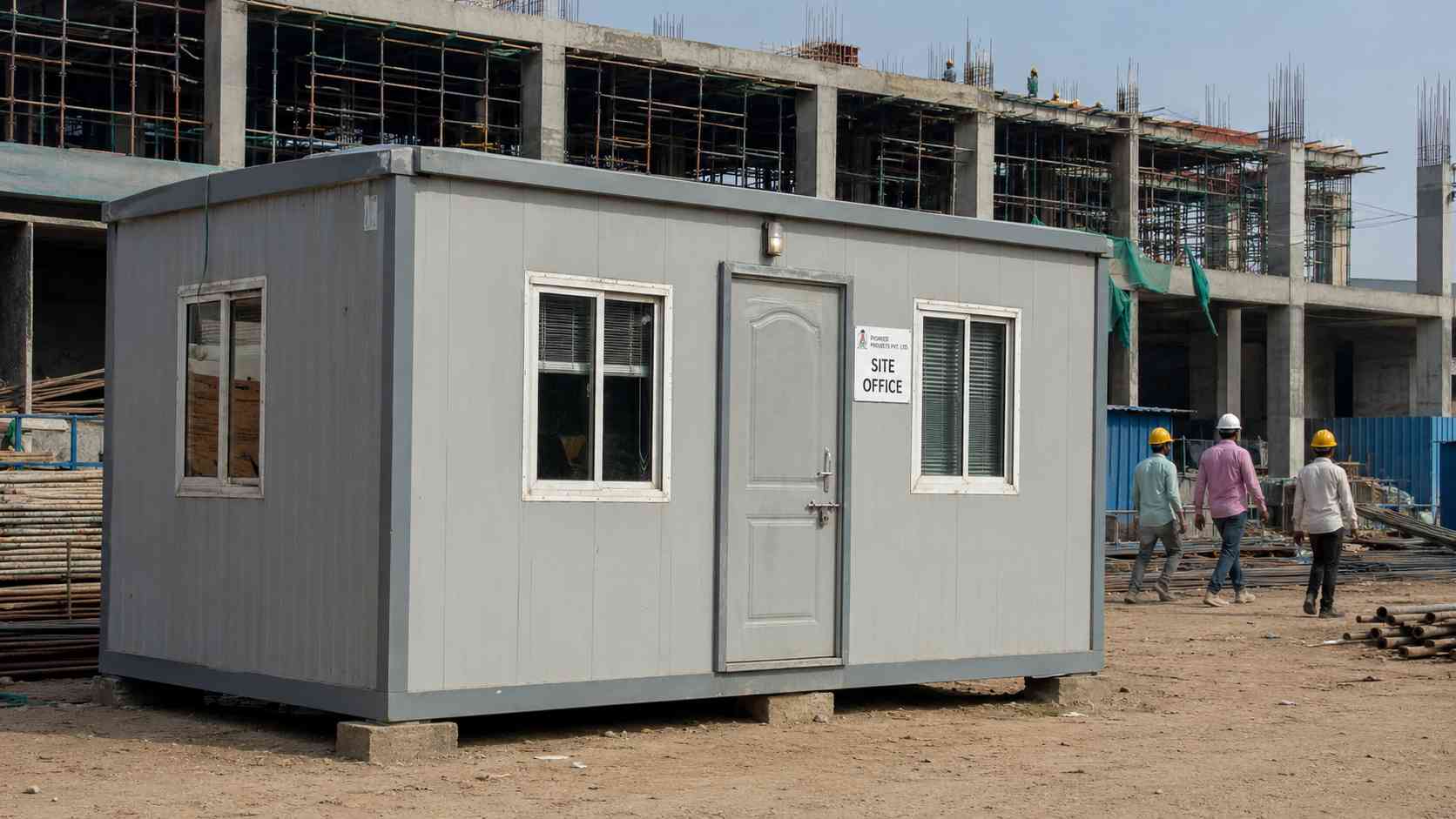
The porta cabin cost in India in 2026 runs ₹1,104 to ₹2,035 per square foot ex-GST for a standard MS-frame, PUF-panel build, before transport, GST, and site preparation. A typical 200 sq ft (20×10 ft) site office lands at ₹2.40–3.70 lakh ex-factory depending on build grade. For a factory-locked figure, see our factory-direct porta cabin prices and specifications.
That single answer is true for most first-time buyers, but the final number on your purchase order is shaped by four cost layers, not one. The base sq ft rate is just the largest of them. Frame grade, panel system, finishes, transport distance, site preparation, and the 18% GST on movable goods together account for 25–40% of the delivered cost. This guide breaks down each layer with the rates we publish from our manufacturing facilities in Bangalore and Greater Noida, so a contractor, SME owner, or first-time procurer can budget without surprises.
How Much Does a Porta Cabin Cost in India in 2026: and What Changes the Final Number
Most buyers ask “what is the cost of porta cabin” expecting a single number. The honest answer is a band. SAMAN’s current product line spans ₹1,104 to ₹2,035 per square foot ex-GST, and that 1.8× spread between the entry and premium ends of our own catalogue tells the same story you will hear from any serious Indian manufacturer: the base material the cabin is built from, the panel thickness, the finish quality, and the size you order all move the rate independently.
Four cost layers shape the final invoice. The first is the sq ft rate, which scales with size bracket and frame grade. The second is add-ons and utilities: false ceiling, vinyl flooring, electrical wiring, AC provision, attached toilet. The third is transport and site preparation: distance from factory, crane hire if the cabin lands above ground floor, RCC plinth for soft soil or rooftop. The fourth is GST and statutory documentation: 18% on the movable structure, plus mill test certificates if your tender requires them.
The same 20×10 ft cabin can finish at ₹2 lakh as a basic site office for a Bangalore-area contractor, or ₹6 lakh as a luxury sales office for a Mumbai retail brand. Neither price is wrong. They are different products built to different specs, and the gap is explained entirely by the four layers above. The rest of this guide quantifies each one so you can read any porta cabin quote and know exactly what you are paying for.
If you are still mapping which cabin variant fits your project, site office, multi-room labour cabin, security post, retail kiosk, start with our ready-built porta cabin range before working through cost mechanics here. The catalogue confirms which form factor matches the use case; the cost framework below confirms the budget.
Porta Cabin Cost per Square Foot: Rates by Size Bracket
The porta cabin cost per square foot is the single most useful budgeting number because it lets you compare quotes from different manufacturers on equal terms. The rate is not flat. A 10×10 ft cabin carries a higher per-sq-ft rate than a 40×10 ft cabin built to the same spec: every unit, large or small, needs the same MS frame perimeter, the same factory-fitted door and window set, the same wiring loom. Those fixed costs amortise across more square footage as size goes up, dropping the rate by 15–25% between the entry size and the largest standard configuration.
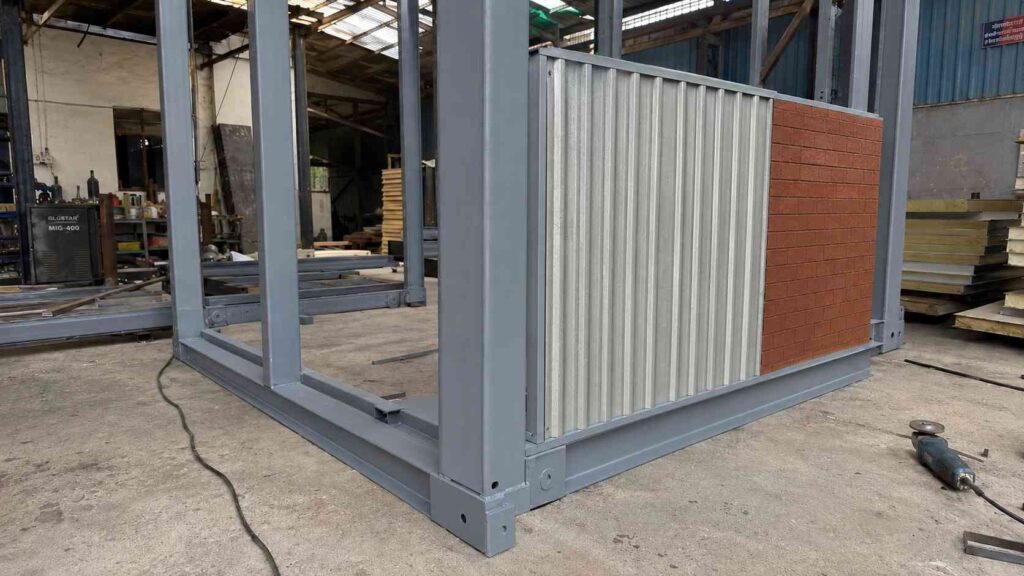
The table below shows the working rate bands for our Bangalore and Greater Noida facilities in 2026. Standard MS+PUF builds use IS 2062 mild steel frame with 50–60 mm PUF sandwich panels, vinyl flooring, single door, two windows, basic electrical loom. Premium builds add heavier gauge framing, 70 mm panels, false ceiling, ACP cladding or higher finish-grade interiors, and AC provision.
| Cabin Size | Floor Area | Low Cost (₹/sq ft) | Standard (₹/sq ft) | Luxury (₹/sq ft) |
|---|---|---|---|---|
| 10 × 10 ft | 100 sq ft | ₹1,320 | ₹1,375 | ₹2,035 |
| 20 × 8 ft | 160 sq ft | ₹1,320 | ₹1,375 | ₹2,035 |
| 20 × 10 ft | 200 sq ft | ₹1,200 | ₹1,250 | ₹1,850 |
| 20 × 12 ft | 240 sq ft | ₹1,152 | ₹1,200 | ₹1,776 |
| 30 × 10 ft | 300 sq ft | ₹1,152 | ₹1,200 | ₹1,776 |
| 40 × 8 ft | 320 sq ft | ₹1,128 | ₹1,175 | ₹1,739 |
| 20 × 20 ft | 400 sq ft | ₹1,128 | ₹1,175 | ₹1,739 |
| 40 × 10 ft | 400 sq ft | ₹1,128 | ₹1,175 | ₹1,739 |
| 40 × 12 ft | 480 sq ft | ₹1,104 | ₹1,150 | ₹1,702 |
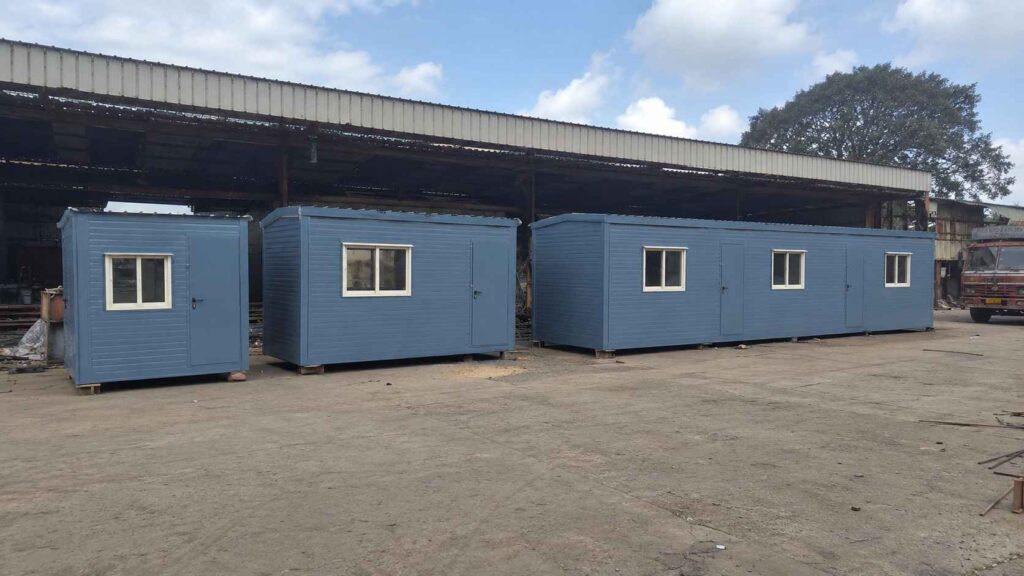
Read the table this way: the rate falls as the cabin gets larger, because the fixed cost of the base frame, door, and electrical package spreads across more floor area. A contractor needing a 20×10 ft site office pays ₹2,40,000 ex-factory in the Low Cost build and ₹2,50,000 in the standard build; the same footprint in the Luxury build is ₹3,70,000 ex-factory. Neither number includes the four-layer adders covered in the next section.
The product-grade reference point for the entry tier is our standard configuration with full specifications and live pricing on the porta cabin product specifications and configurations we manufacture. Quotes that come in 25% below the table above typically mean a thinner panel (40 mm or below), a lighter gauge frame, or skipped finish items, not a better deal.
What Drives the Rate Up or Down: Frame Grade, Panel System, and Finishes
The conventional buyer’s question is “which material is cheapest.” The better question is “which spec choices move my rate by how much.” Three choices account for almost all of the variation inside a size bracket.
Frame grade. The baseline is IS 2062 Grade A mild steel: the standard structural mild steel specification used in factory-built porta cabins across India. Heavier gauge framing, meaning thicker box-section members and a deeper base channel, lifts the rate in exchange for higher load tolerance, better resistance to flexing during transport, and a longer service life on aggressive sites. It is quoted per project because the uplift depends on span, storey height and the loads you specify. For a 3 to 6 month event cabin or a temporary guard post, the baseline frame is correct. For a 5 to 10 year project cabin or a long-duration labour colony unit, the heavier gauge pays back in fewer site repairs.
Panel system. PUF (polyurethane foam) sandwich panels in 50–70 mm thickness are the workhorse. A 50 mm panel insulates adequately for most climates and is the standard specification across the size brackets above. A thicker panel brings materially better thermal performance in coastal and hot-dry regions, and is priced from the panel rate for the thickness you choose rather than as a flat uplift. Above PUF sits ACP, aluminium composite panel cladding, chosen mainly for brand-facing work such as retail kiosks, urban sales offices and container-cafe conversions. ACP does not add structural strength; it is a finish premium and is quoted separately.
Finishes and utilities. A bare-shell cabin costs less than a ready-to-occupy office. Finishes add up in a predictable order, from smallest effect to largest: vinyl or anti-skid flooring, then a false ceiling with insulation, then internal partitions, then a full electrical fit-out with lighting and points, then an attached toilet with WC and plumbing, and finally split AC including installation. Each is quoted on the drawing because the quantity changes with layout, so ask for them itemised rather than as a single fit-out figure. A buyer who accepts a basic shell stays near the Low Cost column; one who needs a full corporate office configuration lands at or above the Luxury column.
Two real product anchors set the floor and ceiling of this spread. At the entry end, our entry-level low-cost porta cabin starting Rs 2,15,000 is a 20×10 ft MS+PUF unit with basic fittings, suitable for a site office or contractor’s project room. At the premium end, the premium-finish luxury porta cabin with AC and false ceiling runs ₹5,35,000 for the same footprint with the full client-facing fit-out. Same cabin size, 2.5× the price, every rupee accounted for by the spec choices above.
The Add-Ons Buyers Forget: Transport, Crane, RCC Plinth, and GST
The ex-factory rate is only the start. Six adders typically lift the final invoice 15–30% above the sticker, and they are the line items on which under-budgeted projects overrun.
| Add-On | Unit | Typical Range (₹) | When It Applies |
|---|---|---|---|
| Transport (40 ft open trailer) | per km | ₹80/km + ODC + RTO charges | Beyond manufacturer’s local delivery zone |
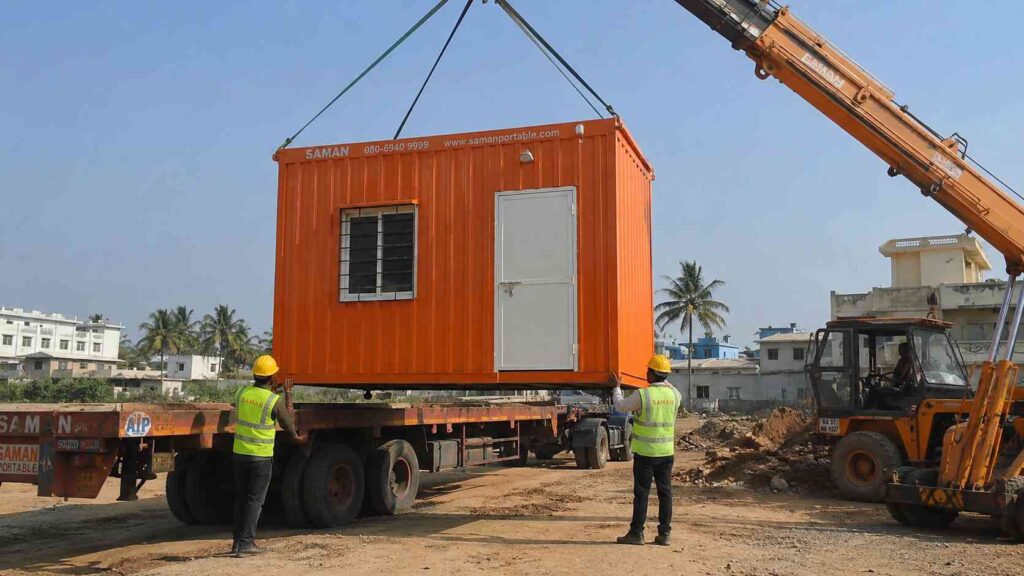
| Crane or hydra lift | per lift | ₹4,000 – ₹8,000 | Terrace install or elevated placement |
| RCC plinth (150 mm, M20) | per sq.m. | ₹800 – ₹1,200 | Soft soil, terrace install, or load-spreading need |
| GST | flat | 18% of cabin + add-on cost | All movable factory-built structures, India-wide |
| Mill test certificate (frame) | per project | ₹10,000 – ₹20,000 | EPC contracts, government tenders, audit-grade sites |
| Site assembly labour | per day | ₹250 – ₹500 per worker | Multi-day onsite assembly or complex layouts |
The transport rate is the single most variable line. Our shipping policy publishes ₹80 per km for a 40 ft open trailer dispatched from either the Bangalore or Greater Noida facility, excluding Over Dimensional Cargo and Regional Transport Office charges that may apply on multi-state routes. A Bangalore-to-Chennai delivery of roughly 350 km lands at ₹28,000 plus ODC/RTO. A Bangalore-to-Mumbai delivery at 980 km lands closer to ₹78,000 plus permits. Choosing the closer manufacturing unit, Greater Noida for any North India project, Bangalore for South and West, typically saves 15–25% on transport alone.
Crane lifts apply when the cabin lands above ground floor. Most rooftop installations need one or two lifts depending on access; a tall building in Delhi or Mumbai can push the lift charge to ₹25,000–₹35,000 once labour and permit costs are added. For the full breakdown of the rooftop-specific cost layer, see our dedicated guide to porta cabin terrace installation costs: RCC plinth specifications, structural certification, waterproofing, parapet compliance, and the municipal approvals every terrace project needs.
GST is non-negotiable at 18% on the movable structure plus add-on services bundled into the invoice. A ₹3 lakh ex-factory cabin becomes ₹3.54 lakh after GST before transport or site work. Mill test certificates are sometimes optional for private SME buyers but mandatory for EPC contractors and government tender submissions, budget them in from the start if your procurement falls in either category.
A Worked Total Project Cost: 200 sq ft Site Office in Bangalore
A buyer in Bangalore commissioning a 20×10 ft (200 sq ft) site office for an 18-month construction project, delivered to a peri-urban site 30 km from our Gopasandra unit, will see the following structure on their purchase order. The base specification is MS+PUF (50 mm panels), vinyl flooring, false ceiling, single door, two windows, basic electrical loom, and one toilet with plumbing.
- Ex-factory cabin, 200 sq ft at ₹1,200/sq ft, Low Cost column: ₹2,40,000
- Attached toilet with WC and plumbing, quoted on drawing: ₹65,000 in this example
- Electrical fit-out with lighting, switches and computer points, quoted on drawing: ₹18,000 in this example
- GST at 18% on the sub-total of ₹3,23,000: ₹58,140
- Transport 30 km at ₹80/km on a 40 ft trailer: ₹2,400
- Site assembly labour, 2 workers × 2 days × ₹400/day: ₹3,200
- Sub-total delivered and installed: ₹3,86,740
That ₹3.87 lakh figure is what the contractor budgets for. The sticker of ₹2.4 lakh for the cabin alone is not. The 61% lift from sticker to delivered is normal for a fully fitted site office; for a bare-shell storage cabin without toilet or electrical, the lift drops to 25–30%.
The same cabin delivered to Mumbai, 980 km from Bangalore, would replace the ₹2,400 transport line with ₹78,400, and at that distance the buyer should source from our Greater Noida facility instead if the project is anywhere in West or North India, or commission a regional quote with locally cited rates. Total project cost is location-sensitive even when ex-factory rates are not.
Rent vs Buy: When the Math Tips Toward Purchase
For projects longer than two years, buying a porta cabin is almost always cheaper than renting. For projects shorter than one year, rental usually wins. The break-even sits in the 22–28 month range, depending on the size and configuration chosen.
A 200 sq ft cabin rents at ₹8,000–₹12,000 per month across most Indian metros, with the lower end reflecting bare-shell units and the upper end matching fully fitted site offices. Twenty-four months of rental at ₹10,000 per month is ₹2.4 lakh: within ₹15,000–₹50,000 of what the same cabin costs to buy ex-factory in the Standard band, depending on spec.
The buy-side math also has a recovery layer. A well-maintained MS+PUF cabin retains 40–60% of its original value at the year-5 resale point. A buyer who spends ₹3 lakh on a cabin and uses it for five project phases of varying duration typically recovers ₹1.2–1.8 lakh at the end of useful life, dropping the effective cost of ownership to ₹1.2–1.8 lakh over five years. Well below the ₹6 lakh that 60 months of rental at the same monthly rate would have cost.
Three project-type rules close the decision quickly:
- Project ≤ 12 months, rent. The break-even has not arrived; capital is better deployed elsewhere.
- Project 12–24 months, break-even zone. Buy if the cabin will redeploy to a second project; rent if it is single-use.
- Project ≥ 24 months, buy. The math has already tipped, and resale residual makes the gap wider with each additional month.
For multi-cabin labour colonies or long-duration EPC site offices, the buy-side math becomes even stronger, bulk procurement typically trims 8–12% off single-unit rates, and the resale market for clean factory-built MS+PUF cabins remains active in most metros.
Why Buy Factory-Direct from SAMAN
SAMAN started in 2009 as SAMAN Portable Office Solutions and was incorporated in 2019 as SAMAN POS India Pvt Ltd (POS = Portable Office Solutions), a 15-year manufacturing record, not a marketplace listing. We build every porta cabin in-house on an IS 2062 mild-steel frame at our own units in Bangalore (560099) and Greater Noida (201308), and have delivered 500+ projects across India. Our systems are certified to ISO 9001:2015, ISO 14001:2015 and ISO 45001, and we are NSIC-enlisted and a DPIIT-recognised startup. Delivery is ₹3,000 with 3–5 day transit; returns within 7 days of delivery.
Call or WhatsApp +91 88616 22859 for a factory-direct quote, or use Send Enquiry.
Frequently Asked Questions
How much does a porta cabin cost in India?
A porta cabin in India costs ₹1,104 to ₹2,035 per square foot ex-GST. The Low Cost build starts at ₹1,104 per sq ft on the largest 40×12 ft unit, the standard MS-frame build runs ₹1,150 to ₹1,375 depending on size, and the Luxury build with heavier framing and upgraded finishes reaches ₹2,035 per sq ft on the compact 10×10 ft unit. A typical 200 sq ft site office lands at ₹2,50,000 ex-factory in the standard build, before transport, GST, and site work.
What is the porta cabin cost per square foot in 2026?
The porta cabin cost per square foot in 2026 ranges from ₹1,104 at the entry end, which is the Low Cost build in 40×12 ft, to ₹2,035 at the premium end, the Luxury build in 10×10 ft. Smaller cabins carry higher per-sq-ft rates because fixed costs, frame perimeter, door, window, wiring loom, amortise across less floor area.
Does material choice (MS, PUF, sandwich, ACP) change the porta cabin cost?
Yes, materially. The IS 2062 mild steel frame baseline is common to most factory-built cabins; the variation comes from panel system and finish. A 50 mm PUF panel is the standard, and a thicker panel is priced from the panel rate for that thickness. ACP cladding for brand-facing exteriors is quoted separately on top of the PUF base, and it is chosen mainly for aesthetics rather than structural strength.
Is it cheaper to rent or buy a porta cabin?
For projects longer than 24 months, buying is almost always cheaper than renting. Twenty-four months of rental at ₹10,000 per month (₹2.4 lakh) approaches the ex-factory cost of the same cabin. Add a 40–60% resale residual at year 5, and the buy-side math wins decisively on any multi-year deployment. Projects under 12 months almost always favour rental, the break-even has not arrived.
What hidden costs (transport, crane, GST, plinth) get added to the base price?
Six adders typically lift the final invoice 15–30% above the ex-factory rate. Transport runs ₹80 per km for a 40 ft trailer plus ODC and RTO charges; crane lifts for terrace installs ₹4,000–₹8,000 per lift; RCC plinth ₹800–₹1,200 per sq.m. when needed; GST 18% on the structure plus services; mill test certificates ₹10,000–₹20,000 for EPC or government tenders; site assembly labour ₹250–₹500 per worker per day.
Does a porta cabin retain resale value?
A well-maintained MS+PUF porta cabin retains 40–60% of its original purchase value at the year-5 resale point. Higher-spec units with ACP cladding or full corporate fit-out hold value at the upper end of that range; basic shells with cosmetic wear sit at the lower end. Frame condition, panel integrity, and absence of corrosion at the base channel are the three signals resale buyers actually inspect.
Get a Quotation for Your Project
For a quotation on the configuration that fits your project, our manufacturing and sales team can scope size, spec, transport, and delivery timeline against your site requirements.
Talk to our team: Call +91 88616 22859 or use the Send Enquiry button with your cabin size, configuration and site location for a factory-direct quotation.
About SAMAN: manufacturer credentials
SAMAN POS India Pvt Ltd (POS = Portable Office Solutions) is a direct porta cabin manufacturer, ISO 9001:2015 (Cert No. E20250218645), ISO 14001:2015 (Cert No. E20250218646) and ISO 45001:2018 (Cert No. E20250218647) certified; NSIC enlisted (Ref. NSIC/GP/BAN/2024/0055207); DPIIT-recognised startup (Ref. DIPP56005); Udyam registered (UDYAM-KR-03-0172770); GST 29ABBCS7101B1ZR (Bangalore) and 09ABBCS7101B1ZT (Noida). We build on IS 2062 steel and dispatch factory-direct from Bangalore (Gopasandra, 560099) and Greater Noida (Jalpura, 201308), with a ₹3,000 default delivery charge and typical transit of 3–5 days. Call +91 88616 22859 or send an enquiry.