
Related Products
Explore similar items

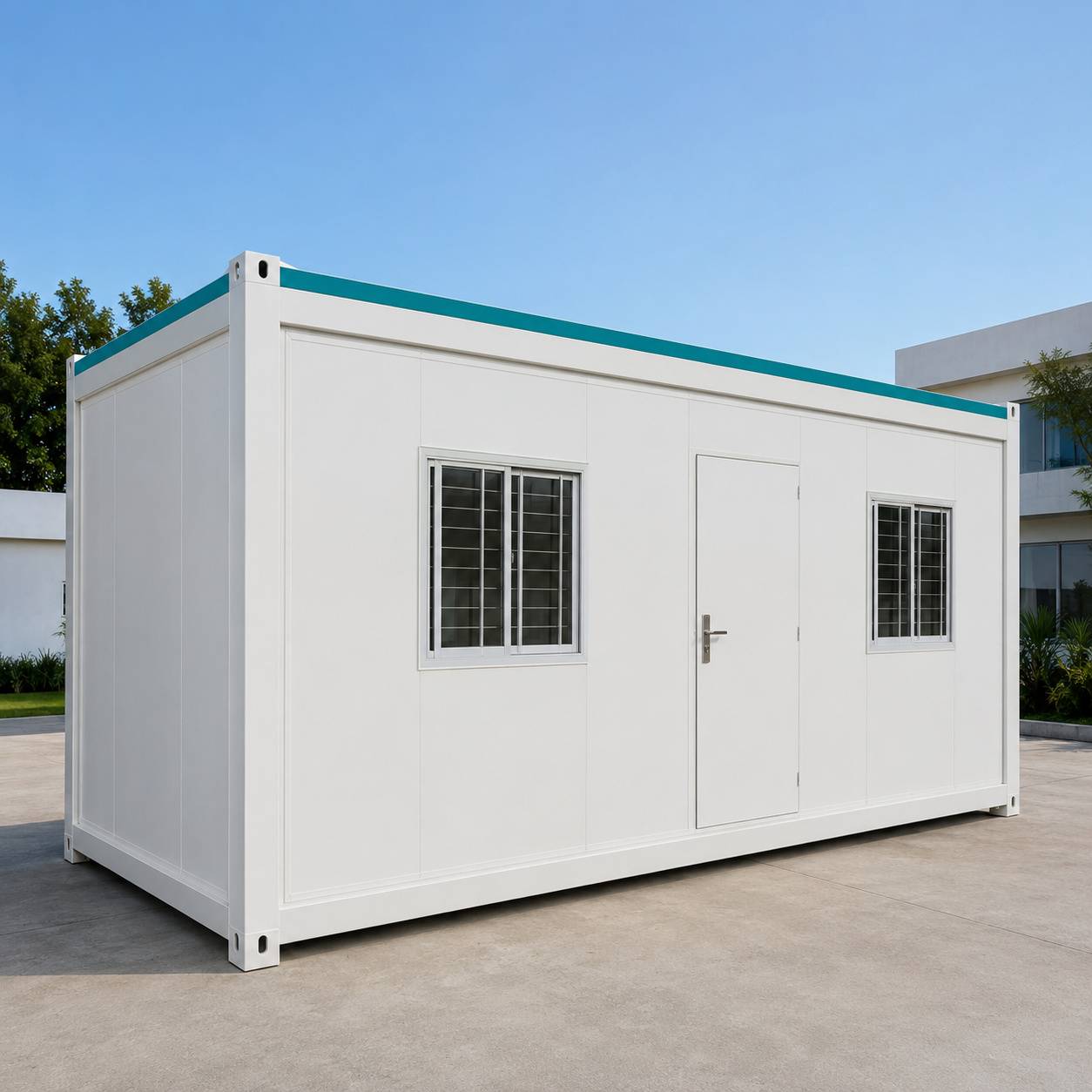
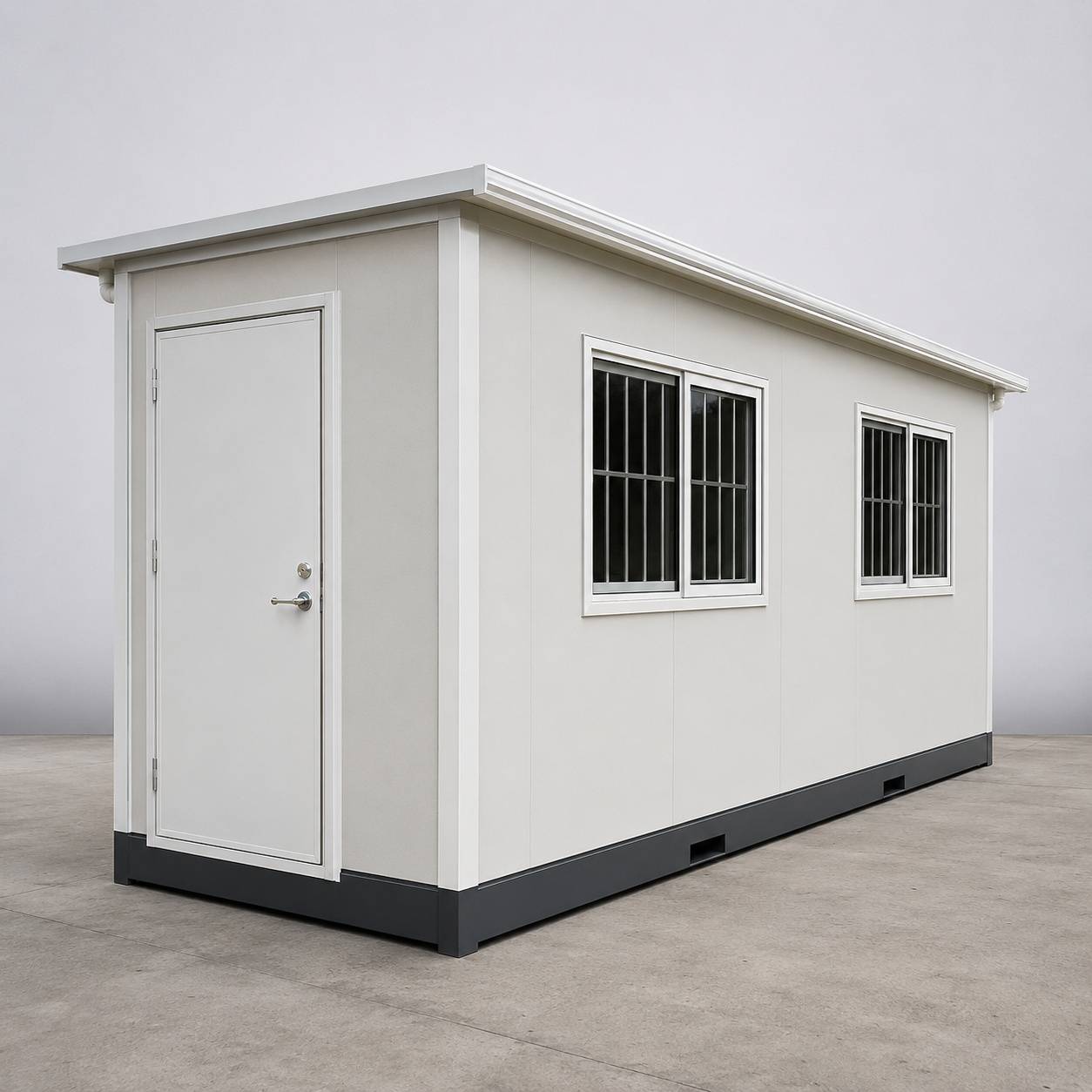
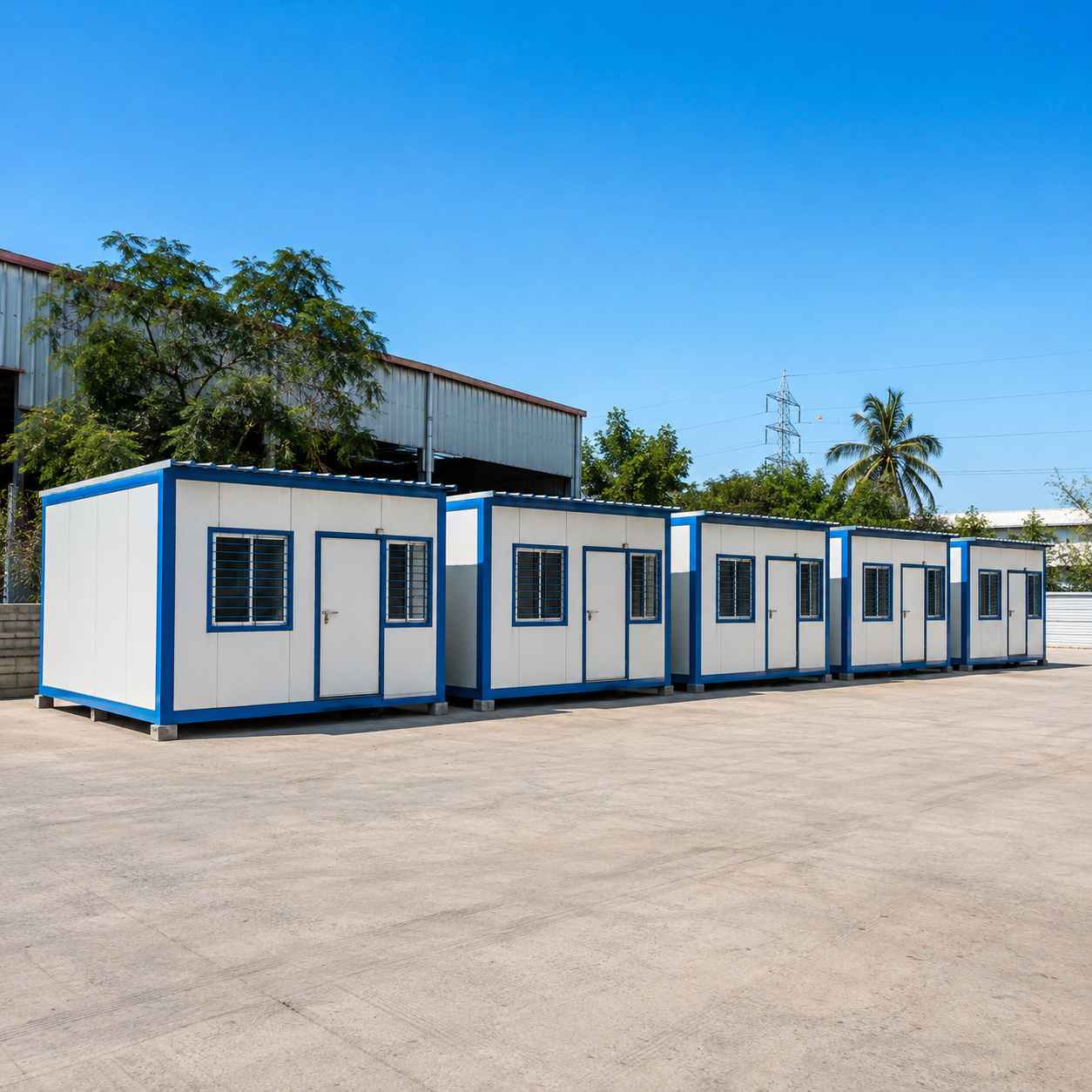
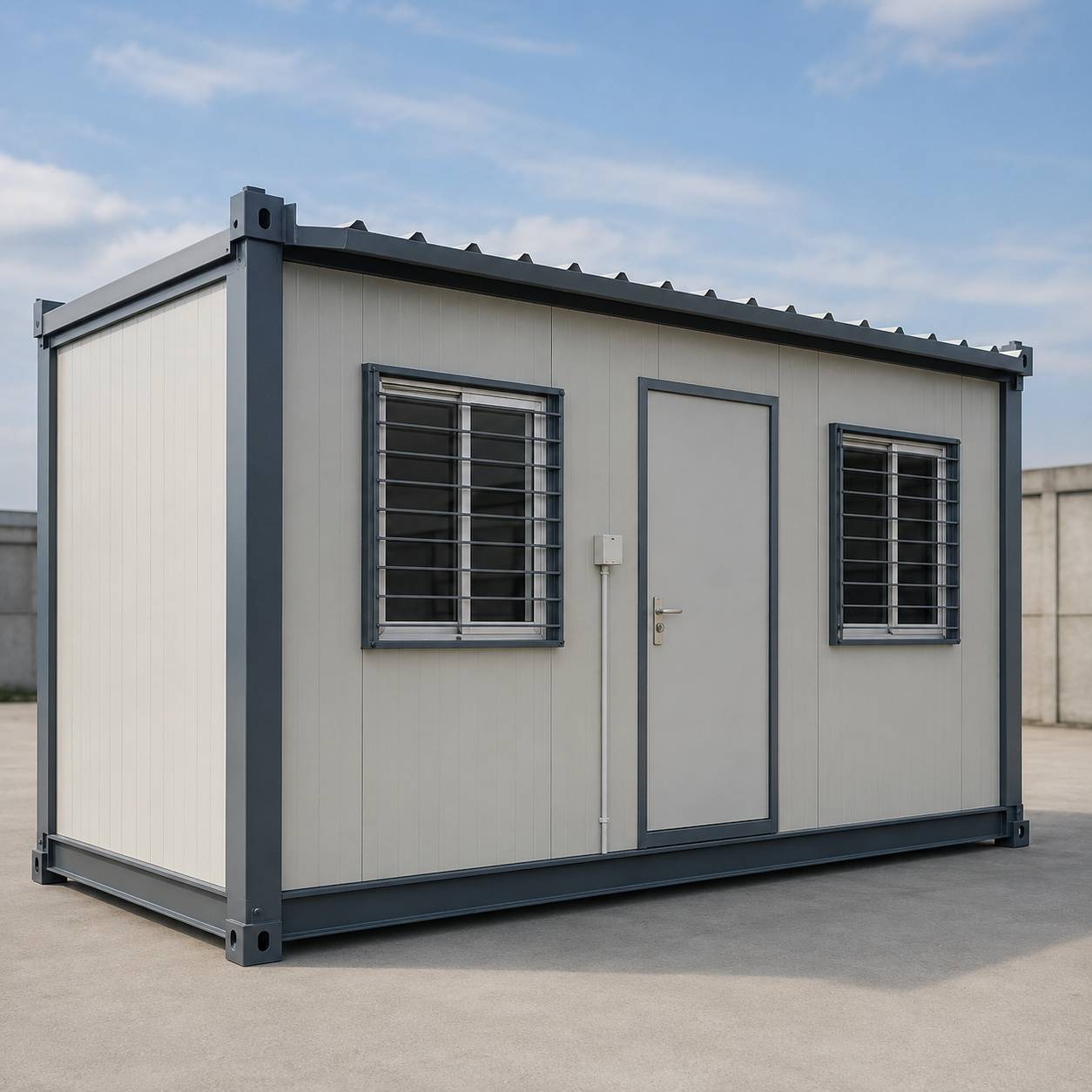
Modular Office Cabin
Inclusive of all taxes
Product Information
Product Details
Comprehensive information about Modular Office Cabin
Product Overview
Detailed information about Modular Office Cabin
Modular Office Cabin — A 2,000 sq ft Office Floor, Site-Joined in 14–21 Days
You're moving a 35-person team into a new site in three weeks. Civil construction would take six months and disrupt the entire schedule. A 19-foot single cabin is built for six people, not thirty-five. The modular office cabin at this scale — 50×40 ft, around 2,000 sq ft of floor — is the option in the middle: factory-built in four to five structural sections, transported on sequenced trailers, joined on site as one continuous office floor, and ready for occupancy in 14 to 21 working days. For smaller-scale alternatives, see the broader portable office cabin range.
Why a modular office cabin is built differently when the floor is 2,000 sq ft
A small modular cabin — anything under 500 sq ft — ships as one finished piece, or as two small modules joined side-by-side. Both methods work because the structures are small enough to travel as complete units on a single flatbed.
At 2,000 sq ft, neither approach works. A 50×40 ft floor will not pass road permits as one piece, and joining ten or twelve small standalone cabins side-by-side is structurally and visually wrong for a single office floor.
The way we build it instead: the entire 50×40 ft office is engineered as one structure on the drawing board, then sliced into 4 or 5 transportable sections — typically 10×40 ft or 12×40 ft each. Each section carries a part of the MS frame, exterior walls, roof, false ceiling, and interior fittings. On site, the sections meet on a single RCC plinth and join structurally and visually into one office floor — not many cabins joined together.
That is what "modular" means at this scale: one office built across multiple factory sections that travel separately and meet only once, at your site.
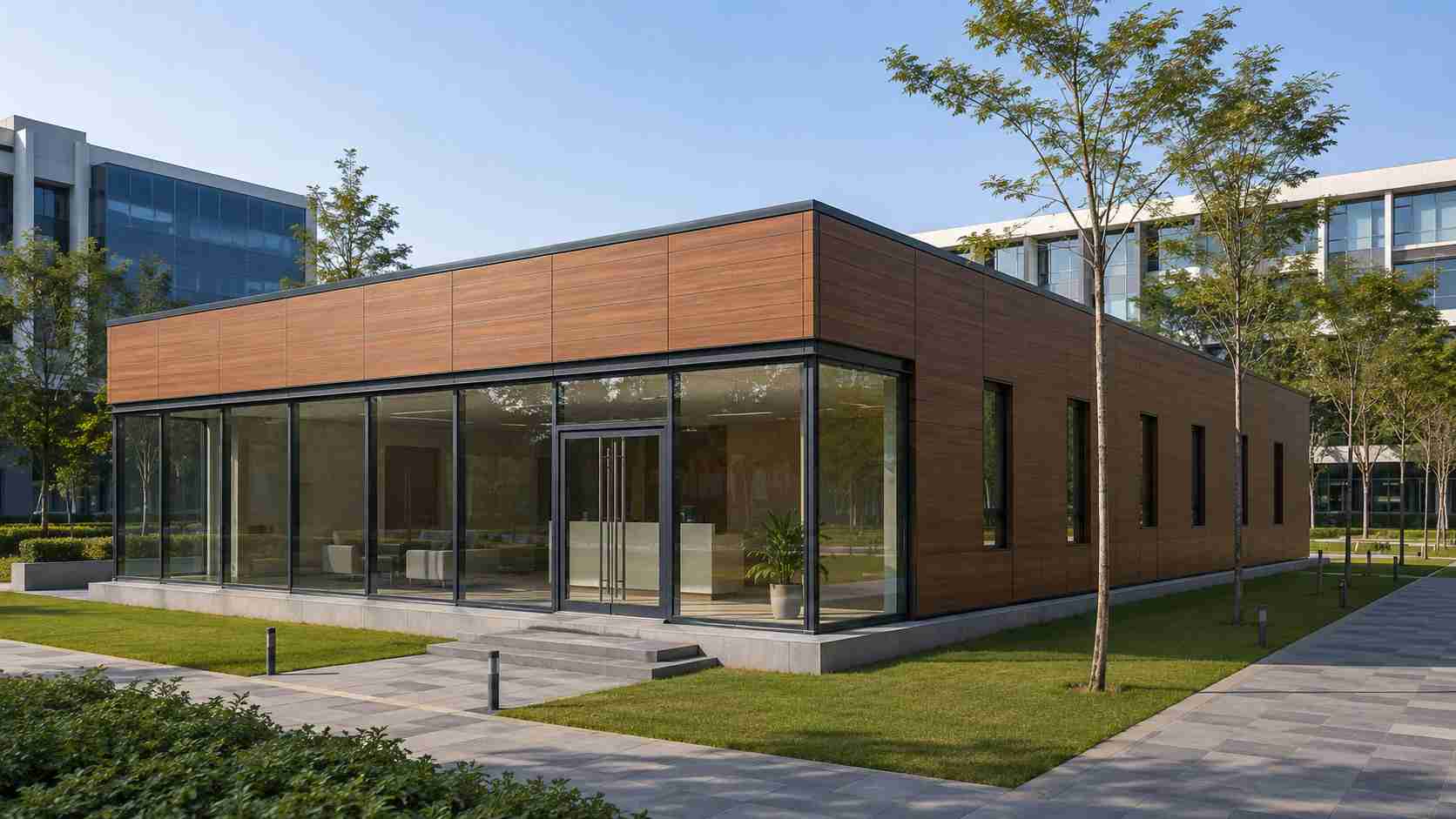
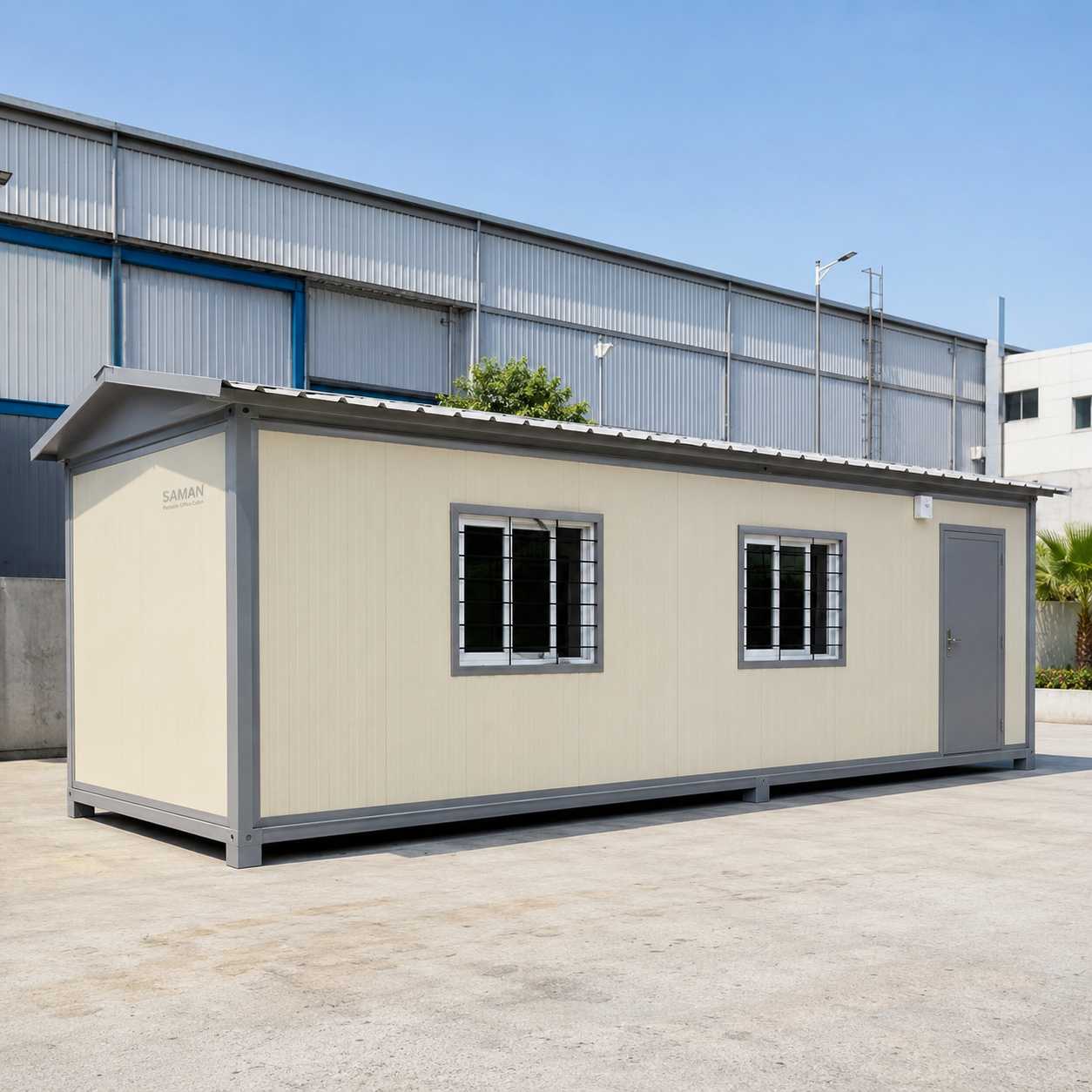
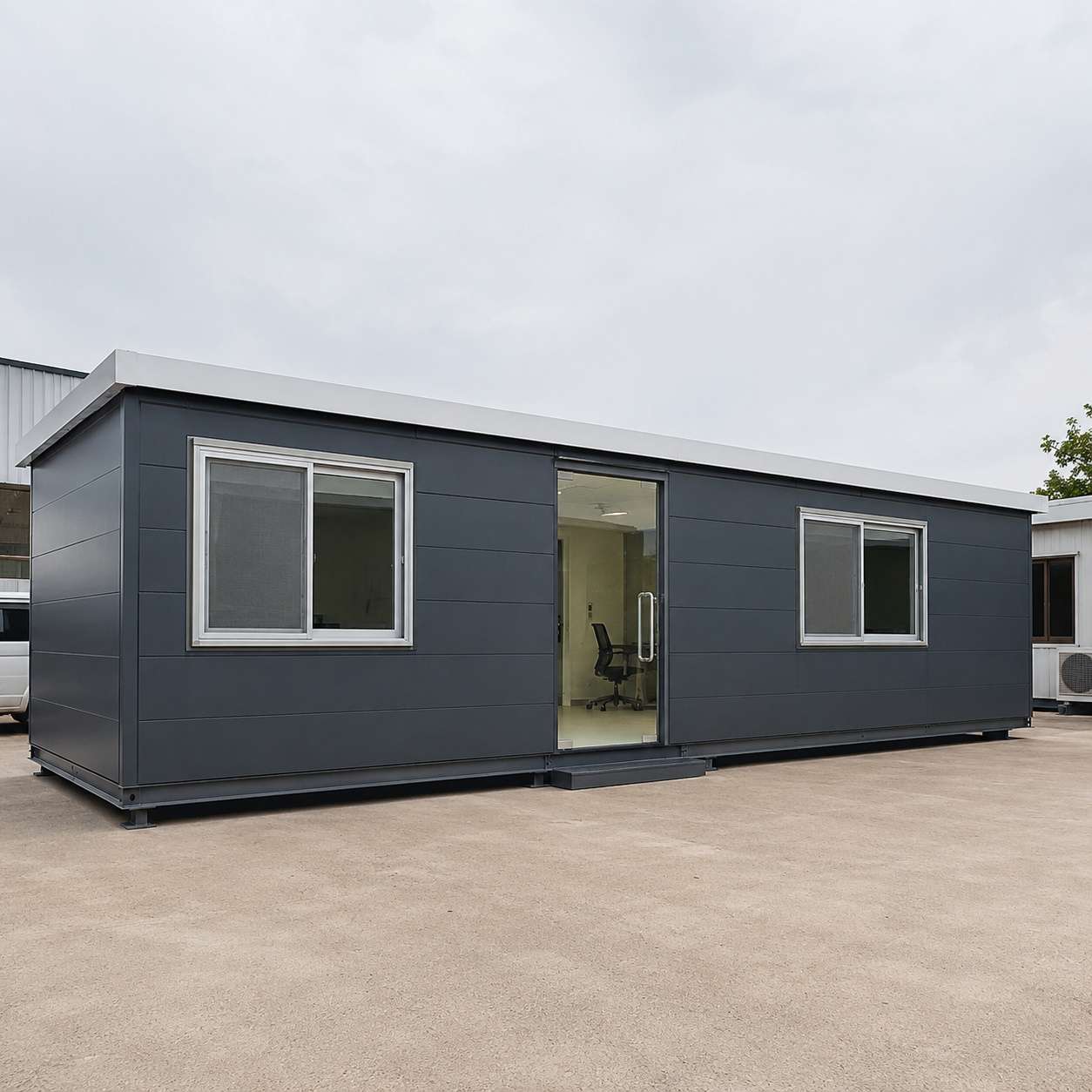
A 2,000 sq ft modular office cabin sited in a Bangalore tech-park business compound.
If your team is going to grow from four people to fourteen over a year, adding office cabins over time as the team grows is the pattern that fits — this page covers the larger one-delivery scale where the team size and the floor plan are known up front.
Inside a 50×40 ft modular office cabin: the standard floor plan
A 50×40 ft modular office cabin gives you 2,000 sq ft to work with. Here is the floor plan we configure by default. Variations are possible and signed off at order.
Reception and waiting — 12×20 ft at the front. Glass-front entry, a reception desk position, two visitor seats, branded back-wall area for signage and company colours.
Open work bay — 24×30 ft in the centre. Fits 24 to 30 workstation positions at 6×3 ft desks, or 18 to 22 cubicled desks at 6×5 ft.
Manager cabins (×2) — 10×10 ft each. One along the rear wall, one along the side. Private door, one window each, room for a desk, two visitor chairs, and a small file cabinet.
Conference / meeting room — 12×16 ft. Seats 8 to 10. AV bracket on one wall. Full-height aluminium-glass partition facing the work bay — visual connection without sound bleed.
Storage / utility / pantry — 8×10 ft along the side wall. File storage, tea and coffee point, water purifier mount.
Circulation — 4 ft corridor connecting all rooms.
The internal partitions are not all the same material. PUF panels (40 mm) form the permanent walls between manager cabins and the work bay. Aluminium-glass partitions are used for the conference room frontage and the reception entry. Gypsum-stud partitions are used where service routing — wiring, network cables — will need later access without breaking through PUF.

The 24×30 ft open work bay configured for 24–30 workstations, with the glass-partitioned conference room visible at the far end.
Variations of this plan — single manager cabin, two meeting rooms instead of one, a dedicated server room corner, an internal store room replacing the pantry — are signed off at order and shaped at the factory. No rework on site.
Send your zone-mix preference — single vs. dual manager cabin, conference vs. open meeting — and we will mark it on a 50×40 layout before quoting.
How a 50×40 ft modular office cabin actually arrives on site
A 50×40 ft office floor does not arrive on one truck. It arrives in 4 or 5 trailer-mounted sections — 4 sections if each is 12×40 ft, 5 if each is 10×40 ft. Each section travels on a 32-foot flatbed.
The placement crew on site is 6 to 8 people, including the crane operator. The crane required is a 12 to 15-ton mobile crane or equivalent boom truck — anything lighter cannot lift a fully-fitted modular section without risking the panel finish.
The placement order is sequenced, not random. Corner sections go first to the maximum reach of the crane; centre sections fill in next; the opposite corner is placed last using the crane's extended reach. This sequence lets every section be positioned on its anchor bolts without the crane having to circle the structure mid-installation.
As each section is set, the seam where it meets the next section is sealed at the exterior — weather strip and silicone caulking — before the next section is placed. By the time the last section lands, the previous joints are already weatherproofed.
The full placement runs 2 to 3 working days from the first trailer's arrival to all sections set and exterior-sealed. The crane is on hire for typically 1.5 days of that window.
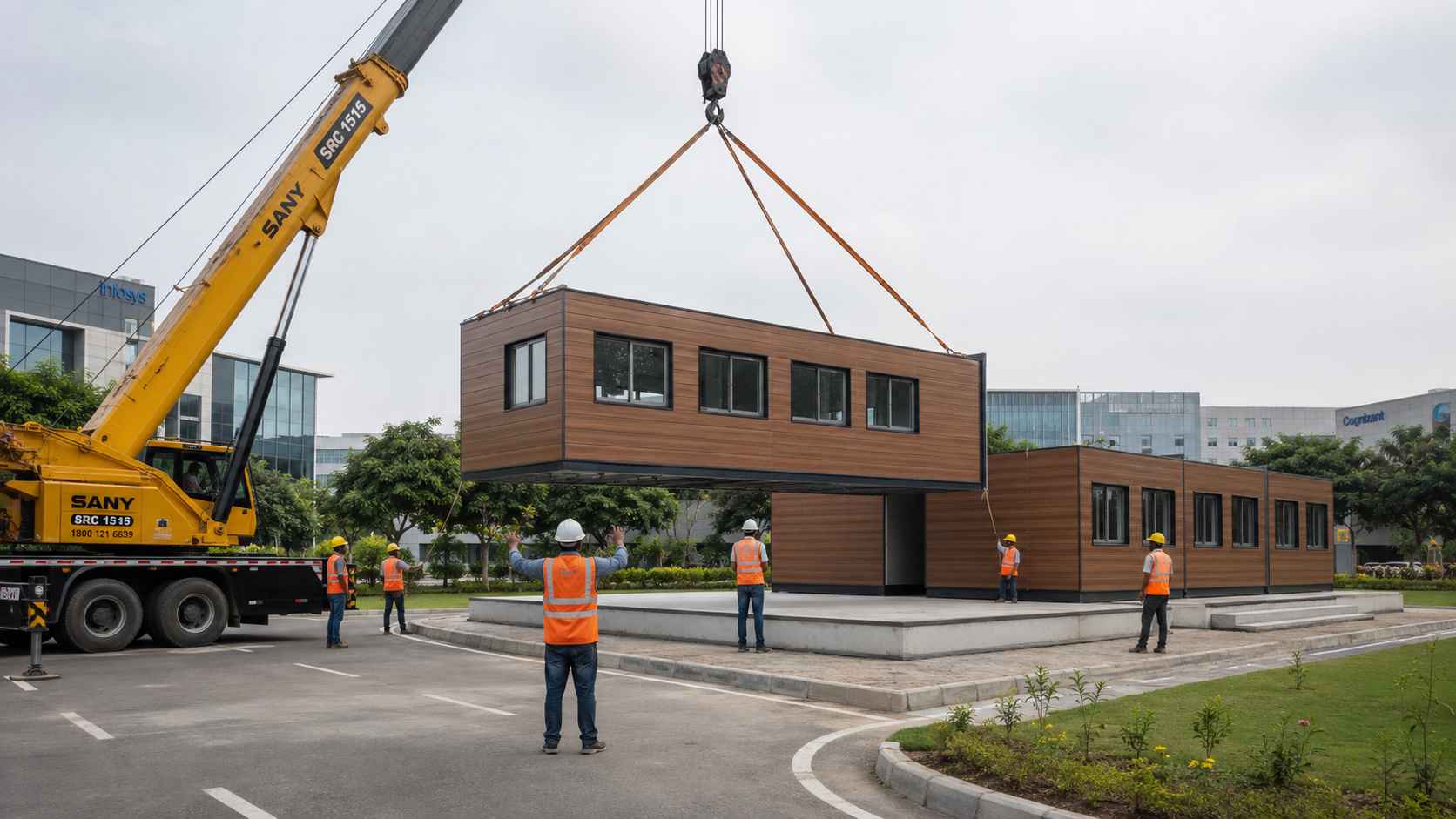
A modular section being crane-placed onto the prepared RCC plinth — fourth of five for this 50×40 ft modular office cabin.
Your site needs to allow a 32-ft trailer to reverse to within crane reach — typically 25 ft of clearance between drop-point and crane base, in line with the crane's reach radius. Most existing premises accept this; tight urban sites occasionally need a longer-boom crane, which we confirm at site survey.
The civil base your site needs under a 50×40 ft modular office cabin
The structure that holds a 2,000 sq ft modular office floor is the plinth, not the cabin. The plinth carries the load; the cabin sits on anchor bolts cast into it.
The standard specification:
M20-grade RCC plinth, 150 mm thick. Footprint approximately 10% larger than the cabin perimeter — 52×42 ft for our standard 50×40 ft modular office. The extra 6 inches around the perimeter gives the wall sections a finished apron rather than a flush edge.
Anchor bolt grid. Structural anchors at every section corner and at every 10 ft along section seam lines. For a 50×40 ft floor with 5 sections of 10×40 ft, this works out to 24 to 32 anchor points. SAMAN issues the exact grid coordinates after order confirmation.
Drainage gradient. 1:100 fall away from the perimeter. A soak-pit or storm drain at the lowest corner handles monsoon runoff.
Cable trench provision. A 6-inch trench from the main supply position to the cabin perimeter, RCC-covered. The incoming-supply position needs to be agreed before the trench is cast.
For project deployments where an RCC plinth is not viable — sites where the office will be relocated in 2 or 3 years and a permanent slab is not worth pouring — we provide an alternative spec: compacted MORD-grade subgrade with concrete grillage at the section corner load points only. This is acceptable for temporary deployments but not recommended for offices intended to stay 5 years or longer.
One clarification buyers ask early: the civil plinth is the buyer's scope by default, not SAMAN's. We issue the plinth design and the anchor-bolt drawing within 3 working days of PO confirmation, which gives your civil contractor 11 working days to cure the slab before our first trailer arrives. A turnkey arrangement — where SAMAN executes both the plinth and the modular structure — is available as a separately quoted scope.
What's fitted at the Bangalore factory vs. completed after placement
A small modular cabin can be 100% factory-fitted and dispatched as-is. A 50×40 ft modular office cabin cannot. Some interfaces only exist once the sections are placed, and those interfaces have to be completed on site.
Factory-fitted before dispatch (per section, all 4 to 5 sections):
- MS IS 2062 Grade A frame, welded at all joints
- Exterior PUF panels: 50 mm thick on roof, 40 mm thick on walls
- Exterior cladding finished and painted
- False ceiling grid with LED panel cut-outs
- Vinyl flooring laid wall-to-wall within the section's internal area
- Primary electricals routed in conduit
- MCB sub-board for the section, tested at factory
- AC bracket positions and wiring
- All external doors and windows, fitted and tested
- Internal partition panels for walls that fall entirely within one section
Site-completed after placement:
- Section-to-section structural bolting at the floor beam and roof purlin
- The central conference-room aluminium-glass partition (this partition spans across section seams; it can only be set once both sections are placed)
- The reception's glass-front entry frame (similarly cross-section)
- Internal doorways where the corridor runs across a section seam
- Cross-linking of section MCB boards into the main DB at the dedicated electrical room
- Final electrical commissioning and load testing
- AC unit installation by the buyer's chosen HVAC vendor (we provide the bracket and the wiring; the unit is the buyer's choice and scope)
- Final perimeter caulking, exterior seam sealing, and paint touch-up at section seams
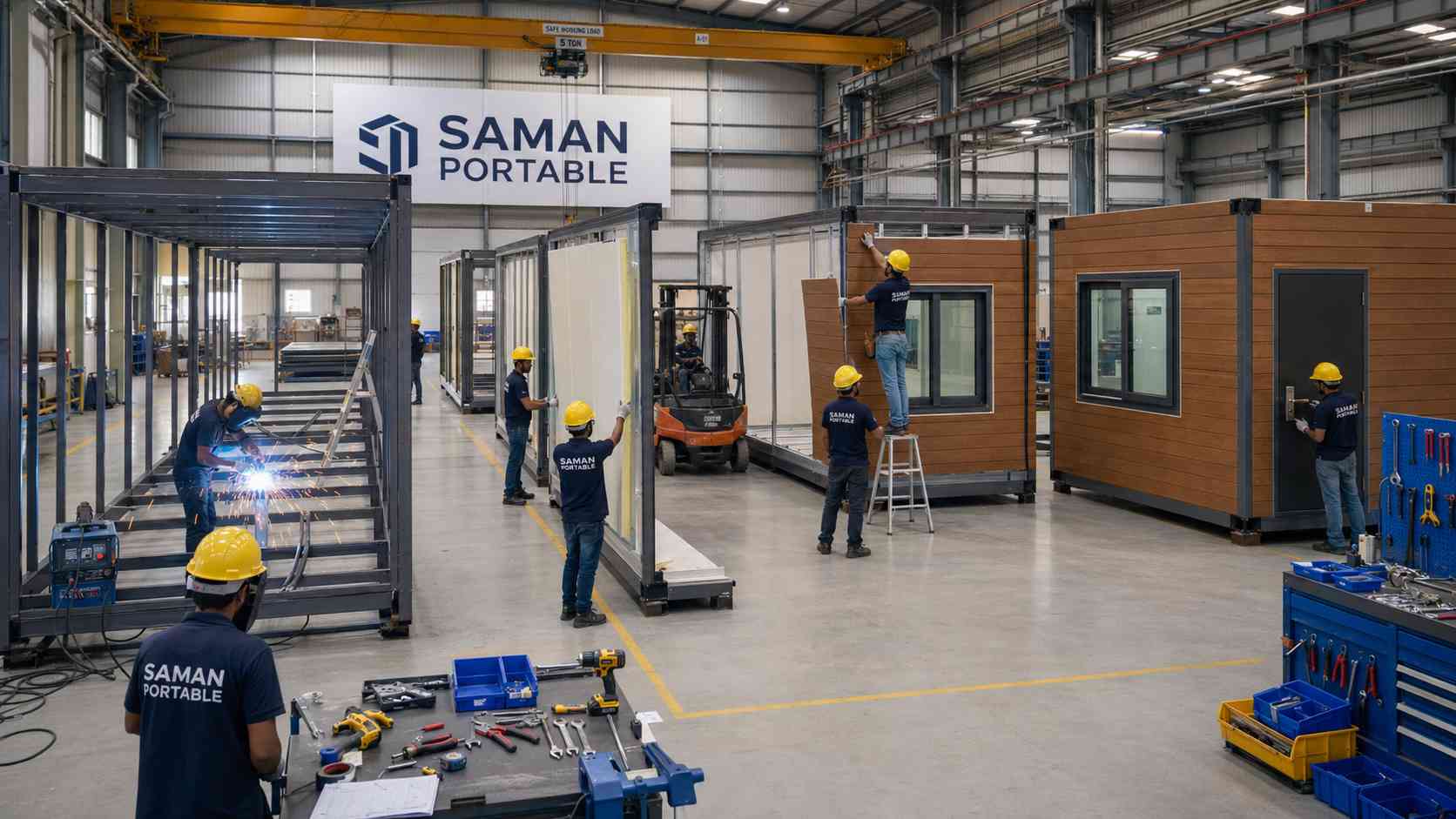
Four modular sections in parallel fabrication at SAMAN's Bangalore facility — frame, panels, cladding, and finishing stages running simultaneously.
This split exists because some assemblies cross section boundaries. It is not extra site work; it is the work that only becomes possible once the sections meet. The total site-work window for finishing is 3 to 4 working days after placement is complete.
What the ₹43–46 lakh price covers and the four levers that change it
The published base price for the 50×40 ft / 2,000 sq ft modular office cabin is ₹43,55,000. Here is exactly what that covers and what changes it.
Included in the ₹43,55,000 base price:
- 4 to 5 modular structural sections, IS 2062 MS frame throughout
- 40 mm PUF wall panels, 50 mm PUF roof panels, exterior cladding finished and painted
- Vinyl flooring across the full 2,000 sq ft
- False ceiling with LED panel grid and LED fixtures
- Internal PUF partitions for two manager cabins and the storage room
- Aluminium-glass partition for one conference room (12×16 ft)
- Aluminium-glass reception frontage with glass entry door
- One main steel door, two emergency exits, six sliding aluminium windows with mosquito mesh
- Complete electricals fitted to MCB-sub-board level on every section
- 4 AC brackets pre-wired (the AC units themselves are the buyer's choice and not in scope)
- All section transport from Bangalore or Greater Noida to the site, on confirmed pincode
Pan-India freight is quoted on confirmed pincode at the time of PO. South Indian destinations and the Greater Noida belt are typically inside the quoted base; longer hauls carry a freight delta.
Four common variations and the concrete price math:
- Upsize to 60×40 ft (2,400 sq ft) — adds approximately ₹4,80,000. This is one additional 10×40 ft section, plus the proportional plinth extension on the civil side (your scope).
- Aluminium-glass partition wall replacing the central PUF corridor wall — adds approximately ₹65,000. This is the upgrade buyers ask for when they want visual openness from the work bay to the reception side without losing the corridor.
- Engineered-wood flooring across the work bay (720 sq ft) — adds approximately ₹1,15,000. Vinyl elsewhere; wood under the workstations only.
- Third manager cabin partitioned from the work bay — adds approximately ₹45,000. A 10×10 ft cabin with door and window. Reduces the open work bay area from 720 sq ft to 620 sq ft.
Price-band position vs. civil construction at the same scale. Building a 2,000 sq ft office through conventional civil construction in a Bangalore or Greater Noida commercial premises typically costs ₹35 to ₹55 lakh depending on finish quality and contractor rates. The modular office cabin sits inside that civil band — the buyer does not trade money for speed. The same money buys the same scope, plus a 14 to 21 day timeline instead of the 6 to 9 month civil one.
Phase-by-phase from confirmed PO to handover — the 14 to 21 working day breakdown
The window from confirmed PO to handover is 14 working days at the fast end and 21 working days at the comfortable end. Here is what happens in each phase.
Days 1 to 3 — Drawings sign-off and order release. Final floor plan confirmed, anchor-bolt drawing released to your civil contractor, 50% advance received, fabrication slot booked at the factory. The plinth specification reaches your civil team on Day 3 so they can start the plinth from Day 4.
Days 4 to 14 — Factory fabrication of all sections in parallel. At our Bangalore facility, all 4 to 5 sections are fabricated at the same time, not in sequence. Frames welded, panels insulated and clad, false ceilings cut to size, flooring rolled and cut, electricals dressed in conduit, MCB sub-boards wired and tested. Each section is checked for joining-line alignment before it leaves the factory.
Days 15 to 17 — Transport and site placement. Trailers depart in sequence on Day 15. On arrival, the crane places sections in the planned order, exterior seam sealing is applied at each section interface, weatherproofing is checked, balance payment is cleared. By end of Day 17 the structure is set, sealed, and standing on its plinth.
Days 18 to 21 — Site fit-finish and handover. Section-interface partitions placed (the conference-room glass, the reception frontage). Section MCB boards cross-linked into the main DB. Final electrical commissioning and load test. Exterior touch-up at section seams. Walk-through with your site team. Handover.
The single most common cause of timeline slippage is the civil plinth not being ready when the first trailer arrives. We release the anchor-bolt drawing on Day 3 to 4 specifically to give your civil contractor 11 working days to cure the slab. If the plinth is not cured by Day 15, the trailers wait — and each waiting day at site is an additional cost. Coordinating the plinth schedule with us at order stage avoids this entirely.
Modular office cabin vs. civil construction at the same 2,000 sq ft scale
For a buyer choosing between a modular office cabin and civil construction at this scale, the decision factors line up like this:
| Factor | Modular office cabin (2,000 sq ft) | Civil construction (2,000 sq ft) |
|---|---|---|
| Timeline | 14 to 21 working days | 6 to 9 months (monsoon-dependent) |
| Cost band | ₹43 to ₹46 lakh at published 50×40 ft spec | ₹35 to ₹55 lakh depending on city + finish |
| Cost predictability | Fixed at PO; pincode freight is the only variable | Subject to material moves, contractor variability, scope creep |
| Site disruption | 14 to 21 days of phased delivery work | 6 to 9 months of active construction |
| Reversibility (year 5+) | Sections detach, transport, re-deploy at another site | The building is the site |
| Multi-floor option | Ground floor + light-load mezzanine only | Available |
| Deep custom finishes | Not available (brick, vaulted, atrium) | Available |
The modular office cabin is the right call when timeline certainty, predictable cost, and future relocation outweigh the multi-floor and deep-finish options of civil construction. If your requirement is a permanent multi-storey commercial building with deep customisation, the modular route is not the right answer — and we will tell you so at site survey.
Modular office cabin vs. modular portable office vs. modular portable office cabin — which scale fits your need
Three pages in our portable office range share the word "modular" — and each is built for a different decision.
The modular office cabin (this page) is the right call when you need a full office floor — 1,500 to 2,000 sq ft — delivered as one configured structure for a fixed team of 25 to 60 people. Factory sections, single timeline, single price, single handover.
If your team is four people today and might be eight or twelve in the next year, growing your office one cabin at a time is built for that pattern — separate small cabins joined side-by-side as the headcount confirms, with the second and third cabins ordered later.
If your team is fixed at six to nine people and you need internal manager-cabin and meeting-corner partitions factory-built into one ~210 sq ft unit, that is the configured small cabin route — different product, different price band, different scale.
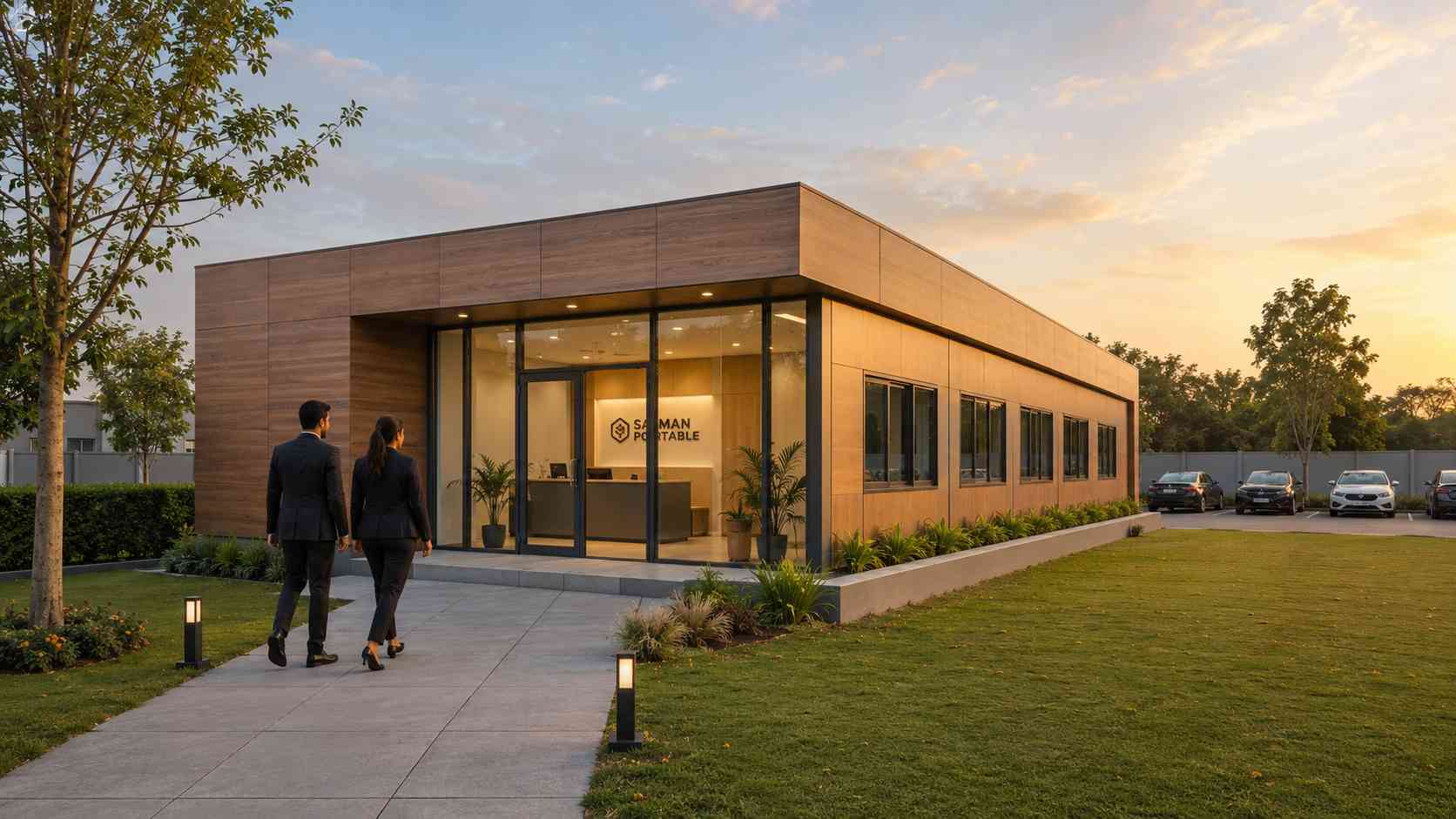
Completed modular office cabin at golden hour — reception entrance, paved access, adjoining parking area.
Not sure which one fits? Tell us your team size and the timeline you are working toward. We will send you the right route in one reply.
Frequently Asked Questions
Our site only has access to one side — can a 50×40 ft modular office cabin be placed without the crane needing to circle the structure?
Yes. The sequenced placement we use is designed for one-side crane access. The crane positions on the long side with the most clearance, then sections are placed in reach-then-rotate order: corner section first at maximum reach, centre sections next, opposite corner last using the crane's full extension. Sites with sub-25 ft clearance on all sides need a longer-boom crane, which we confirm at site survey. One-side access is the more common arrangement on existing premises and adds no time to placement.
Is the RCC plinth quoted by SAMAN or do we arrange a separate civil contractor?
By default the plinth is the buyer's scope and the buyer's civil contractor builds it from our drawing. SAMAN issues the plinth design — M20 grade, 150 mm thick, anchor-bolt grid coordinates — on Day 3 to 4 after PO confirmation, which gives your civil team 11 working days to cure the slab before our first trailer arrives. If you would prefer a turnkey arrangement, we quote the plinth as a separate add-on at city-specific rates — typically ₹2,40,000 to ₹3,20,000 for the 52×42 ft civil scope, including soak-pit and cable trench.
If the office is relocated to another site in year 5, how much of the original ₹43+ lakh actually recovers?
The structural sections are designed to be detached and re-deployed. In year 5, with normal commercial use and standard maintenance, recovery on the original capital typically runs 55 to 70%: the MS frame and PUF panels carry well; the internal vinyl flooring and false ceiling are usually replaced at re-deployment; the electricals require reterminating to the new site's main DB. Relocation cost — decommissioning, transport, re-placement, civil base at the new site — typically runs ₹4 to ₹6 lakh on top of the recovered structure. We quote relocation as a separate service when the question comes up.
We're planning to phase furniture and IT cabling into the week after SAMAN's handover. Does the 14 to 21 day window account for that, or do we extend?
The 14 to 21 day window covers SAMAN's scope only — from PO to handover. Furniture, network cabling, and IT equipment installation typically need an additional 3 to 7 working days after handover and are run by your interior or IT vendor. We coordinate handover timing with your downstream vendors at Day 15 to 16 so they can start on Day 22 without dead days. If you need the office fully populated and operational — not just structurally complete — by a fixed date, work backward from that date by 28 to 35 working days.
Tell us your team size, target footprint (50×40 ft is published; other sizes are available), starting city, and the date you need to be operational. We will send a floor plan, anchor-bolt drawing, and price band within 24 hours.
Call or WhatsApp: +91 97089 89937
Manufactured at SAMAN's Bangalore and Greater Noida facilities. Delivered and installed Pan India.
Customer Reviews
0 reviews
No reviews yet. Be the first to review this product.
Write a Review for Modular Office Cabin

Need Custom Requirements?
Get in touch with our experts for customized solutions and bulk orders. We're here to help you find the perfect solution.