Bangalore & South Zone
Delhi NCR & North Zone
Shipping Container Tiny House
Inclusive of all taxes
Product Information
Explore the Range
Related products

Container Houses
Modern Container Home

Container Houses
Shipping Container Homes

Container Houses
Prebuilt Container Home

Container Houses
Affordable Container Homes
Container Houses
Inexpensive Container Homes

Container Houses
Prefabricated Container Home
Container Houses
Tiny Container Homes

Container Houses
Storage Container House

Container Houses
Cargo Container House
Container Houses
Prefabricated Container House

Container Houses
Prefab Container Homes
Product Details
Comprehensive information about Shipping Container Tiny House
Product Overview
Detailed information about Shipping Container Tiny House
A shipping container tiny house from SAMAN is a 40 ft × 16 ft × 18 ft factory-built home that carries both a specific product spec and a specific design intent — the ISO corrugated steel exterior is not incidental to this build, it is the point. Starting at ₹21,55,000, this configured unit is built for buyers who researched the global tiny house movement and arrived with a clear brief: a home that looks like a shipping container, lives like a house, and reaches their site in weeks without a construction project.
The shipping container form — why the ISO corrugated exterior is the design choice, not just the structure
The corrugated weathering steel profile of an ISO shipping container is recognizable because it was engineered for ocean freight — the ribbed profile distributes load, the corner castings enable crane handling, the industrial scale was sized for cargo ships, not residential plots. None of this was designed for home aesthetics, which is precisely why buyers who choose it do so on purpose.
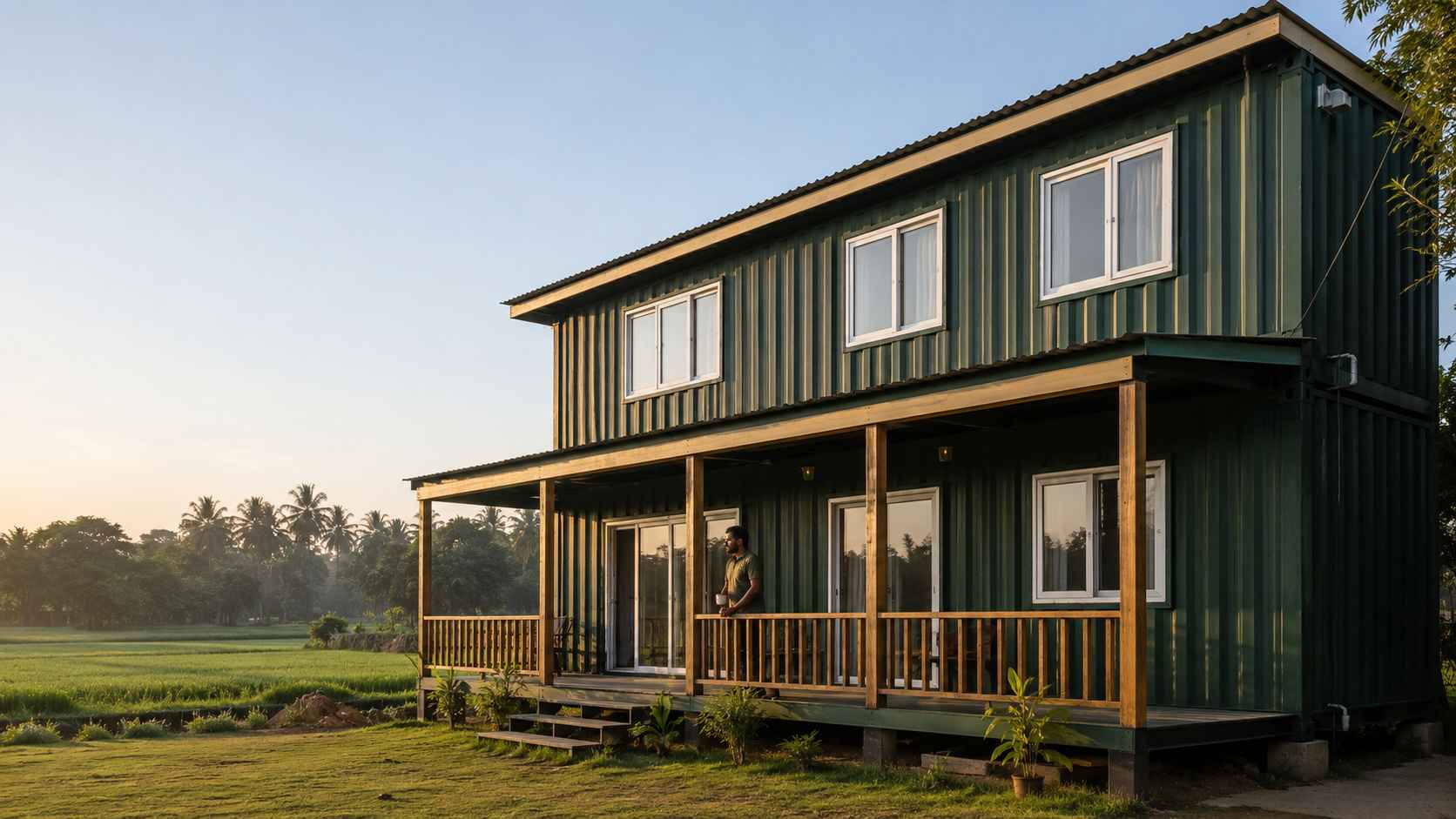
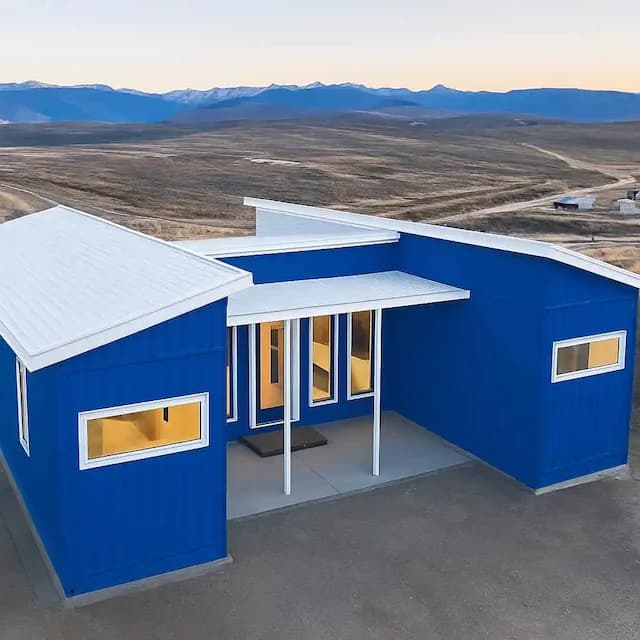
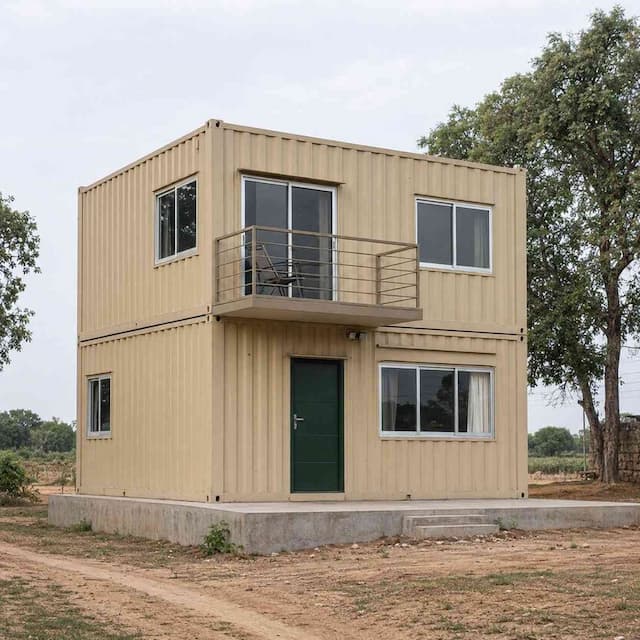
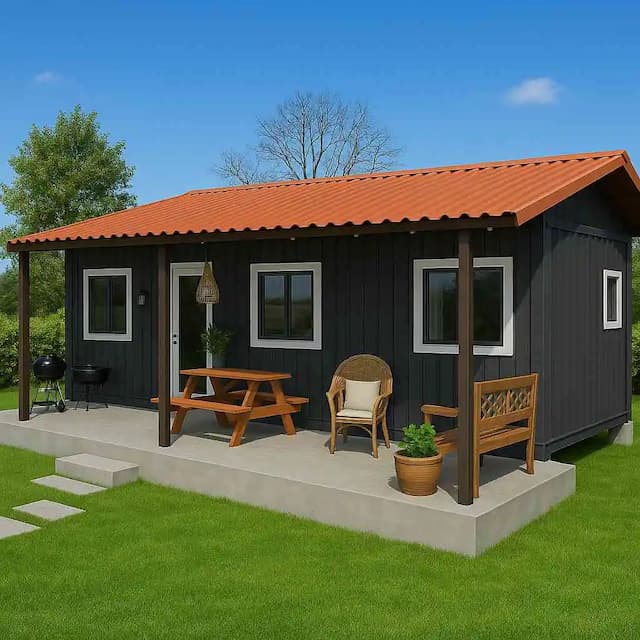
Shipping container tiny house on a rural farmland plot — intentional living, factory-built and delivered. From ₹21.55 lakh.
The global tiny house movement — which grew substantially in the US and Europe through the 2010s and has found a growing audience in India among eco-conscious, alternative-living, and farmhouse-plot buyers — is built around intentional minimalism: choosing a smaller, self-contained home as a deliberate decision rather than a financial constraint. A tiny house shipping container fits this philosophy with unusual precision. The structure already exists. It is fabricated from high-grade industrial steel built to withstand dynamic ocean-cargo loads — structural performance far beyond what any residential build requires. Converting it into a home reuses a purpose-built industrial structure rather than casting fresh concrete and firing brick, which carries its own logic for the buyer who thinks in those terms.
This is also where the shipping container form separates from a generic container micro home or flat-panel prefab house. A buyer choosing SAMAN's shipping container tiny house is not choosing the cheapest way to get a container home. They are choosing a specific visual identity — the corrugated ISO exterior as an architectural statement, the industrial provenance as part of the home's character. The interior is fitted to residential standard; the exterior is retained as the design.
What does SAMAN's shipping container tiny house include at ₹21,55,000?
SAMAN's shipping container tiny house is a 40 ft × 16 ft × 18 ft configured unit at ₹21,55,000 — factory-built with 50mm PUF insulation on all six faces, MS frame with anti-corrosion treatment, pre-wired electricals, plumbing, interior wood finish, and exterior paint. Delivery within the standard zone is included. Site plinth, electrical service connection, and utility tie-ins are scoped separately.
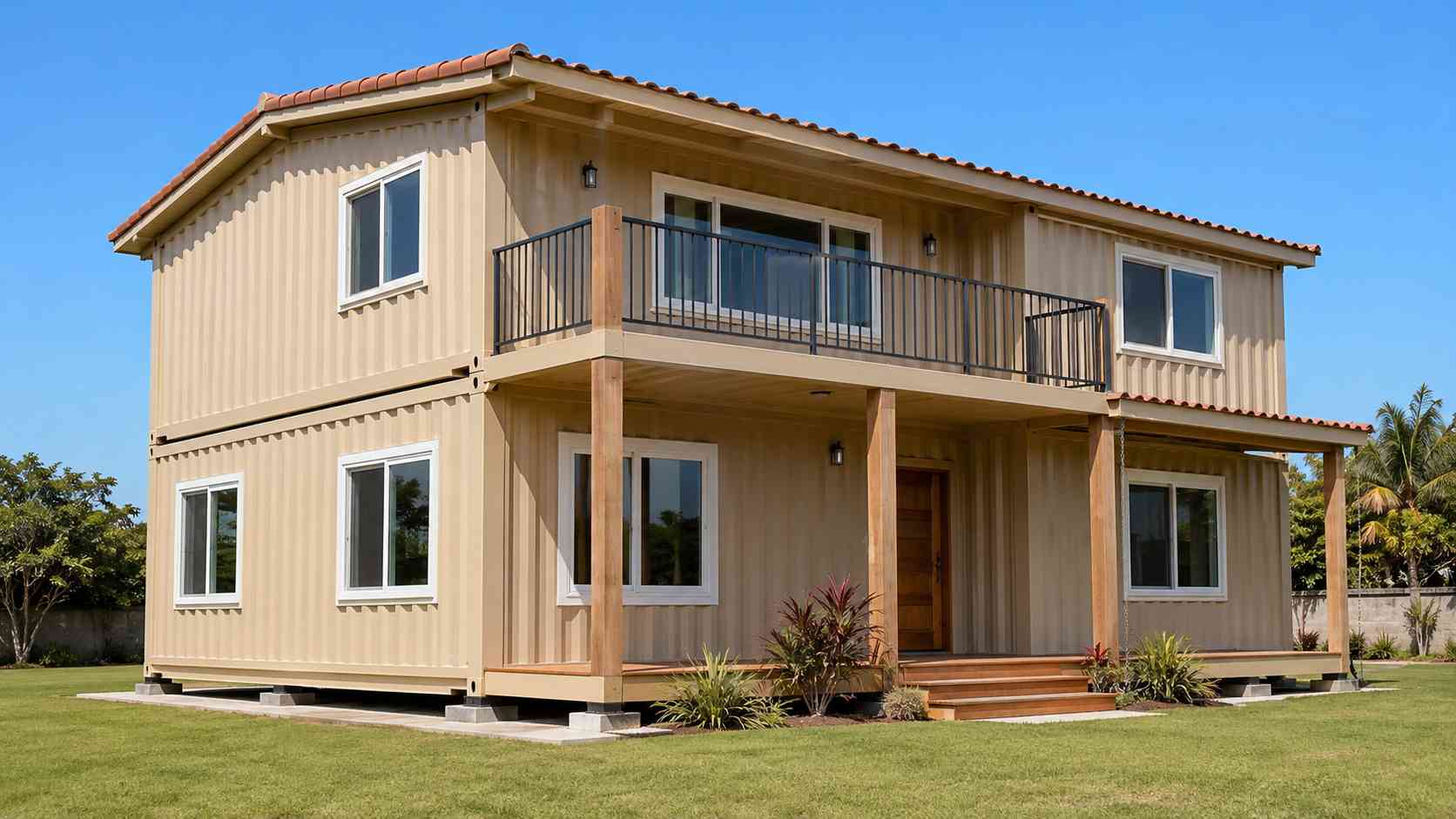
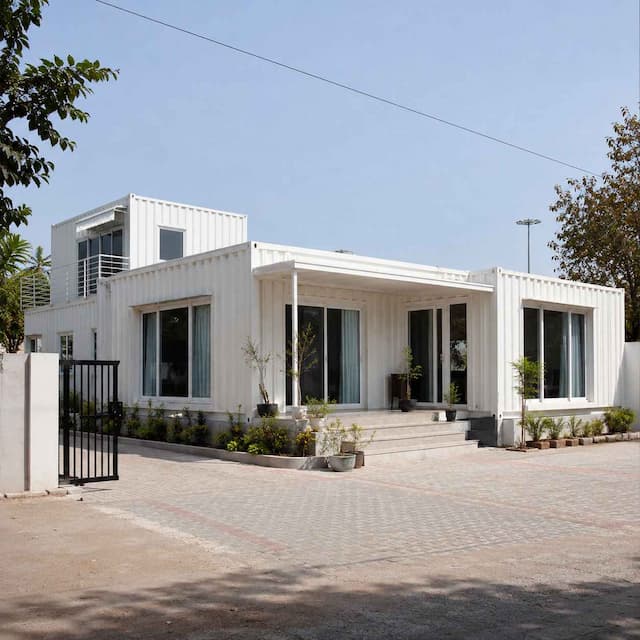
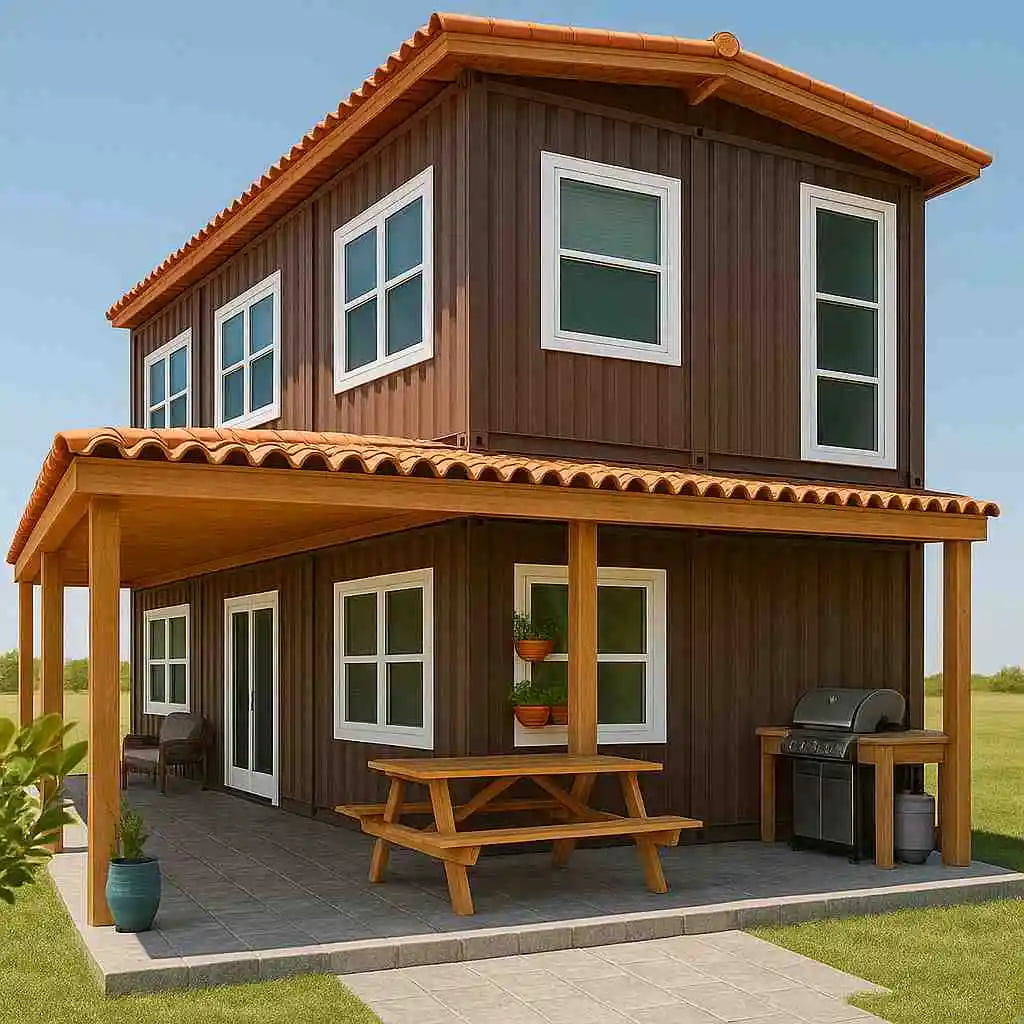
40 ft × 16 ft × 18 ft shipping container tiny house — Sandstone Beige cladding, veranda, concrete plinth base. Factory-built specification.
Structure. The MS frame runs the full 40 × 16 ft footprint at 18 ft height. Anti-corrosion primer treatment is applied to the frame before fit-out begins. The corrugated ISO exterior shell is retained and finished in standard exterior paint — the container profile is preserved, not cladded over, unless the buyer specifically requests ACP exterior cladding as a customization at design alignment.
Insulation. 50mm PUF panels are applied to all six faces — walls, roof, and floor — at the factory, before the interior fit-out begins. This is a structural thermal break, not a surface lining added to an existing wall. The 18 ft height of this unit creates a larger internal volume than the 20-ft format; a 1.5-tonne split AC is the standard recommendation for most Indian locations at peak summer.
Interior fit-out. Plywood-backed vinyl flooring, wood-finish interior wall panels, false ceiling with recessed lighting provision. Pre-wired electrical circuit with switchboard, fan points, AC provision point, and power outlets throughout. Kitchen platform with sink and chimney provision. Wet area with WC, washbasin, and tiled shower zone.
Delivery. Factory build at our Bangalore or Greater Noida facility runs 28–35 working days from confirmed design alignment. Delivered on a flatbed, crane-placed on your prepared plinth. Standard-zone delivery is included in the ₹21,55,000 price. Remote locations or states outside the standard zone carry a transport surcharge confirmed at order time.
What pushes to ₹22,75,000. ACP exterior cladding, additional windows or sliding glass panels, granite kitchen counter, upgraded bathroom fittings, or premium interior panelling. Each option is priced and confirmed at design alignment — the ₹1.2 lakh band between base and upper configuration is a real ceiling, not an open-ended estimate.
Scoped separately — buyer arranges. Site plinth: four levelling pads on compacted ground (no concrete slab required for standard installations). Electrical service connection from the buyer's meter point. Water supply and drainage tie-in at the plinth. Municipal approval documentation if required by the local authority.
Shipping container tiny house vs tiny container home — which format fits your brief
Both are factory-built container homes from SAMAN, and both share the same container home production process. The decision between them is driven by what the buyer is primarily optimising for.
| Shipping Container Tiny House | Tiny Container Home | |
|---|---|---|
| Format | 40 ft × 16 ft × 18 ft | 20 ft × 8 ft |
| Starting price | ₹21,55,000 | Contact for quote |
| Primary driver | Shipping container identity + tiny house movement values | Smallest livable footprint at lowest entry price |
| Best for | Eco-lifestyle buyer, design-forward homebuyer, farmhouse plot, alternative housing | Solo or couple, compact plot, budget entry, minimalist living |
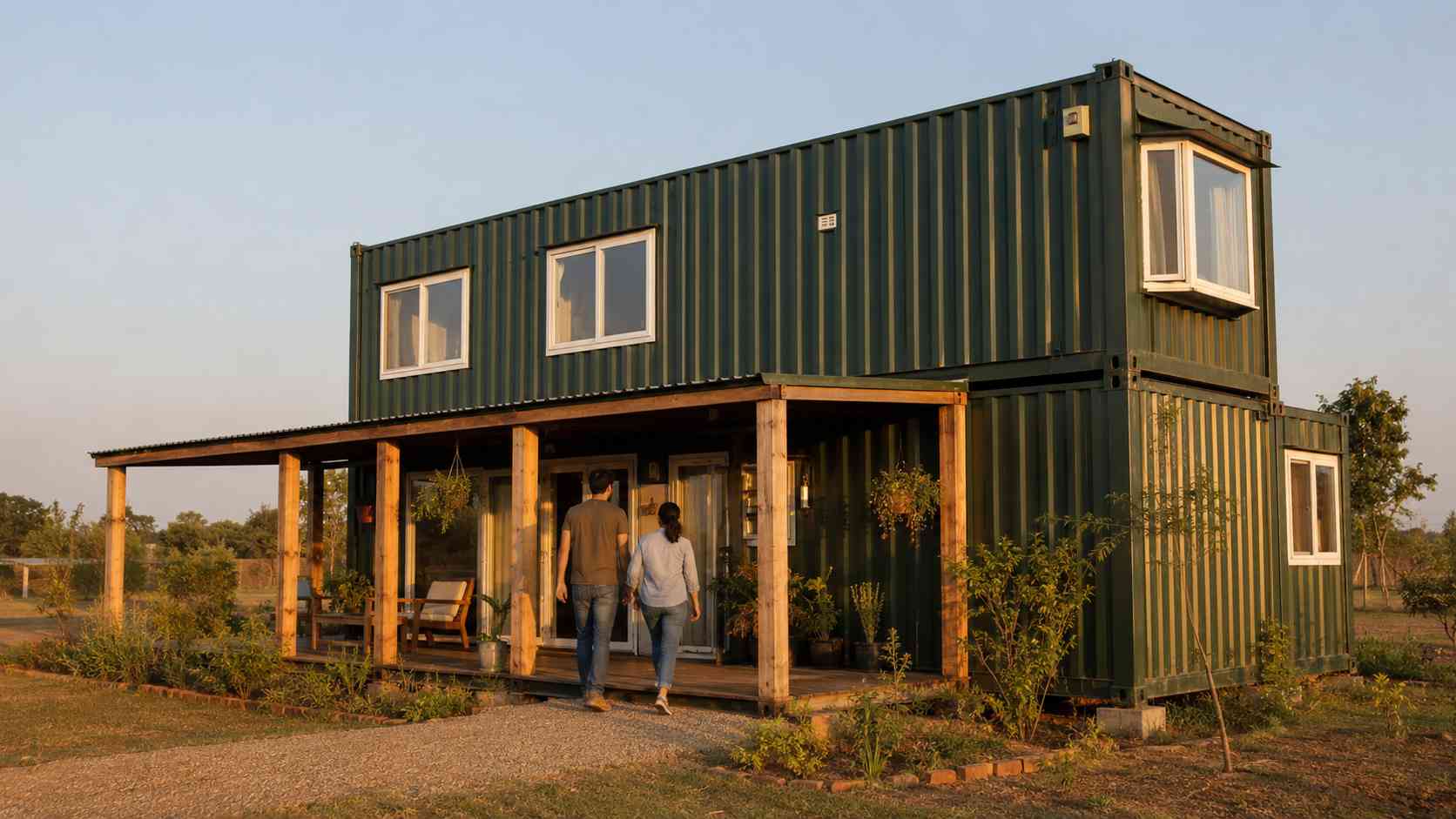
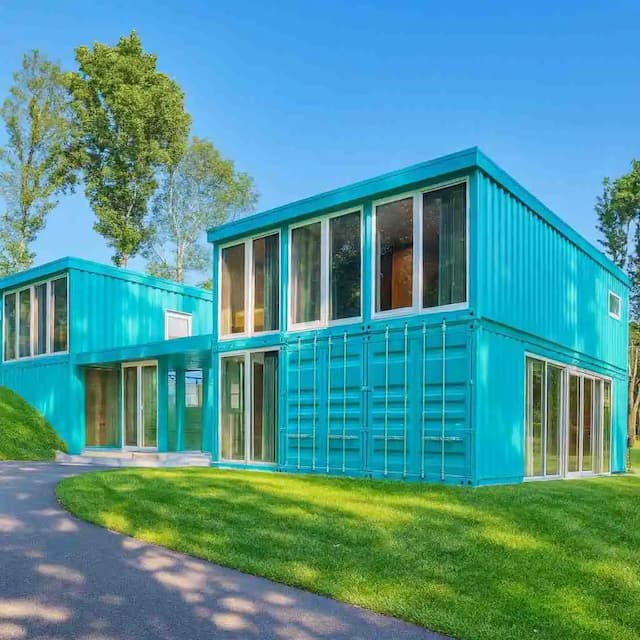
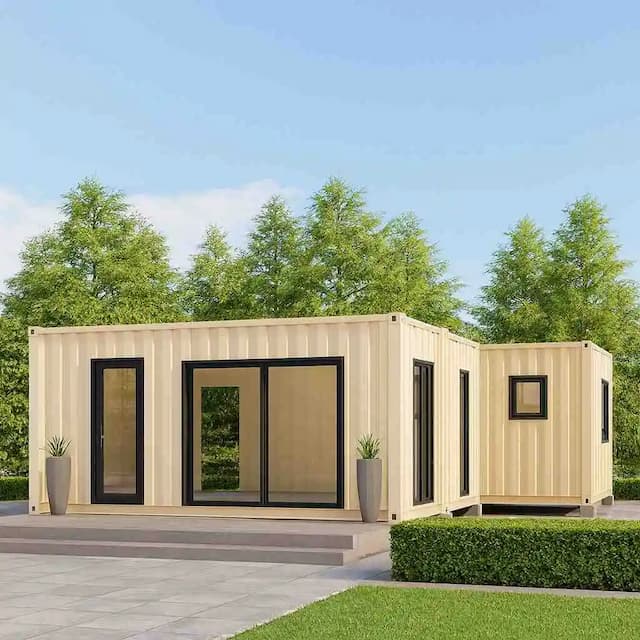
The corrugated ISO exterior retained as the design statement — shipping container tiny house, forest green, rural residential plot.
If the ISO corrugated steel exterior is part of why you want this home — if the visible container silhouette is the design statement, and the tiny house movement philosophy is the frame — you are on the right page. If your primary question is how small can I go while still living comfortably, at the lowest price possible, see our compact 20-ft tiny container home range, which is a fully fitted, factory-built 20-ft unit — price depends on size and specification. Both pages serve the same cluster — neither is a compromise version of the other; they serve different buyers with different primary motivations.
The eco and sustainability case — why shipping container construction makes sense for alternative living in India
The sustainability argument for a shipping container home is not a marketing claim — it is material logic, and it is worth stating specifically.
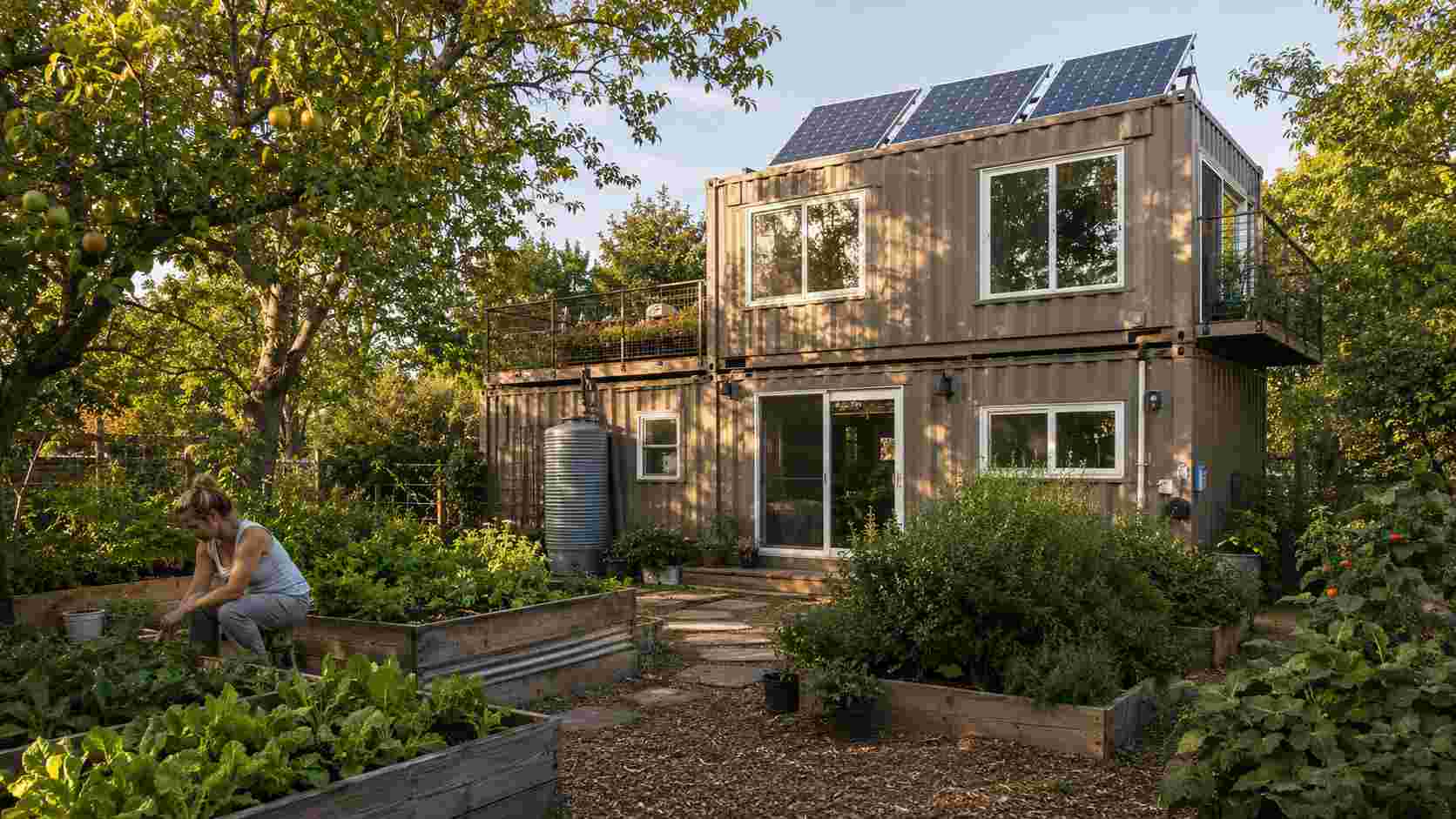
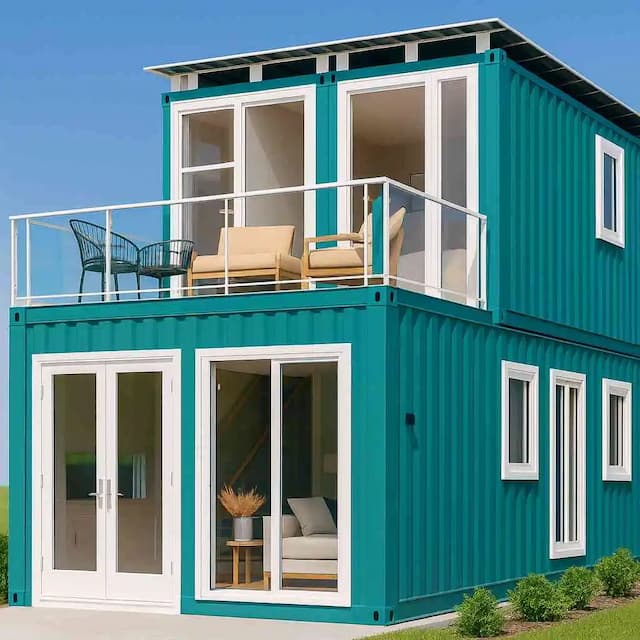
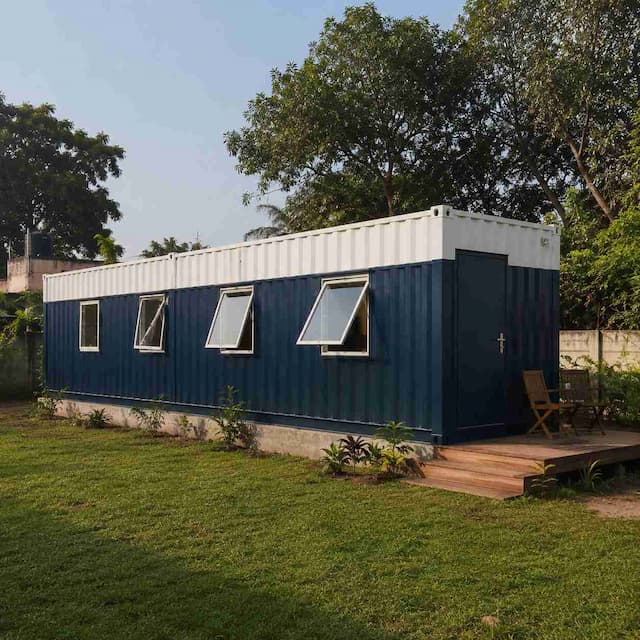
Shipping container tiny house in an eco-living garden — solar-ready roof, factory-applied PUF insulation, sustainable residential placement.
A standard ISO container is fabricated from industrial-grade weathering steel: heavy, durable, and already in existence. Converting one into a home reuses that steel rather than manufacturing fresh structural material. In India, brick production is one of the largest contributors to localised air pollution and agricultural topsoil degradation. Concrete pours require aggregate extraction, on-site batching, and curing time. A shipping container conversion replaces the bulk of both with a structure that already exists and is being repurposed.
The factory build model further compresses the site-phase impact. The entire configured unit leaves our factory on a single flatbed trailer and is crane-placed on the plinth in one operation. No months of on-site construction activity, no material waste accumulation at the plot, no cement batching or brick stacking. For a buyer building on a farmland plot, a hill-station site, or a coastal location where site construction logistics are complex, this is not a minor point.
On the operational side, 50mm PUF insulation on all six faces reduces the energy load required to maintain interior comfort. An eco-friendly container home that is inadequately insulated defeats the logic — the thermal specification here is built to limit AC runtime, not to invoke a material claim while ignoring the performance that follows.
For Indian buyers considering a sustainable container house as an alternative to conventional construction — on a farmland plot, for a resort or holiday home, or as a primary residence on the urban fringe — the material reuse, factory production, and insulation performance are all verifiable against the alternative. This is not a product that requires environmental claims to justify itself.
Placing a shipping container tiny house in India — land, site, and approval basics
This is the question most Indian buyers carry when they begin researching container homes, and it is the one that almost no competitor in the market answers usefully.
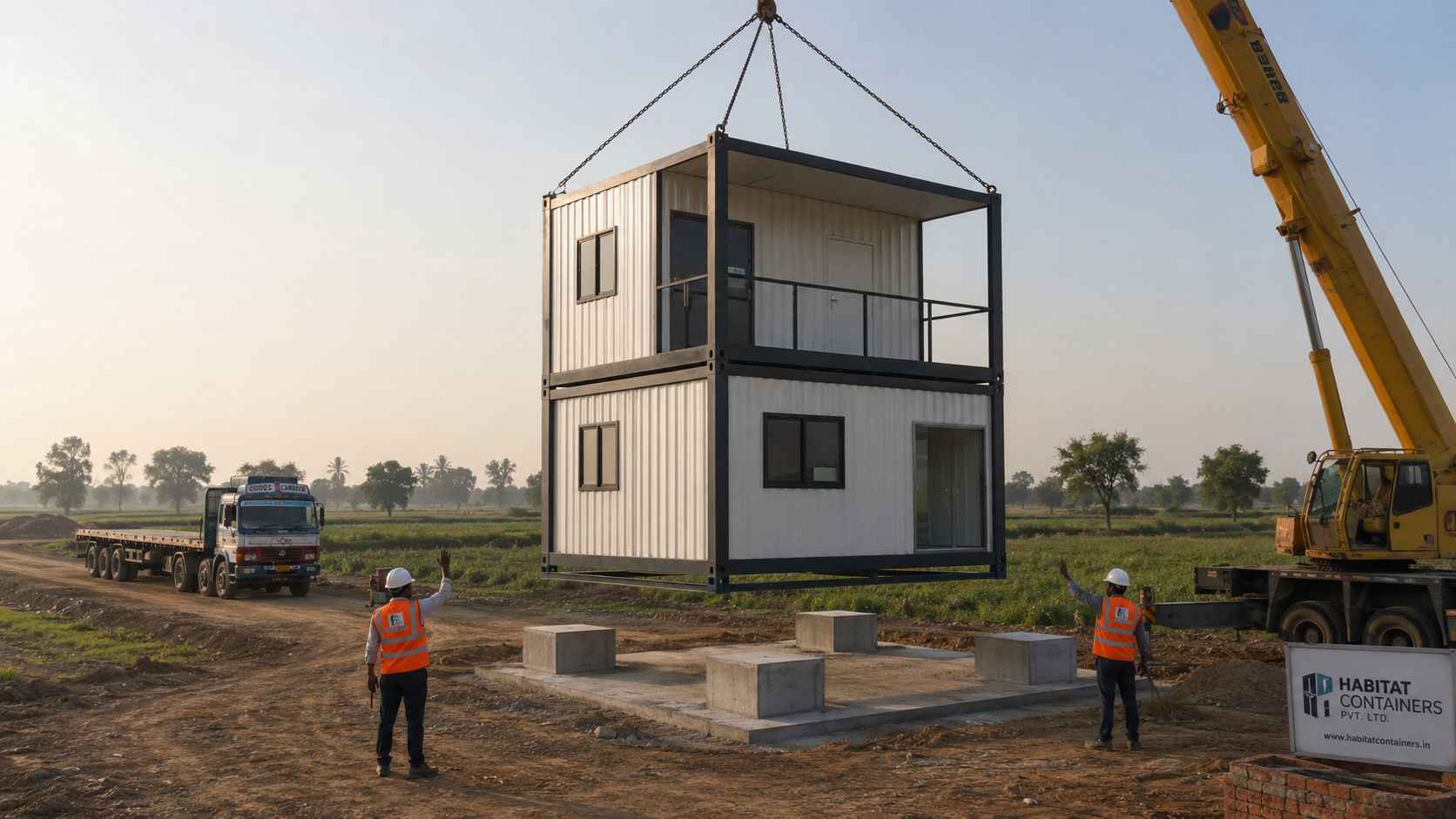
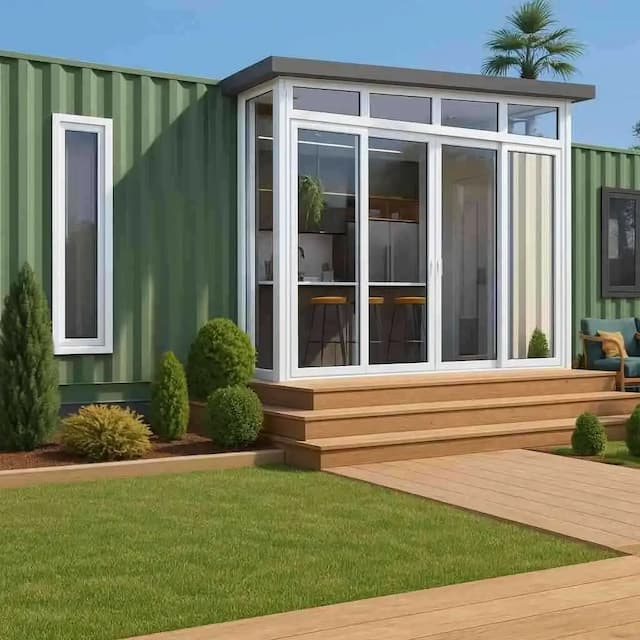
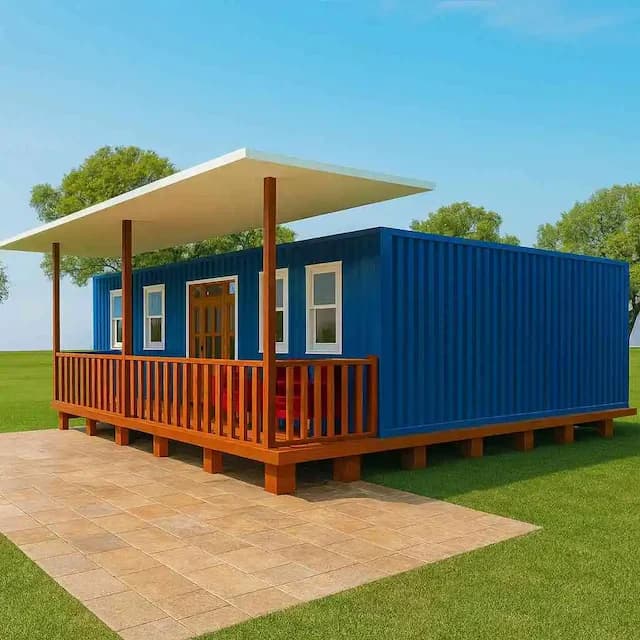
Factory-built shipping container tiny house being crane-installed on a prepared plinth at a rural Indian plot. Single-day installation.
Temporary vs permanent structure. In most Indian states, a container home placed on a prepared plinth is treated as a temporary or semi-permanent structure by panchayat bodies and urban local bodies. Under this classification, it does not typically require the full building plan sanction that governs permanent RCC construction. The rules that apply to brick-and-mortar structures — which in many jurisdictions require approved architectural drawings, structural engineer certification, and formal plan sanction before construction begins — do not uniformly apply to a steel unit that can be lifted and relocated. For buyers on private agricultural or rural residential plots with patta rights, this is the practical advantage that makes container homeownership accessible without a building project.
The critical caveat. Rules vary significantly by district, local body, and land-use classification. Some metro-fringe ULBs have begun applying building regulations more broadly. Some districts have specific restrictions on permanent or semi-permanent structures on agricultural land regardless of the structure type. Before ordering, verify your specific plot's land-use classification and the applicable rules under your district's panchayat or ULB. SAMAN does not provide legal advice, but we can share the documentation buyers in comparable situations have used.
For buyers on formal urban residential plots within BBMP, MCD, HMDA, or equivalent municipal jurisdictions, the approval process follows the same path as conventional construction — a licensed architect's drawing, structural engineer sign-off, and plan sanction with the relevant local body. Our container house overview covers that full process in detail.
What SAMAN provides. Structural drawings, material certificates, steel specification documentation, and a product datasheet that most local authorities accept when formal paperwork is requested. If your authority needs confirmation that the structure meets basic load and safety requirements, the documentation covers it.
Site requirements. An accessible road for a flatbed trailer — typically requiring approximately 3.5 m clear width and adequate turning radius for a long flatbed. Level or near-level ground for crane placement. A prepared plinth with four levelling pads on compacted ground — no concrete slab is required for standard single-unit installations. Electrical service, water supply, and drainage connections at the plinth are the buyer's scope.
Home loan reality. Container homes on agricultural or rural plots do not typically qualify for conventional home loans secured against the structure. Buyers generally use a loan-against-property on the land, a construction loan from an NBFC, or direct purchase. This is a buyer-must-verify item with your lender before committing.
For a full overview of every container home format SAMAN builds — across all sizes, price tiers, and configurations — see our container house overview.
Other container home options from SAMAN
The shipping container tiny house is one configuration in SAMAN's container home range.
For buyers whose primary question is footprint and price — the smallest livable container home at the lowest entry point — our compact 20-ft tiny container home range delivers a complete fitted 160 sq ft unit; contact SAMAN for a factory-direct quote from the same factories. For buyers who want the highest finish tier — tiled bathrooms, modular kitchen with chimney, designer interior panelling, multi-container villa builds — the luxury container house range starts at ₹5.15 lakh for a configured entry unit and scales to full villa specifications.
To compare all formats together, the container house overview covers the full range.
Configure your shipping container tiny house today: share your site location, plinth status, and any layout preferences, and our design team will confirm a floor plan and a buildable quote within 48 hours. Call +91 88616 22859, WhatsApp +91 97089 89937, or email sales@samanportable.com.
Frequently Asked Questions
Note for WordPress: Enter each Q&A below using the Rank Math FAQ Block in Gutenberg — do not paste as raw HTML. This generates the FAQPage schema automatically.
What does ₹21.55 lakh include in a SAMAN shipping container tiny house — and what's scoped separately?
The ₹21,55,000 price covers the complete factory-built configured unit: 40 ft × 16 ft × 18 ft MS steel frame, 50mm PUF insulation on all six faces, pre-wired electrical circuit (switchboard, fan and AC provision points, power outlets), plumbing (WC, washbasin, tiled shower zone), wood-finish interior wall panels, kitchen platform with sink and chimney provision, exterior paint, standard-zone delivery, and crane placement on your prepared plinth. Scoped separately — buyer arranges: site plinth preparation, electrical service connection from your meter, water supply and drainage tie-in at the plinth, and any municipal approval documentation your local authority requires. Customisation to ₹22,75,000 covers ACP exterior cladding, additional windows, granite kitchen counter, and upgraded bathroom and interior fittings — all priced and confirmed at design alignment before fabrication begins.
How is a shipping container tiny house different from a tiny container home?
Both are SAMAN factory-built container homes. The difference is the primary decision driver. A shipping container tiny house is chosen when the ISO corrugated steel exterior and the tiny house movement philosophy are central to the decision — the buyer wants the visible container silhouette and the intentional-living values it represents, not just a small home. A tiny container home is chosen when the primary question is the smallest livable footprint at the lowest price — 20 ft, approximately 160 sq ft. Same production process and insulation standard, different buyer motivation and physical configuration. If the container's visual identity is the point, this page is correct. If smallest footprint and price entry are the primary drivers, our separate tiny container homes page covers that in detail.
Is a shipping container tiny house legal to place on land in India — what approvals are needed?
In most Indian states, a container home on a prepared plinth is treated as a temporary or semi-permanent structure by panchayat or ULB authorities, meaning it does not typically require the full building plan sanction that permanent RCC construction requires. Buyers on private agricultural or rural residential plots with patta rights generally find container home placement is accepted without a formal building project approval. However, rules vary by district and local body — some ULBs apply building regulations more broadly. Before ordering, confirm your specific plot's land-use classification and the applicable rules for your district. SAMAN provides structural drawings, material certificates, and product documentation that local authorities typically accept as formal paperwork where needed. We do not provide legal advice, but we can share what documentation buyers in similar situations have used.
Does a shipping container tiny house get too hot in Indian summers — what insulation does it have?
Every SAMAN shipping container tiny house ships with 50mm PUF insulation applied to all six faces — walls, roof, and floor — as a factory-applied standard before interior fit-out begins. This is a structural thermal break built into the unit from the start, not a lining added after fabrication. The 40 × 16 ft internal volume at 18 ft height is larger than a 20-ft unit, so a 1.5-tonne split AC is the standard recommendation for most Indian locations at peak summer temperatures. At 38–42°C outdoor temperature, a properly insulated unit at this specification maintains comfortable interior temperature under AC comparable to a well-built conventional room of equivalent area. Siting the unit to minimise direct western sun exposure and adding a simple roof overhang or external pergola further reduces peak heat gain with minimal additional cost.
Certifications and Manufacturer Credentials
SAMAN POS India Private Limited (POS = Portable Office Solutions) has manufactured steel structures since 2009 (incorporated 2019), with 500+ projects across India from our plants at Gopasandra, Bengaluru 560099 and Greater Noida (Vill Jalpura, Tehsil Dadri, Greater Noida, Gautambudha Nagar, Uttar Pradesh 201308). Certifications and registrations: ISO 9001:2015 (Cert No. E20250218645), ISO 14001:2015 (Cert No. E20250218646), ISO 45001:2018 (Cert No. E20250218647), NSIC enlisted (Ref. NSIC/GP/BAN/2024/0055207), DPIIT-recognised startup (Ref. DIPP56005), Udyam registered (UDYAM-KR-03-0172770), GST 29ABBCS7101B1ZR (Bangalore) and 09ABBCS7101B1ZT (Noida). Structural steel to IS 2062. Explore the full container houses range.
Customer Reviews
0 reviews
No reviews yet. Be the first to review this product.
Write a Review for Shipping Container Tiny House
Built by a verified manufacturer: ISO 9001:2015 certified, Udyam registered, NSIC-enlisted, GST registered.
View manufacturer credentials