
Related Products
Explore similar items
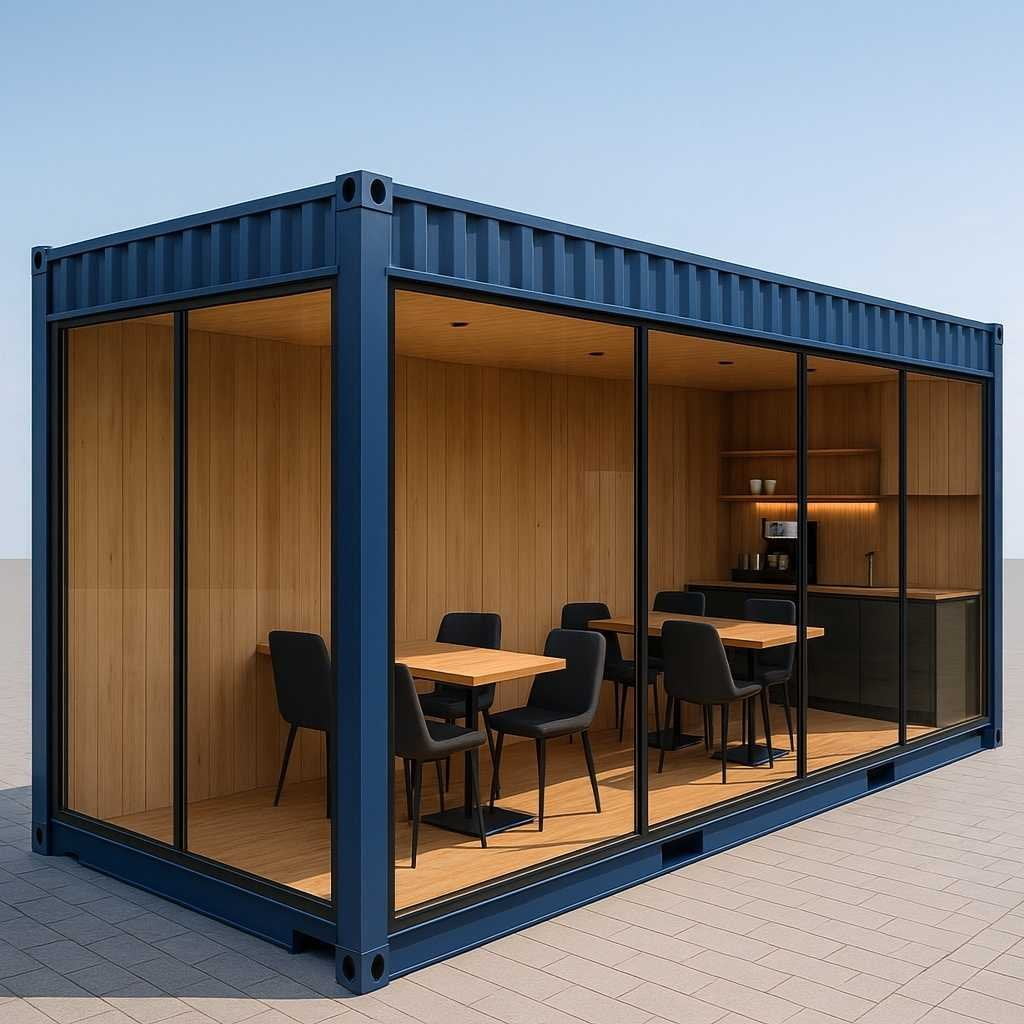
Shipping Container Hotel
Inclusive of all taxes
Quantity
Product Information
Product Details
Comprehensive information about Shipping Container Hotel
Product Overview
Detailed information about Shipping Container Hotel
A shipping container hotel is a hospitality property built from ISO shipping containers, with each container module serving as a guest room, a suite, or a paired-room unit. The format is built for hotel developers, resort operators, and hospitality investors planning a 20-key to 100+ key property — where stacking, modular scale, and per-room economics decide whether the project pencils. This page walks through how the architecture stacks, what fits inside each module, how a 20-key, 50-key, or 100+ key project plans out, what per-room cost looks like against conventional hotel construction, what your site needs to be ready, and where shipping container hotels work best in the Indian market.
Why ISO Shipping Containers for Hotel Projects
The case for ISO shipping containers in hospitality rests on three things, not the usual "eco-friendly and fast" pitch.
First, the 20-ft and 40-ft container dimensions match useful hotel-room footprints almost exactly. A 20-ft container gives ~160 sq ft of internal floor — clean for a compact single-occupancy room with attached bathroom. A 40-ft container gives ~320 sq ft — comfortable for a suite or two paired single-occupancy rooms with a shared corridor. Hotel operators don't have to over-design.
Second, ISO standardisation cuts procurement risk. The container shell is a known commodity with predictable cost, predictable lead time, and predictable structural behaviour. Conventional hotel construction reprices every site; ISO modules don't.
Third — and this is what makes the format actually work for hotels rather than just look good in renders — ISO containers are engineered to be stacked. The corner castings on top of one container were designed to carry the weight of another container above, fully loaded with cargo. For a hotel, that means a multi-storey property without a separate structural frame. The container is the frame.
Stacking Architecture for Multi-Storey Container Hotels
Stacking is where most "shipping container hotel" content on the internet stops short. Here's how it actually works in a SAMAN build.

A SAMAN-built double-stack shipping container hotel at a coastal resort site — 12 ISO containers stacked in two storeys with external staircase access.
Single-storey rows
The simplest layout — containers placed side by side on a prepared pad, doors facing a shared corridor or facing outward to private patios. Works for tourism zones with land to spare, glamping resorts, and boutique projects up to about 25 keys.
Double-stack
Two containers high, second level sitting on the first via the corner castings. The base level needs structural reinforcement only at the corners — the rest of the container floor is unchanged. External staircases connect to the upper level (sized for guest use, not service). Most resort-scale shipping container hotels we design land here — the build cost stays controlled while key count doubles per ground footprint.
Triple-stack
Three containers high, requiring engineered base modules with reinforced corner columns and an internal stair tower or lift shaft. This is the right pick for highway hotels and urban capsule-format properties where ground footprint is tight and key count needs to climb. Triple-stack is where structural drawings get serious — SAMAN handles the engineering as part of the project design.
Stair towers, lifts, and services routing
A separate container module configured as a stair core, sometimes housing a small service lift, gets stacked alongside the room modules. Guests use one stair tower per row of stacked rooms. Plumbing risers run inside dedicated wall cavities between paired containers; electrical risers do the same. The building looks like stacked containers, but it operates like a properly serviced hotel.
Hotel Layouts Inside Each Container Module
What goes inside a 20-ft or 40-ft container shell decides whether it reads as a real hotel room or as a parked shipping unit.

Premium-tier shipping container hotel guest room interior — queen bed, wood-batten finish, en-suite bathroom, full-height view glazing.
Single-key (20-ft container)
Bed (queen or twin), 32-inch wardrobe, work-corner desk or vanity, en-suite bathroom partitioned at one end (~35 sq ft for shower, toilet, basin). Service access door on one short end. Window or full-glass long side for view. AC unit wall-mounted, ducted exhaust for the bathroom.
Twin-key (40-ft container)
Two single-key layouts mirrored back-to-back, with the shared wall containing the plumbing riser. Each side gets its own bathroom and entry door. Useful for budget hotels, transit properties, and group bookings.
Suite (40-ft container)
One room treated as a bedroom-plus-sitting layout. Larger bathroom (full bath possible), small balcony cantilever from the long side, premium fit-out. The configuration most boutique resort projects pick for their top tier.
Fit-out tiers — standard vs premium
Standard fit-out runs insulated walls (50mm PUF panel), vinyl flooring, painted finish, basic AC, standard fixtures — suited to budget hotels, highway transit, and project hotels. Premium fit-out moves to wood-batten internal cladding or laminate finish, tile flooring, inverter AC, premium sanitary fittings, full-height glazing on the view side, balcony module — suited to coastal resorts, hill-station boutiques, and brand-aligned hotel-chain operators.
Resort-Scale Project Planning: 20-Key, 50-Key, 100+ Key
Project size decides almost everything else — the layout, the stacking strategy, the common-area planning, the cost per key. Three planning tiers cover most projects.
20-key projects
Typically single-storey row with 20 single-key containers, or double-stack with 10 + 10. Common areas: a small reception module (one 20-ft container converted), one F&B block (a 40-ft container for kitchen and counter), and one staff/back-office module. Site footprint: 0.5–0.75 acres including circulation. Time to open: ~120 days from order to keys-ready.
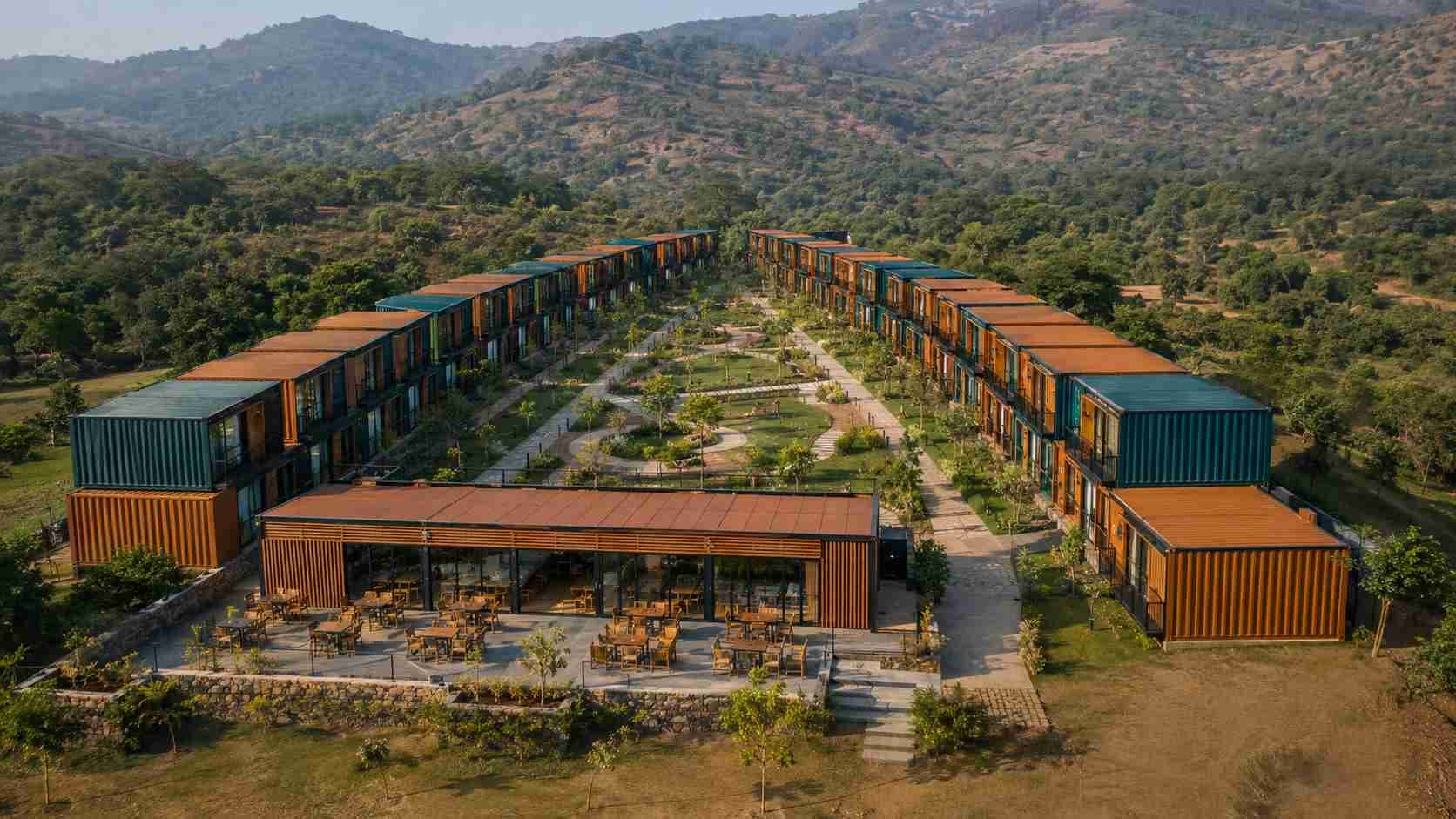
Aerial of a 50-key shipping container hotel resort — stacked container rows arranged around a central landscaped courtyard with a reception-and-dining block.
50-key projects
Usually double-stack with 25 + 25, or a mix of 30 single-key and 10 twin-key (10 containers running twin layout). Common areas grow: reception, dining (two 40-ft containers joined for ~600 sq ft restaurant), back-of-house kitchen, two staff modules, separate housekeeping module. Site footprint: 1–1.5 acres. Time to open: ~150 days.
100+ key projects
Triple-stack or multi-row double-stack across the site. Common areas planned as a separate hospitality block — reception, lobby, dining, kitchen, spa or wellness, and back-of-house all integrated as container modules around an open central space. This scale benefits from running F&B as a dedicated container build — for that component, SAMAN's F&B-only modular cafe units are typically integrated into the property design as the dining and kitchen block. Site footprint: 2+ acres. Time to open: ~180 days.
Per-Room Economics vs Conventional Hotel Construction
Per-key cost is where shipping container hotels make their case most clearly. Honest ranges, not exact prices — final numbers depend on fit-out tier, site complexity, and configuration choices.
| Build approach | Per-key cost (standard fit-out) | Per-key cost (premium fit-out) | Time to open |
|---|---|---|---|
| Shipping container hotel (this format) | ~Rs 4–6 lakh | ~Rs 8–12 lakh | 90–180 days |
| Conventional brick-and-mortar hotel | ~Rs 12–20 lakh | ~Rs 20–35 lakh | 18–36 months |
The cost gap isn't only the construction itself. Conventional hotel construction carries an 18- to 36-month opportunity cost on the land — no revenue until the building is ready. A shipping container hotel project earns revenue within four to six months of order. For a 50-key property, that's a difference of roughly 12–24 months of operating revenue, on top of the lower capex.
What it doesn't include: land, permits, soft costs (design beyond standard SAMAN scope, project management, branding), furniture beyond the standard fit-out, and operational setup. Those scale similarly across both build approaches.
Site Requirements and Project Execution
The site has to be ready when containers arrive. Four things in place make the difference between a 90-day project and a 180-day project.
Foundation
RCC pads under each container's four corner casting positions, plus connecting strip footings if the corridor is to be paved. Pad thickness 8–12 inches depending on soil bearing capacity and stacking level (single, double, triple). Sized 2 ft larger than the container on all sides for installation tolerance.
Services routing
Water inlet line sized for the property's peak draw (typically 1-inch main, branched per stack). Drainage either to municipal connection or to a soak pit and septic system sized for the room count. Electrical mains brought to a single intake point with downstream distribution panel; load planning depends on AC count and kitchen demands.
Site slope
Shipping container hotels handle slope with stepped pad design — each row of containers on its own level pad, with circulation steps between. Severe slopes (greater than 15 degrees) need civil engineering input on retaining and pad levelling before site work starts.
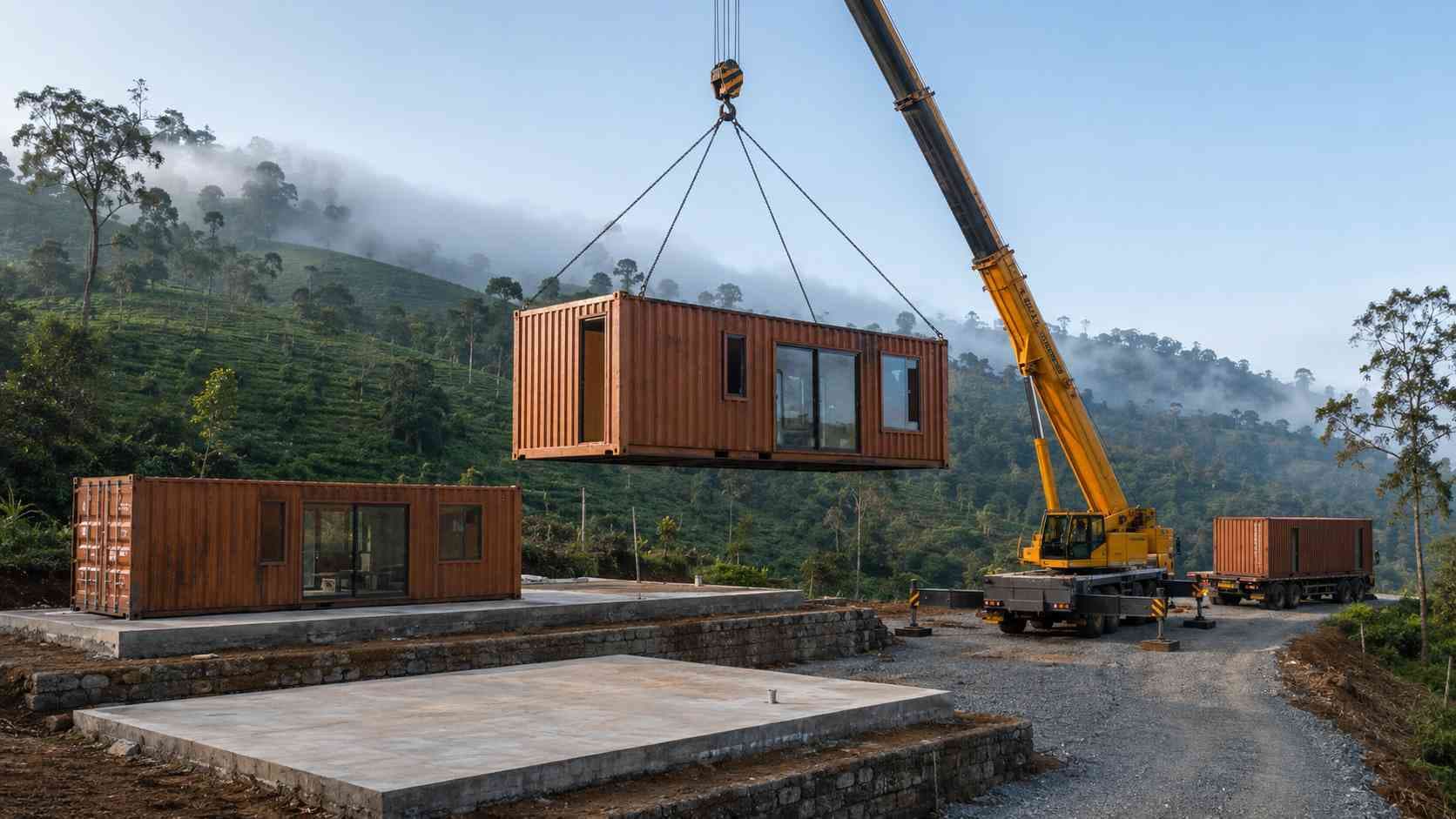
30-tonne crane lifting a shipping container hotel module onto its RCC pad at a hill-station project site — SAMAN on-site installation.
Crane access
Each container module needs crane placement on its final position. The site access road must take a 30-tonne crane and a low-loader truck delivering containers. For multi-storey stacks, the crane is needed for each level — a one-day operation per stack on a properly prepared site.
Where Shipping Container Hotels Work Best — Use Cases
Six use cases cover most shipping container hotel projects we see in the Indian market.
Coastal and beach resorts
Goa, Gokarna, Pondicherry, the Konkan coast — locations where the corten exterior or wood-clad container module feels right against the landscape, and where rapid site work matters during monsoon-bounded construction windows.
Hill stations and weekend getaways
Coorg, Chikmagalur, the lower Himalayas, the Nilgiris — sloped sites where stepped pad foundations and stackable units adapt better than conventional construction.
Highway hotels and transit properties
Mumbai-Pune, Delhi-Jaipur, NH-44, golden quadrilateral corridors — where 30 to 50-key transit properties open faster than conventional, and triple-stack keeps the road frontage tight.
Tourism zones and heritage corridors
Rann of Kutch, Hampi, the desert circuit, Northeast tourism — locations where temporary or low-permanence construction is the only viable approach for sustainable tourism development.
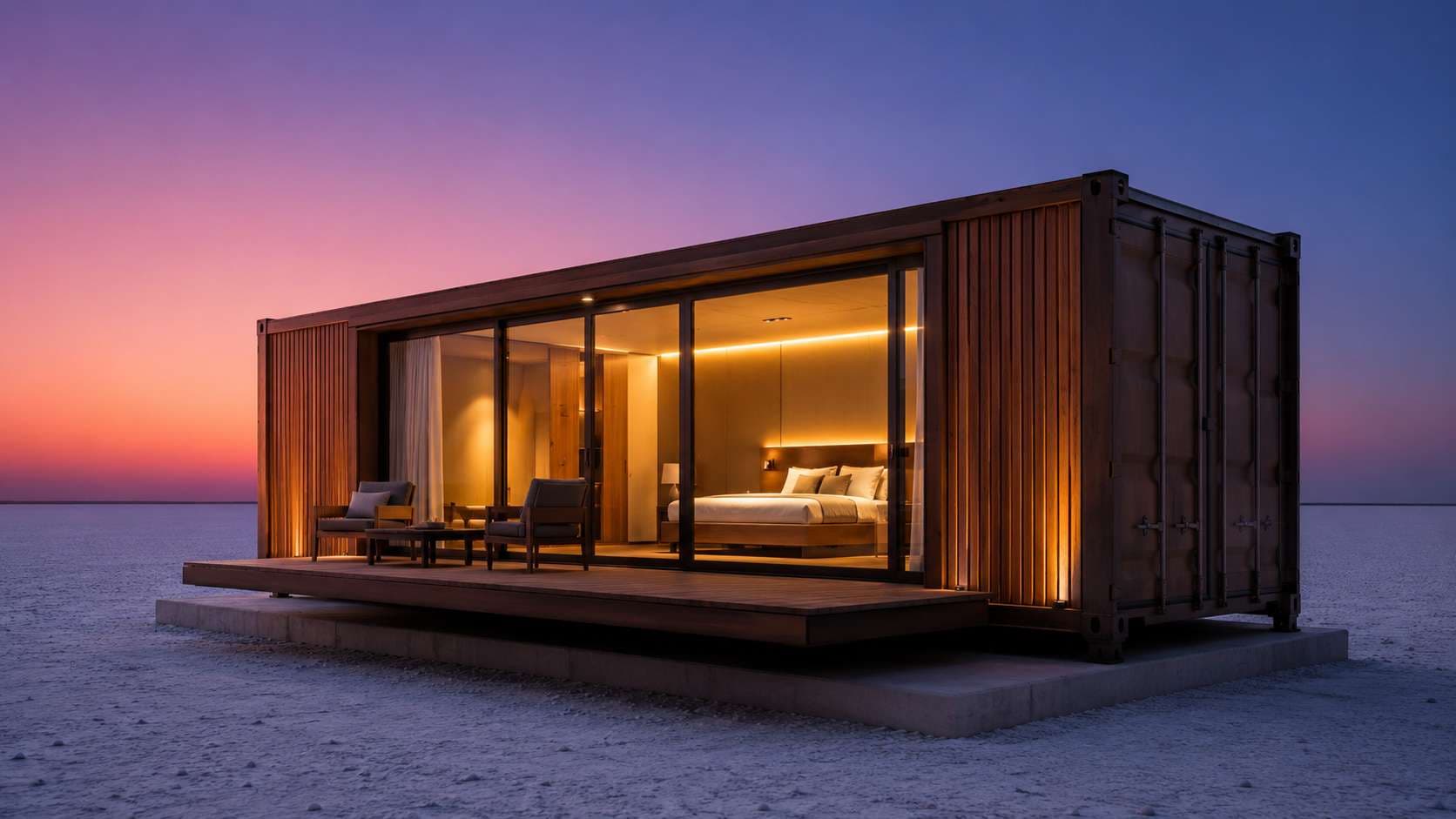
A glamping-tier shipping container hotel suite in Rann of Kutch — bronze corten and wood-batten exterior, cantilever balcony, dusk lighting.
Glamping resorts and luxury camping
Premium-tier shipping container modules with full-glass walls, balconies, and brand-aligned interior finish. The format works because the structural shell ships flat-pack to remote sites where conventional builds aren't possible.
Capsule hotel format
Urban high-density sites — airport-adjacent, business-district transit hotels — where a triple-stack of 20-ft modules delivers a tight key-per-square-metre ratio. The compact single-key configuration was originally designed for this use case.
Fit-out Tiers and Brand-Matched Finishes for Hotel Operators
A shipping container hotel module ships from the SAMAN factory wearing the operator's brand, not generic finishes.
Exterior options
Corten-look corrugated steel for the iconic visible-container appearance; pre-painted GI cladding in any brand colour; wood-batten cladding for resort-grade warmth; perforated metal screens for premium boutique. Each option ships finished from the factory — no exterior work on site.
Glazing and balconies
Standard window cut-outs on the view side, or full-height glazing replacing the long side. Balcony modules — short cantilever or full-width — bolt onto the exterior corner castings, structurally sound for guest weight.
Interior fit-out tiers
Standard runs vinyl flooring, painted PUF wall finish, basic AC, standard sanitary. Mid-tier moves to tile flooring, laminate wall finish, inverter AC, mid-range sanitary fittings. Premium adds wood-batten internal cladding, designer lighting, premium fittings, and finish detailing to operator brand specs.
Brand-aligned finishes for chain operators
Hotel chains running a 50-key or 100+ key project supply their brand manual; SAMAN's factory finishes each module to the manual before dispatch — signage, paint codes, fixture brands, wayfinding integration.
When to Choose a Shipping Container Hotel vs a Single-Property Container Hotel
Two related SAMAN builds sit in the container-hotel space, and the choice between them is mostly about project scale and what the corten-steel exterior means to your brand.
Shipping container hotel (this page). Built from ISO shipping containers, stackable to two or three storeys, designed for 20-key to 100+ key projects where modular scale and per-room economics drive the decision. The container silhouette stays visible — the build's identity is the stacked container form. Best for resorts, highway hotels, tourism zones, and chain-operator projects with a growth plan.
Single-property container hotel. A smaller-scale build approach better suited to boutique single-property concepts in the 5-key to 25-key range, where the operator wants a softer-finish, less-industrial appearance and doesn't need multi-storey stacking. For that route, see SAMAN's single-property container hotel approach when that page publishes.
If your project is a residential container home for personal use — a weekend farmhouse, a private stay unit, or a second-home project — neither of these is the right page. SAMAN's container houses for residential use is built for that scope, and it cross-links from this page for that reason.
How SAMAN Builds Hotel Container Projects
Shipping container hotel projects run through SAMAN on a fixed sequence, with each stage handled by the team that handles SAMAN's other large-format builds.
Design lock
Site layout drawing, module count, stacking plan, common-area integration, fit-out tier, and brand finish — locked before factory dispatch.
Factory production
Containers procured to ISO spec, modified at SAMAN's Bengaluru and Greater Noida facilities. Cut-outs for doors, windows, glazing, and service routes; structural reinforcement at corner castings for stack-bearing units; insulation, wall lining, electrical wiring, plumbing rough-in, and interior finish — all factory-installed.
Quality checkpoints
Each module passes inspection before dispatch — structural integrity, finish quality, services functional test, and brand-finish compliance.
Delivery and crane placement
Modules trailered to site, crane-lifted onto prepared pads. Multi-storey stacks placed level-by-level. Pan-India delivery handled from both production facilities.
On-site assembly and fit-out
Inter-module connections sealed; corridor and circulation built; common-area block integrated; final services connected; final paint and signage applied. The full container hospitality range — from cafes through hotels — runs through this same factory process, which is why operators booking a hotel project get the same delivery reliability SAMAN ships on its container cafe and labour colony work.
Frequently Asked Questions
Is a shipping container hotel different from a container hotel?
Yes. Shipping container hotel is the SAMAN build using ISO shipping containers — stackable two or three storeys high, designed for resort-scale projects with 20+ keys where the corten exterior and modular form are part of the brand. A general container hotel build approach is better suited to smaller single-property hospitality projects in the 5–25 key range with a softer, less-industrial finish. The structural format and the project-scale fit are the two real differences.
How many shipping containers are needed for a 30-room hotel?
For 30 keys with all single-occupancy rooms, you need 30 × 20-ft containers for the rooms, plus 3–4 additional containers for reception, dining/kitchen, and back-office. If you go twin-key (two rooms per 40-ft container), the count drops to 15 × 40-ft containers for rooms plus the common-area modules. Most 30-key projects we design land at 28–32 containers in total.
Can shipping containers be stacked 2 or 3 storeys high for a hotel?
Yes. Two-storey is straightforward — the container corner castings carry the load. Three-storey needs base-level structural reinforcement on the bottom corners and engineered stair towers or a lift shaft. Beyond three storeys, the build moves into hybrid steel-frame territory and the economics shift away from pure container construction.
What does a shipping container hotel cost per room in India?
Standard fit-out lands around Rs 4–6 lakh per key for single-occupancy 20-ft modules. Premium fit-out (wood cladding, full glazing, balcony, brand finish) lands around Rs 8–12 lakh per key. These are SAMAN's build cost per module — they don't include land, permits, soft costs, or operational setup. Conventional hotel construction for comparable per-key scope runs Rs 12–35 lakh.
How long does it take to open a shipping container hotel?
A 20-key project opens in around 120 days from order to keys-ready. A 50-key project in ~150 days. A 100+ key resort project in ~180 days. Site readiness — foundation, services, crane access — happens in parallel with factory build, which keeps the overall timeline tight.
Where in India is a shipping container hotel a good fit?
Coastal locations (Goa, Konkan, Pondicherry), hill stations (Coorg, Chikmagalur, lower Himalayas), highway transit corridors (Mumbai-Pune, NH-44), tourism zones (Rann of Kutch, Northeast), and urban transit-density sites (airport-adjacent, business-district capsule format). Sites with slope, remote access, or monsoon-bound construction windows are where the format outperforms conventional hotel construction.
Get a Project Quote
Tell us your target key count, fit-out tier (standard / mid / premium), and site location. SAMAN will return a per-key estimate, a site-readiness checklist, and a project timeline within two working days. Quotes available for 20-key, 50-key, and 100+ key projects.
Customer Reviews
0 reviews
No reviews yet. Be the first to review this product.
Write a Review for Shipping Container Hotel
Need Custom Requirements?
Get in touch with our experts for customized solutions and bulk orders. We're here to help you find the perfect solution.