
Related Products
Explore similar items
Restaurant Food Container
Inclusive of all taxes
Quantity
Product Information
Product Details
Comprehensive information about Restaurant Food Container
Product Overview
Detailed information about Restaurant Food Container
A restaurant food container is what an F&B operator builds when the business needs a kitchen, not a customer-facing space. The SAMAN build at ₹7,65,000 (regular ₹7,95,000) is a 20'×10'×9' factory-fitted unit configured around commercial cooking — food-grade stainless steel cooking wall, exhaust hood opening sized for commercial extraction, LPG inlet, commercial-rated electrical, and zero dining floor. It's the kitchen container that supplies a restaurant operation — not the restaurant itself.
What a Restaurant Food Container Is — A Kitchen Build, Not a Customer-Facing Restaurant
A restaurant food container is a 200 sq ft commercial kitchen built into a single steel container shell. There is no service window, no customer dining floor, no front-of-house finish. Every square foot inside is configured for prep, cooking, and food handover — to your own delivery riders, to a third-party logistics partner, to a sister outlet's pickup runner, or to staff at an adjacent customer-facing venue.
If you've landed here searching for a food container for restaurant to run as a back-of-house kitchen behind an existing restaurant — or as a standalone cloud-kitchen unit — this is the right build. The fitout commitment is three specific things: a food-grade interior, commercial ventilation, and a custom kitchen layout planned around your cooking flow.
This page is the kitchen container. Different from a customer-facing restaurant build (dining-led), different from a coffee-shop format (single product + customer window), different from a food-truck container (mobility-led). One product identity, one buyer type.
Inside the 20×10×9 ft Build at ₹7,65,000 — Cooking Wall, Exhaust, and Commercial Electrical
The cooking wall runs along one of the two long sides of the unit. Factory-fitted before dispatch: food-grade stainless steel lining floor-to-ceiling along the cooking line, the exhaust hood opening sized for a commercial extraction fan, the LPG inlet stub with isolation valve, a 600mm × 600mm stainless steel sink with 15mm water inlet and 32mm waste outlet, and the commercial-rated MCB panel mounted at standing reach. The wall is the working face of the kitchen — wipeable, FSSAI-compatible on the cooking-side surface, and pre-routed for the equipment your menu calls for.
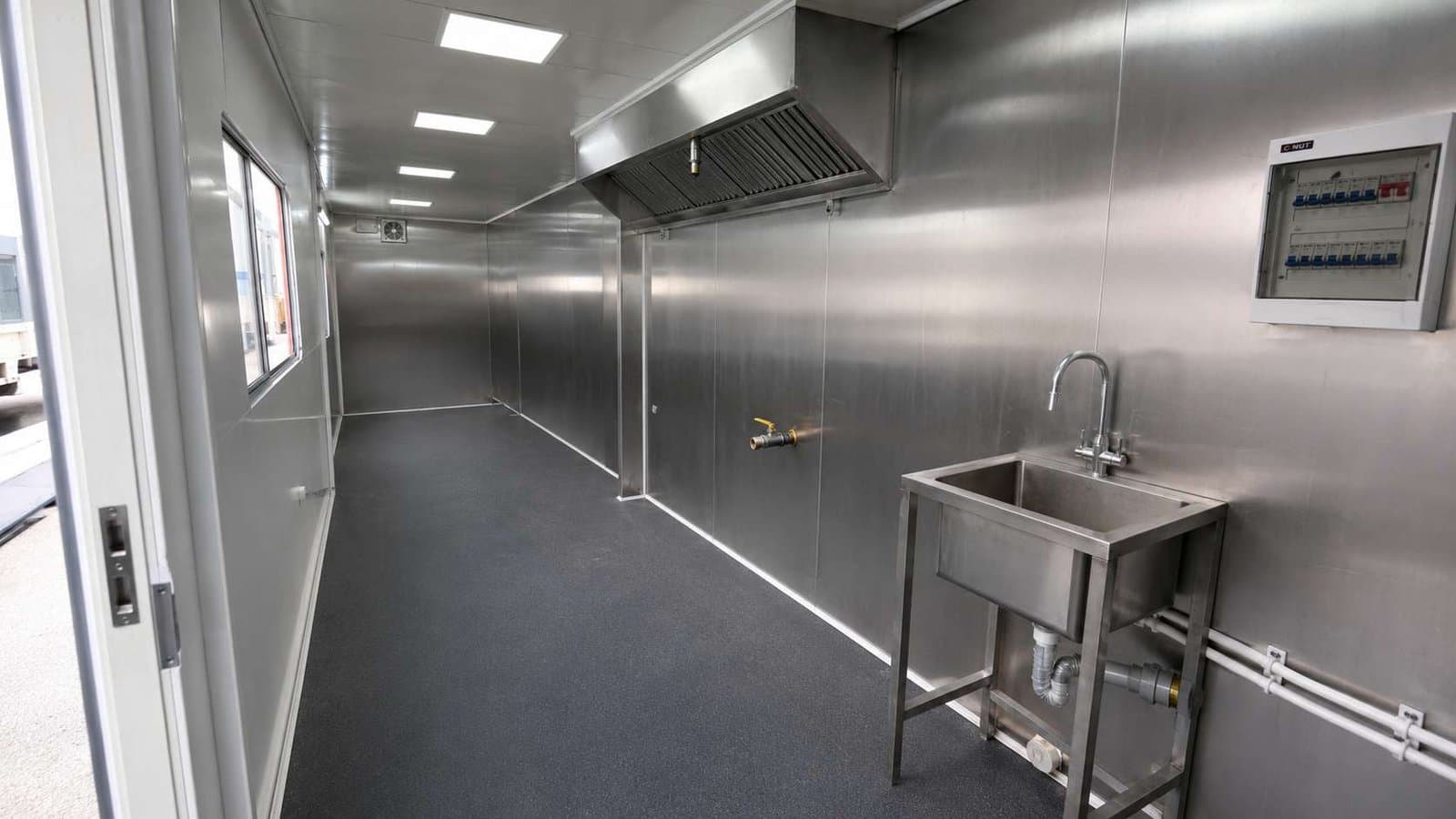
The cooking wall, factory-fitted before dispatch — food-grade stainless steel lining, exhaust hood opening, LPG inlet stub, sink, and commercial-rated MCB panel.
The MCB panel is sized for commercial cooking loads, not residential. A typical configuration: a 32A three-phase main feeding the kitchen subpanel, with separate breakers for refrigeration, lighting, the commercial extraction fan, and a 16A circuit for low-load equipment (mixer, blender, food processor). Specify your equipment list at quote stage and the breaker sizing is set at the factory — not retrofitted at site.
The shell is steel — IS 2062 Grade A frame, 50mm PUF sandwich panels on the walls and roof, and an anti-skid kitchen-grade floor finish. PUF on the walls matters in two ways here: it keeps cooking heat from bleeding into the next room when the unit sits adjacent to a customer-facing venue, and it gives the food-side surface a wipeable hygienic finish.
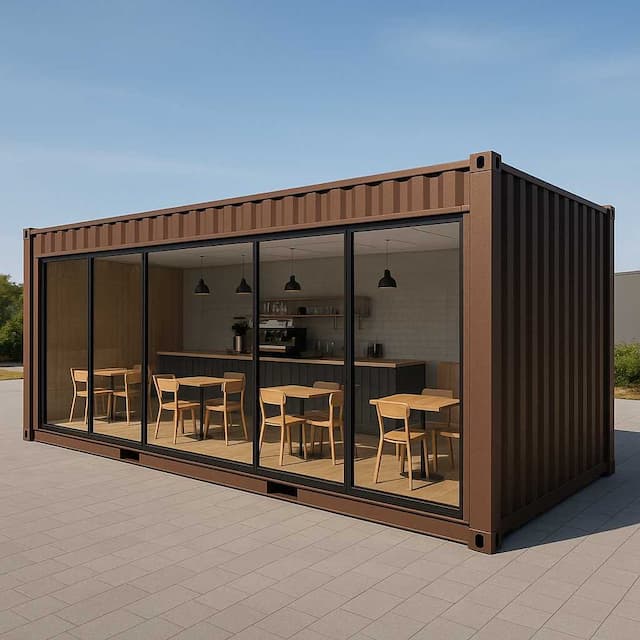
There is a single service door positioned for staff entry and food handover, an observation window cut into the door for line-of-sight, and one prep-side window for daylight and airflow. No customer-facing window. No service counter. No display fitout. The unit is closed to the public on three sides — which is exactly what a cloud kitchen, central kitchen, or back-of-house operation needs.
Five Operations This Kitchen Container Is Built For
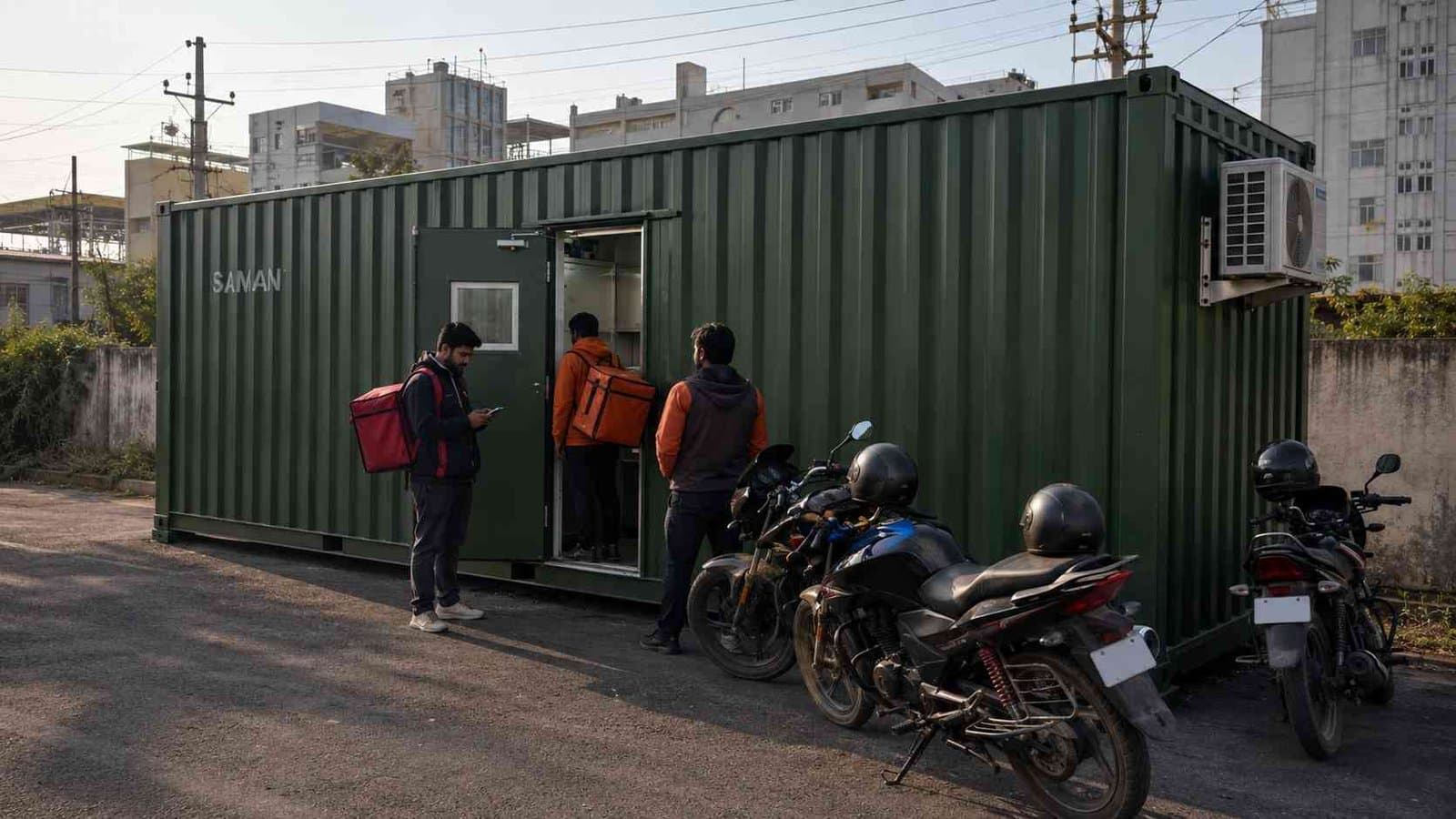
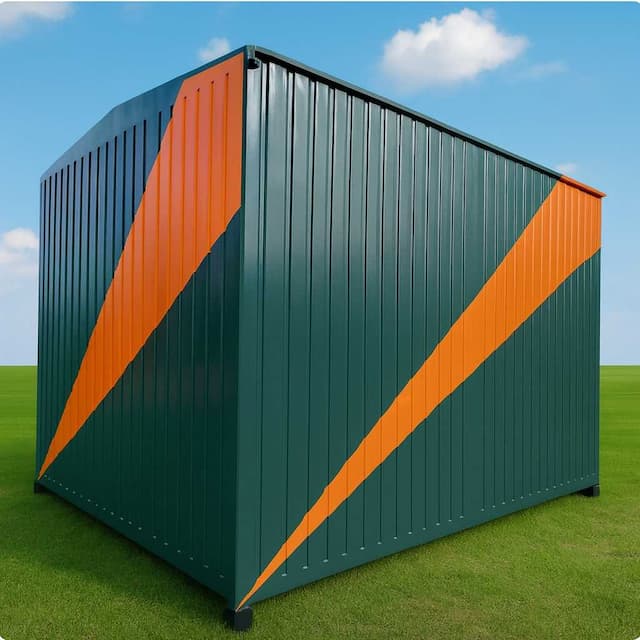
A 20-foot restaurant food container running as a cloud-kitchen node — aggregator delivery riders collect prepared orders at the service door.
The same 20×10 kitchen container slots into five F&B operations. Each one needs the kitchen but not the dining floor.
Cloud kitchen or dark kitchen. A delivery-only food brand opening or scaling a new node. Single-cuisine or single-brand operation; output goes to aggregator riders (Zomato, Swiggy) or own-fleet bikes. The 200 sq ft kitchen handles a focused menu — biryani-only, momos-and-burgers, pizza, a regional cuisine cloud brand — at a leased plot or industrial-zone site with rider access.
Ghost kitchen for a multi-brand operator. One container hosts the kitchen for two or three delivery brands operating off the same equipment line. The common pattern in metros: a parent brand runs Brand A on lunch slots and Brand B on dinner slots from the same fryers, burners, and prep counter. The shared MCB panel and cooking wall make multi-brand prep workable inside 200 sq ft when the cuisine pair is well chosen.
Central kitchen or commissary for a multi-outlet brand. A QSR chain, a regional sweet shop, or a tiffin operator running 4–10 customer-facing outlets supplied from one production kitchen. The container becomes the prep hub — sauces, marinades, dough, batter, base curry, ready-to-fry items — and trucks or vans run daily distribution to the outlets. Output throughput is the design driver, not customer service.
Catering and event-catering kitchen. A catering business with a fixed production kitchen for event work — banquet catering, corporate canteens, school lunch programmes. The container sits at the catering company's owned plot and the cooked food transports in hot-holding cases. Some catering operators also use the unit as a relocatable kitchen — crane-lifted to a long-duration event site for a 30–90 day engagement.
Hotel, resort, or campus F&B annexe. A property with a dining venue that's not architecturally a kitchen — a lawn-dining setup, a pool-deck cafe, a banquet hall added later, a campus food-court annexe. The kitchen container sits behind or beside the customer-facing venue and feeds the service line through the back. The customer never sees the container; the kitchen output is the only interface.
When You Need the Kitchen, Not the Restaurant — This 20-ft Build vs the 40-ft Container Restaurant Build
If you're comparing this page with the 40-ft container restaurant build with full dining floor, the trigger question is plain: will customers eat inside the container?
If yes, the 40-ft build at ₹15,55,000 is the right buy. That unit gives a dining floor for 16–24 covers, a wood-clad customer-facing wall, restroom-ready footprint, and the restaurant-grade interior fitout customers experience.
If no — if the kitchen is feeding delivery riders, a separate dining venue, multiple outlets, or a catering operation that serves elsewhere — this 20-ft kitchen-only build at ₹7,65,000 is the right buy. You save ₹7,90,000 by not paying for dining fitout that no customer will ever sit in.
The two builds share the same factory and the same kitchen specification along the cooking wall — food-grade stainless steel lining, exhaust hood position, LPG inlet, commercial MCB panel. What changes is the rest of the floor. In the 40-ft build, 30 ft of length goes to dining, service pass, and restroom. In this 20-ft kitchen-only build, every inch is kitchen.
Some operators run both — a 40-ft customer-facing dining build at the storefront site and a 20-ft kitchen-only container at a separate production site supplying it. That's the central-kitchen-plus-storefront model multi-city brands use. For that configuration, this page is the back-of-house side.
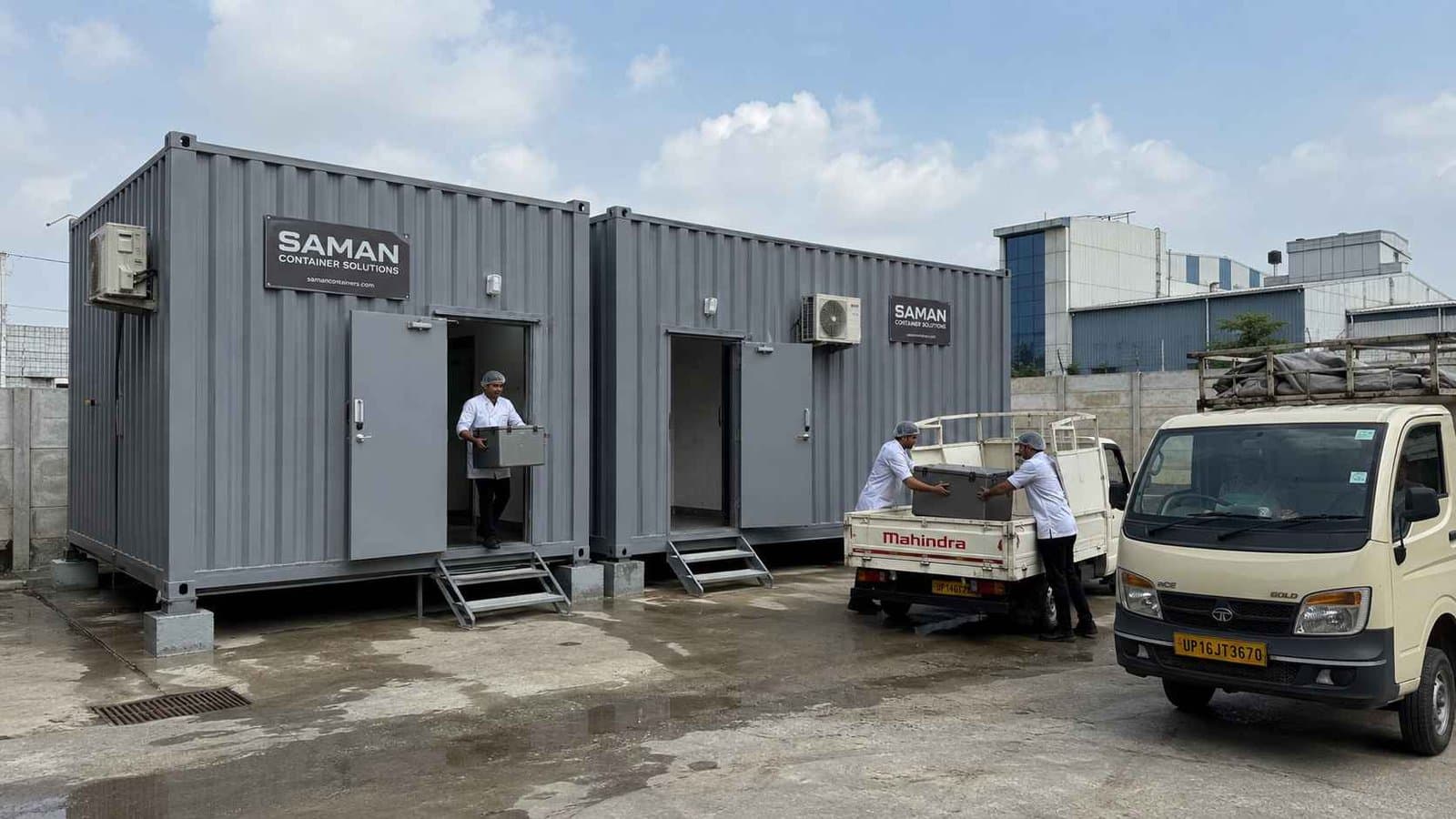
A central kitchen pair supplying multiple customer-facing outlets — daily distribution by light commercial vehicles to the brand's storefronts across NCR.
FSSAI for a Non-Dining Commercial Kitchen — Manufacturing License Logic and Hygiene Zoning
FSSAI doesn't care whether the kitchen is brick, steel, container, or shed. It cares about who's filing, what category they're filing under, and whether the build meets the hygiene and food-safety requirements for that category.
For a kitchen container running a cloud-kitchen, central-kitchen, ghost-kitchen, or catering operation — output goes elsewhere, no customer eats on site — the FSSAI category is Manufacturing, not Fixed Establishment with dining service. The license tier follows the standard turnover band: State License (Form B) for annual revenue between Rs 12 lakh and Rs 20 crore, Central License above Rs 20 crore. The application is filed by the food business operator at the kitchen container's address. SAMAN supplies the layout documentation showing the food-grade cooking wall, the exhaust hood position, the FSSAI airflow direction, and the IS 2062 Grade A material certification.
Inside the unit, hygiene zoning works at smaller scale than in a brick kitchen, but the principles are identical. The cooking line is the contaminated zone — exhaust draws upward through the hood and out, never back into the prep area. The prep zone faces the service door, draws fresh air through the prep-side window, and stays the clean zone. A 200 sq ft kitchen container satisfies FSSAI Manufacturing hygiene requirements when the wall and floor surfaces are food-grade (factory-fitted), the exhaust direction is correct (designed in), and the operator maintains standard kitchen-cleaning discipline.
Where this kitchen-only setup differs from a fixed-establishment restaurant license: no dining-area inspection, no customer-facing handwash at front-of-house, no public restroom inside the FSSAI scope. The license sits cleanly inside the Manufacturing tier.
What ₹7,65,000 Includes — and What Your Kitchen Equipment Budget Covers Separately
The ₹7,65,000 sale price (regular ₹7,95,000) on this SKU (SP-CC-40-2024) is the factory-finished 20-ft kitchen container — not a bare shell with a quote-for-everything caveat.
Included in the ₹7,65,000 build: 20' × 10' × 9' shell with IS 2062 Grade A steel frame and 50mm PUF wall and roof panels; factory exterior paint or GI cladding finish; food-grade stainless steel lining along the cooking wall; exhaust hood opening sized for commercial extraction fan; LPG inlet stub with isolation valve; 600mm × 600mm stainless steel sink with 15mm water inlet and 32mm waste outlet; commercial-rated MCB panel with breakers sized to your equipment load; anti-skid kitchen-grade floor finish; single service door, observation window, one prep-side window; reinforced corner lift points for crane relocation; delivery within India and crane unloading at site.
Owner-supplied (separate kitchen-equipment budget): commercial cooking equipment — burners, range, fryer, tandoor, tawa, oven — bought to your menu spec; refrigeration (undercounter chiller, walk-in cooler if footprint allows, freezer); commercial extraction fan and ducting from the factory-fitted hood opening to atmosphere; dishwash station fittings if your operation washes in-unit; prep tables, storage racks, dry-stock shelving; cooking utensils, gas cylinders or pipeline gas connection; FSSAI Manufacturing License application (SAMAN supplies layout documentation; your business files); fire NOC where the local municipality requires one for commercial cooking; grease trap at the drain outlet — mandatory for any commercial kitchen wastewater.
The unit dispatches from Gopasandra (Bangalore) or Jalpura (Greater Noida) within 7 to 21 working days from confirmed order, depending on customization volume and the order queue at the time.
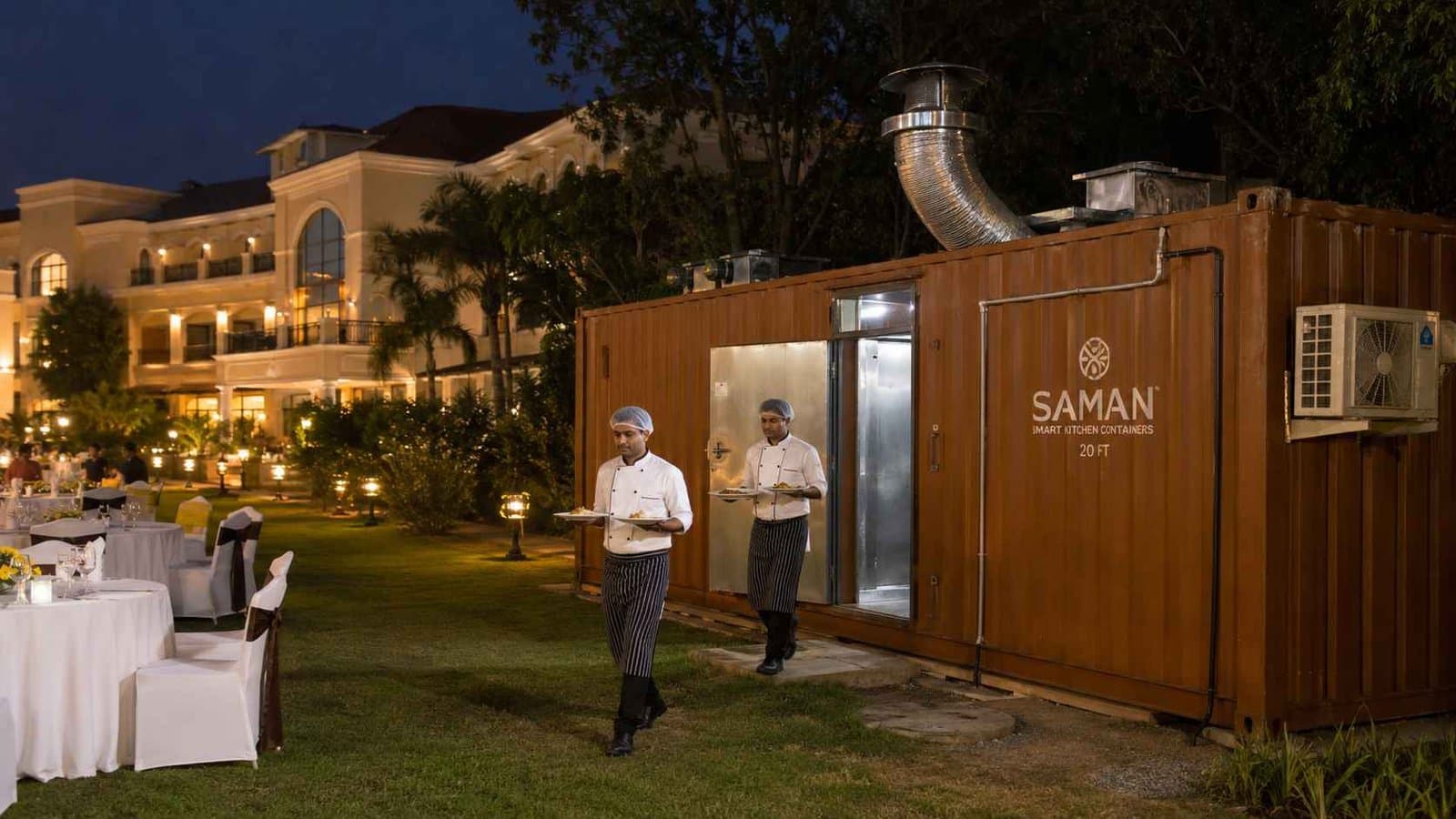
A back-of-house kitchen container serving a resort's lawn dining venue — the customer never sees the container, only the food on the table.
Five Indian Sites Where SAMAN Restaurant Food Containers Are Already Running
Deployed SAMAN kitchen container projects include sites in Whitefield, HSR Layout, and Hosur across Bangalore, plus Greater Noida and Gurugram in the Delhi NCR cluster. These are running F&B kitchens — cloud-kitchen delivery operations, central kitchens supplying multi-outlet brands, and hotel-property kitchen annexes serving venues that don't have their own back-of-house. Photographs of these deployments sit in the product gallery at the top of this page.
Manufacturing happens at two SAMAN facilities. The Gopasandra unit near Indian Oil petrol pump in Bengaluru serves South India deliveries. The Jalpura unit on Bisrakh Road in Greater Noida serves North and Central India. Pan-India delivery and crane unloading are handled from whichever facility is closer to your site — for a Bangalore cloud-kitchen plot the unit travels less than 40 km, for Pune or Hyderabad it ships out of Gopasandra, for Lucknow or Jaipur it ships out of Jalpura.
Site Prep and Delivery — From Confirmed Order to a Working Kitchen
Site prep runs in parallel with fabrication. A 150mm M20 concrete pad sized to the 20-ft footprint. Three-phase electrical supply at the site boundary, sized for commercial cooking load. Water inlet from the municipal connection, plus a 32mm drain line to a sewage point — with a grease trap at the drain outlet, since kitchen wastewater carries grease that municipal lines won't accept unfiltered. LPG bank (cylinder cluster) or pipeline gas connection at the cooking-wall side of the pad. And a fire NOC from the local municipality where local rules require one for commercial cooking.
Site prep usually clears in 5 to 10 working days. The SAMAN fabrication window of 7 to 21 working days runs alongside, so site-readiness and unit arrival rarely block each other. Crane lifts the unit off the truck, places it onto the pad, and the unit anchors at the corner lift points. Utility hookup happens after that — power feed in, gas line connected at the inlet stub, water and drain at the kitchen-wall stubs. A typical first cook-test happens 1 to 2 working days after the unit lands on site.
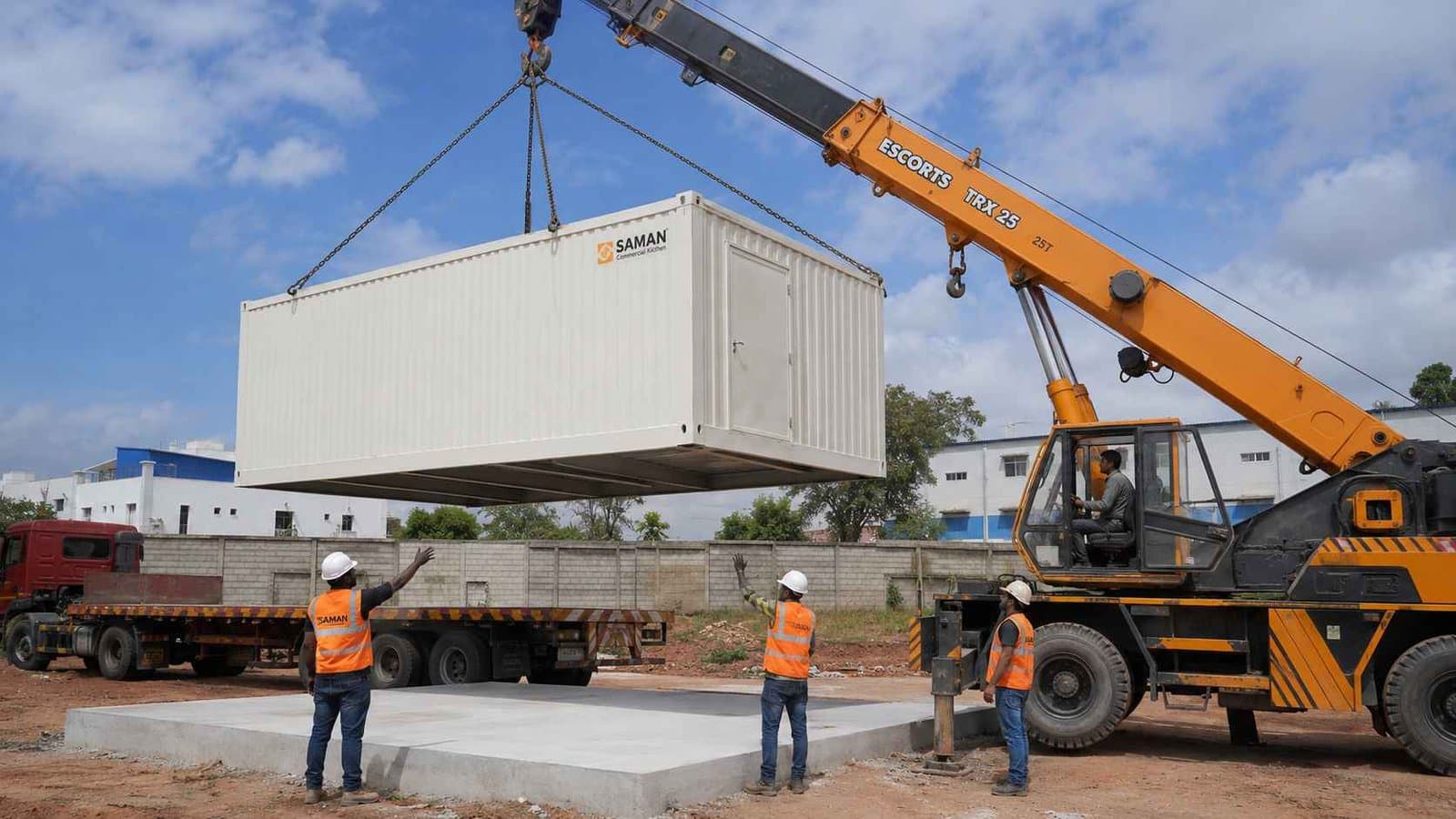
Factory-finished kitchen container crane-lifted onto a 150mm M20 concrete pad — site prep and fabrication ran in parallel.
Frequently Asked Questions
Can a cloud-kitchen operator run multiple delivery brands from a single 20-ft restaurant food container, or is 200 sq ft too small?
Multi-brand operation works inside a single 20-ft unit when the brands share equipment categories. A burger-and-momo combination shares fryers, grills, prep counters. A biryani-and-curry combination shares burners, tawa, and oven. What doesn't fit inside 200 sq ft is two brands that need separate equipment lines — for example, a tandoor-led North Indian brand alongside a pasta-led Italian brand with non-overlapping gear. For that configuration, the answer is two kitchen containers side by side or a larger build. Most ghost-kitchen operators we build for run 2 to 3 menus through one cooking line by matching cuisine pairs.
What's the difference between a food container for a restaurant and a full container restaurant — when does each one fit my business?
The split is whether customers eat inside the container or somewhere else. A restaurant food container is kitchen-only — output goes to delivery riders, a separate dining venue, or multiple outlets. The 20-ft build at ₹7,65,000 has no dining floor, no customer-facing window, no service counter. The full container restaurant build is the opposite: a 40-ft unit at ₹15,55,000 with kitchen plus dining floor for 16 to 24 covers, customer-facing wall finish, and optional in-unit restroom. If customers arrive, sit, eat, and leave inside the unit, you need the dining build. If output goes to a different address, you need the kitchen container.
Does FSSAI treat a kitchen container differently from a brick-and-mortar commercial kitchen?
No. FSSAI Manufacturing License requirements apply to the operation, not the building material. A cloud kitchen running out of a 200 sq ft container faces the same hygiene zoning, food-grade surface, exhaust direction, and operational-discipline requirements as a 2,000 sq ft brick commissary kitchen at the same turnover band. The license tier (State Form B vs Central) is set by annual turnover, not by structure type. What the container adds is a faster build — 7 to 21 working days factory-fitted vs four to six months for a brick build — at a lower capex.
Can this kitchen container be relocated later if my central-kitchen site changes, or is it fixed once installed?
It's relocatable. Every SAMAN unit has reinforced corner lift points designed for crane-lift relocation. The factory-fitted kitchen items — cooking wall, exhaust hood mount, MCB panel, sink and plumbing stubs, PUF wall and roof — stay inside the unit through transit. Owner-supplied loose equipment (commercial burners, refrigeration, racks, utensils) is removed before lift. Utility lines (LPG, water, drain, electrical) are decoupled at the site. A typical relocation window is 3 to 5 working days from crane-lift at the old site to first cook at the new one, subject to site prep at the new location.
If my operation outgrows a single 20-ft kitchen container, can I add a second unit alongside, or do I need to start over?
A second unit alongside is the standard scaling path. The most common pattern: a cloud-kitchen brand starts with one container handling one menu, runs at full throughput for 9 to 18 months, and adds a second 20-ft container for the next menu or the next brand. The two units operate independently with their own MCB panels and LPG inlets, sharing only the site's utility connections. If the scale need is bigger — three or more kitchens, an integrated commissary with separate prep and finishing zones, or a kitchen-plus-dining-plus-bar layout for a food-court concept — the multi-unit modular configuration we publish separately is engineered for that footprint instead.
Plan Your Kitchen Container Build
If you're operating a cloud kitchen and need a delivery-only production unit, we'll quote the kitchen container configured around your menu, your throughput target, and your site. If you're running a central kitchen for a multi-outlet brand, the quote covers the kitchen plus the equipment-load sizing for your distribution model. If you're adding a back-of-house kitchen behind a hotel, resort, or campus venue, the quote also covers the customisation needed to match the host venue's finish standards.
Need Custom Requirements?
Get in touch with our experts for customized solutions and bulk orders. We're here to help you find the perfect solution.