
Related Products
Explore similar items
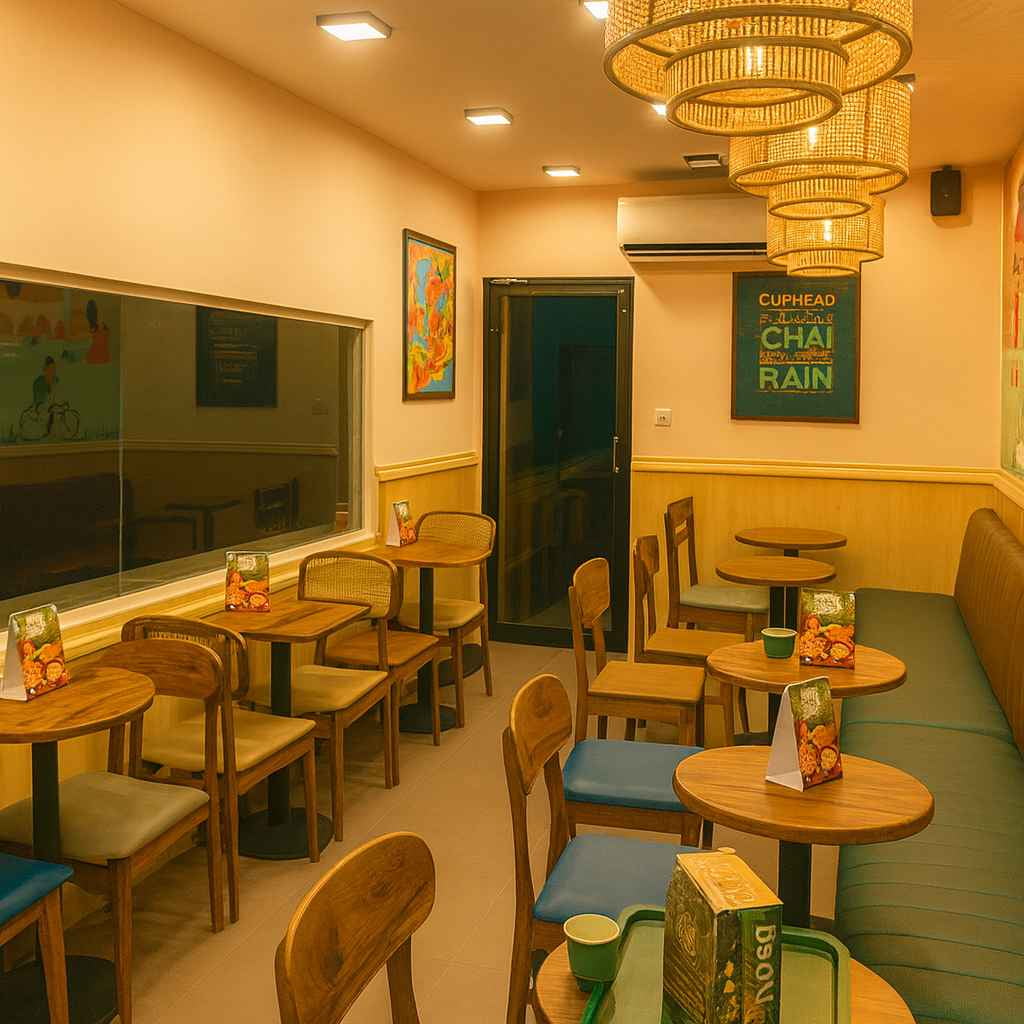
Modular Container Cafe
Inclusive of all taxes
Quantity
Product Information
Product Details
Comprehensive information about Modular Container Cafe
Product Overview
Detailed information about Modular Container Cafe
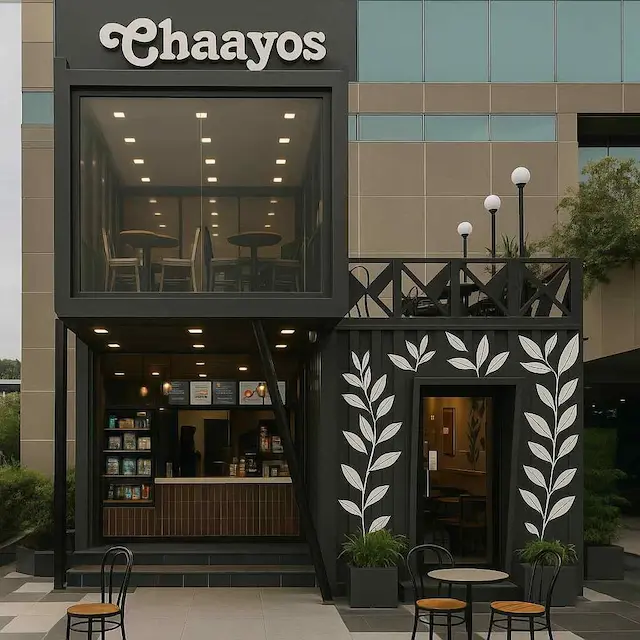
A modular container cafe is the SAMAN configuration for cafe operators who plan to grow — start with one container today, add another when the business proves out, scale to a multi-container layout when the next location calls for it. The starter system is a 25'×20' two-storey stacked unit (~1,000 sq ft total floor area) at ₹33,25,000 (currently on sale, regular ₹35,45,000) — built ready to expand, not built to be replaced.
What a Modular Container Cafe Actually Is — and Why It Beats Buying One Oversized Container
Most "modular" cafe pages on the internet are sales pages dressed up with the word. In SAMAN's system, modular means engineered for staged expansion. Each unit is fully operational on its own. Each unit is also pre-built with the electrical capacity, structural connection points, and kitchen interface ready for the next unit to join — even if you don't order it for another year.
The alternative most first-time cafe operators consider is buying one bigger container — say a 40-ft single — and trying to fit everything inside. This works until your menu grows, your seating cap binds, or you want a second location. At that point you're selling the original or living with its constraints.
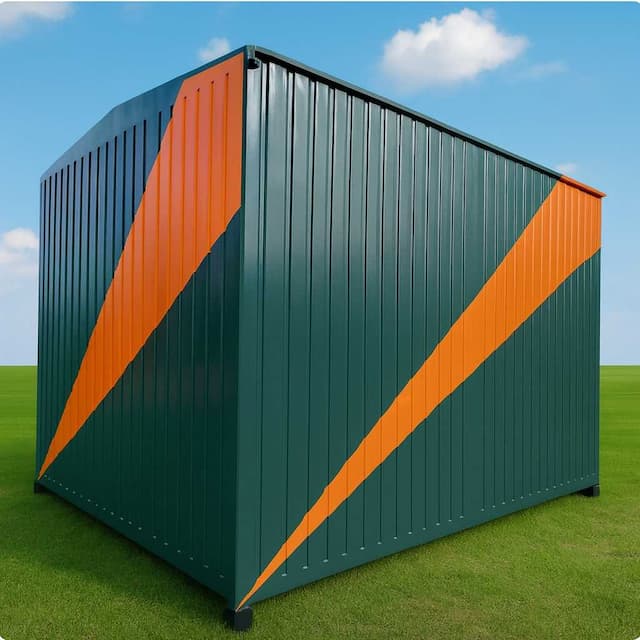
A modular container cafe avoids both. The first unit funds the second through revenue. The exterior corten finish and dimensions stay consistent across additions, so your brand identity holds. Containers stack and connect in ways brick-and-mortar buildings simply can't match. That's why a multi-container cafe makes sense for any operator with growth plans — and why an expandable container cafe is structurally a different product than a single fixed-size cafe.
Three Modular Configurations We Build
Three configurations cover the vast majority of modular cafe projects. Each starts from the same engineered base — what changes is how units relate to each other in space.
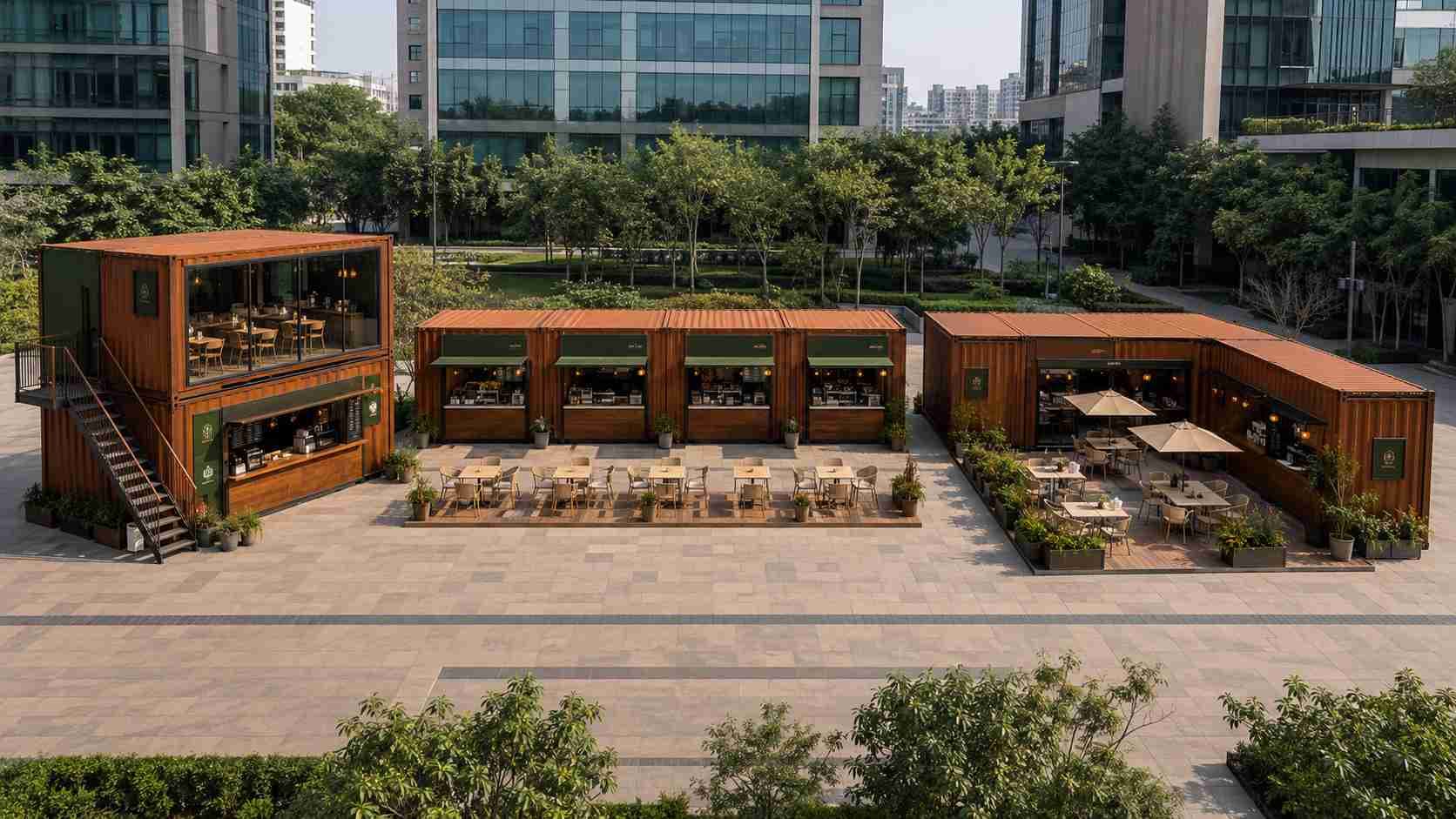
Three modular container cafe configurations SAMAN builds — left to right: two-storey stacked starter, side-by-side multi-unit container food court cluster, and L-shape courtyard arrangement. Each shares the same engineered base, differs in how units relate in space.
Two-Storey Stacked (25×20 footprint × 20 ft tall, ~1,000 sq ft)
This is the live starter system at ₹33,25,000 (sale) / ₹35,45,000 (regular). One container on the ground, one stacked above it, joined with a sealed structural floor between. Around 500 sq ft per level, ~1,000 sq ft total. External staircase to the upper level included. Service dumbwaiter or compact internal stair available as upgrades.
Right when: ground footprint is tight (urban high-street, mall plot, rooftop terrace), or you want the kitchen on one level and dining on the other for natural separation. The 20-ft total height stays within ground-clearance limits for most municipal zoning.
Side-by-Side Multi-Unit Cluster (the container food court approach)
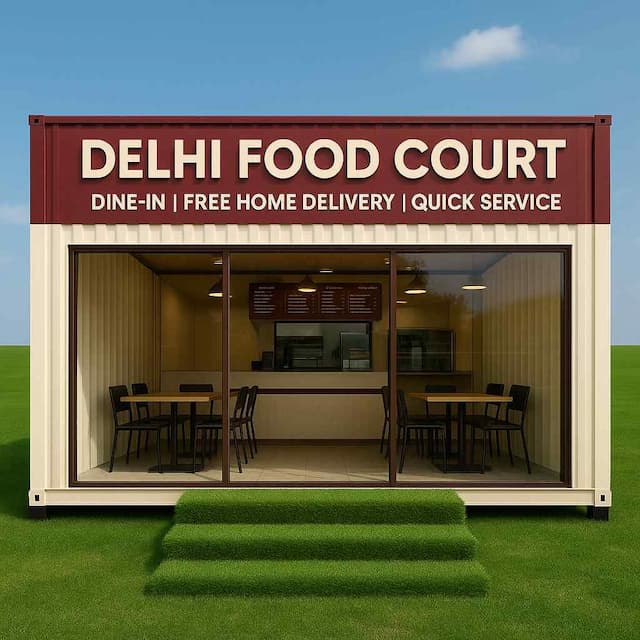
Three, four, or six units joined in a row or shallow arc. Each unit can run as a separate F&B zone with its own brand — that's the container food court model — or all units can serve one larger operation with dedicated kitchen, prep, and dining zones.
Right when: a food court concept (multiple cuisines, shared seating), a large single venue (multi-zone restaurant with a kitchen unit, dining unit, and bar unit), or a campus or college F&B installation.
Pricing for 3+ unit configurations is project-based. Typical 4-unit clusters fall in the ₹65–95 lakh range depending on kitchen complexity and exterior finish; 6-unit food courts go higher.
L-Shape or Courtyard Multi-Unit
Three or four units arranged around an open inner courtyard. The containers form the perimeter — kitchen, service counter, restroom block, and bar — while outdoor seating sits in the protected centre.
Right when: a resort property, large campus, or destination F&B space where the outdoor dining is the experience. Works particularly well in cities with year-round outdoor weather.
How the Kitchen Splits Across Two Connected Units
The single most-asked question from buyers considering modular: how does the kitchen actually work when you've split it across two units?
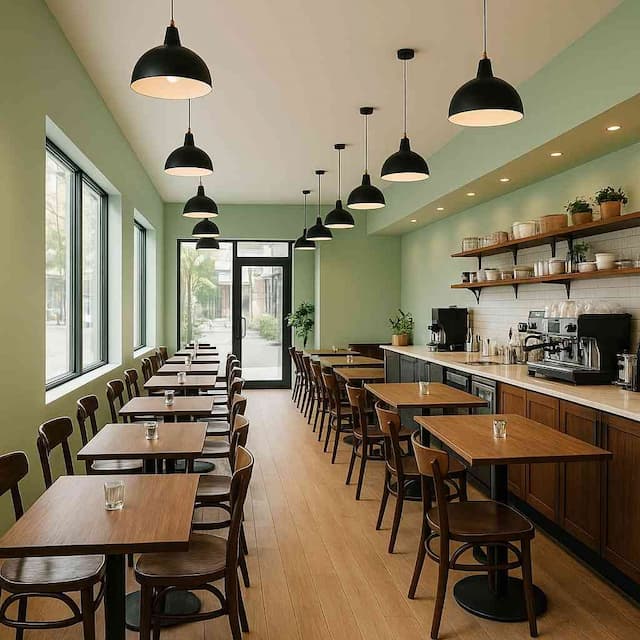
The standard SAMAN layout puts the kitchen entirely in one unit and the dining entirely in the other. The two units share an insulated dividing wall — 100mm PUF panel for sound and heat isolation — with a double-action service window cut through the centre. Plates pass from kitchen to dining through that window; staff don't cross zones.

The standard SAMAN modular container cafe layout: kitchen entirely in one unit, dining entirely in the other, connected through a 100mm PUF insulated dividing wall with a central service window.
Why this beats stuffing kitchen and dining into a single oversized container:
- FSSAI airflow direction is automatic. The clean-to-contaminated zone separation that FSSAI inspectors look for happens at the sealed wall — no special ventilation routing needed inside one unit.
- The dining unit gets natural light through windows on three exterior walls without kitchen heat or cooking smell migrating into the dining experience.
- HVAC zoning works properly. Dining AC doesn't fight kitchen exhaust extraction.
- Sanitation isolation is built in. Cleaning the kitchen unit doesn't disrupt the dining unit, and vice versa.
For the full kitchen specification — exhaust hood sizing, food-grade stainless steel surfaces, LPG inlet, FSSAI airflow direction requirements, and the commercial electrical layout — see our container cafe page, which documents the kitchen build in detail. The same kitchen specification applies to the kitchen unit in any modular configuration we build.
What's Engineered Into Unit 1 to Let You Add Unit 2 Later
"Expand later" only works if Unit 1 was built ready. SAMAN engineers six features into every starter modular unit, regardless of whether the customer orders Unit 2 today or a year from now.

Every SAMAN modular container cafe starter unit ships with six engineered features that make adding the next unit a connection task, not a rebuild.
- Electrical panel sized for 2× load. The MCB panel installed in Unit 1 carries spare 3-phase capacity for Unit 2's appliances and lighting. Spare breakers are mounted and labelled but unwired — when Unit 2 arrives, the electrical extension is a one-day commissioning job, not a panel rebuild.
- Pre-welded structural connection plates. The right-hand exterior wall (for side-by-side) or top frame (for stacked) carries factory-welded connection plates. When Unit 2 ships, alignment and bolting to Unit 1 takes hours, not days.
- Kitchen exhaust hood capacity rated for expansion. If you indicate Unit 2 is likely during the order conversation, we oversize the hood and duct work at Unit 1's factory build. Adding kitchen capacity later doesn't mean rebuilding the exhaust.
- Insulation interface ready for wall removal. The PUF wall panel on the connection face is fitted in a pattern that allows a clean cut when Unit 2 arrives — the opening becomes a finished door or service window without dismantling the insulation envelope.
- Foundation prep recommendation documented. Every starter ships with a load-bearing diagram showing the additional 25 ft of ground prep needed for a future side-by-side unit, or the 150mm M20 concrete pad spec for an eventual stack.
- Service window framing pre-cut and blanked off. The hole for the kitchen-dining pass-through is cut at the factory and covered with a removable insulated blank panel. When Unit 2 is installed, we remove the blank, install the window, and the pass-through is operational in a day.
This is what container cafe expansion looks like when the system is designed for it from the start — not retrofitted after the fact.
Phased Build-Out — From Unit 1 to a Container Food Court
The phased timeline works like this:
Month 0 — Unit 1 ships and installs. Standard SAMAN fabrication timeline runs 15 working days from order confirmation, with installation taking one day at your site. By the end of month 1 you're operational with one unit.
Month 9 to 12+ — Unit 2 added. Once you've proven the location and the cash flow, Unit 2 is fabricated in about 10 working days — faster than Unit 1 because the kitchen build-out and pre-fitting are simpler (you already have a kitchen unit, this one is typically dining). Installation takes 2 days at your site: one for placement and bolting, one for electrical commissioning and pass-through completion. You're not closed during the install — only the connection wall is offline for those two days.
Month 18+ — Unit 3 added for a container food court. Same 10–12 working day fabrication; site install takes 2 days. By this stage you've built a three-unit operation, possibly running multiple F&B brands under one roof, with phased capex spread across 18+ months instead of committed upfront.
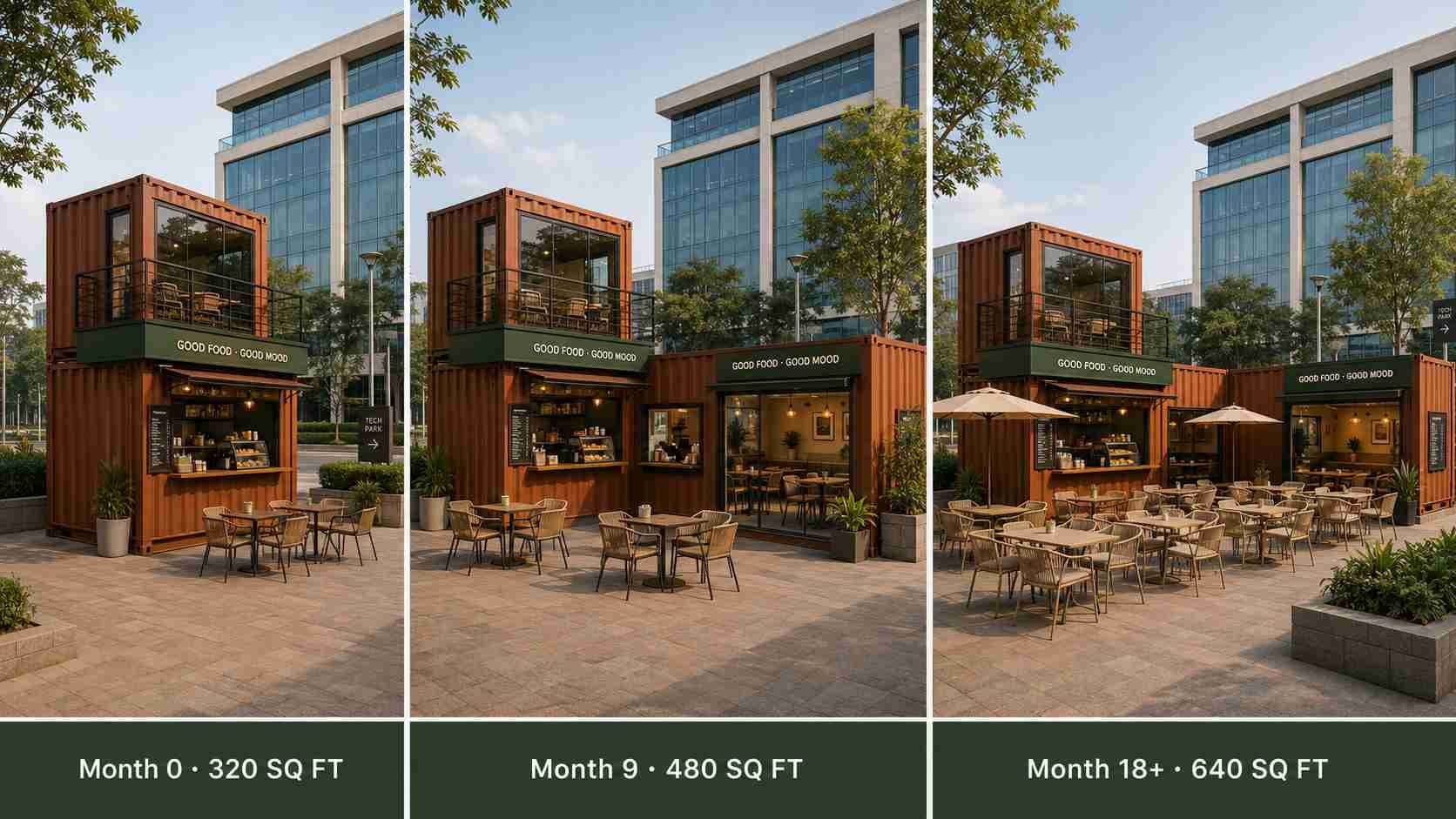
A SAMAN modular container cafe expanded in three phases — Unit 1 operational at month 0, Unit 2 added at month 9, Unit 3 added at month 18+ to form a container food court. The site, the brand, and the corten exterior stay consistent across phases.
A working illustration (actual numbers come back at quote stage):
- Phase 1 (one unit operational): roughly ₹15–25 lakh range depending on kitchen complexity
- Phase 2 (joined two-unit, kitchen-dining split): ~₹33–40 lakh range total
- Phase 3 (3-unit container food court): from ~₹65 lakh, project-quoted
Phase 1 generates revenue that funds Phase 2. By the time Phase 3 capex is needed, two units of customer base and brand equity are already paying for it. That's the financial difference between modular cafe expansion and committing six months of restaurant lease deposit on day one.
For operators whose first instinct is actually a compact single-format coffee setup without phasing, or the full restaurant configuration without the multi-unit angle, those dedicated SAMAN configurations cover those cases more directly.
When to Pick Modular over a Single Container
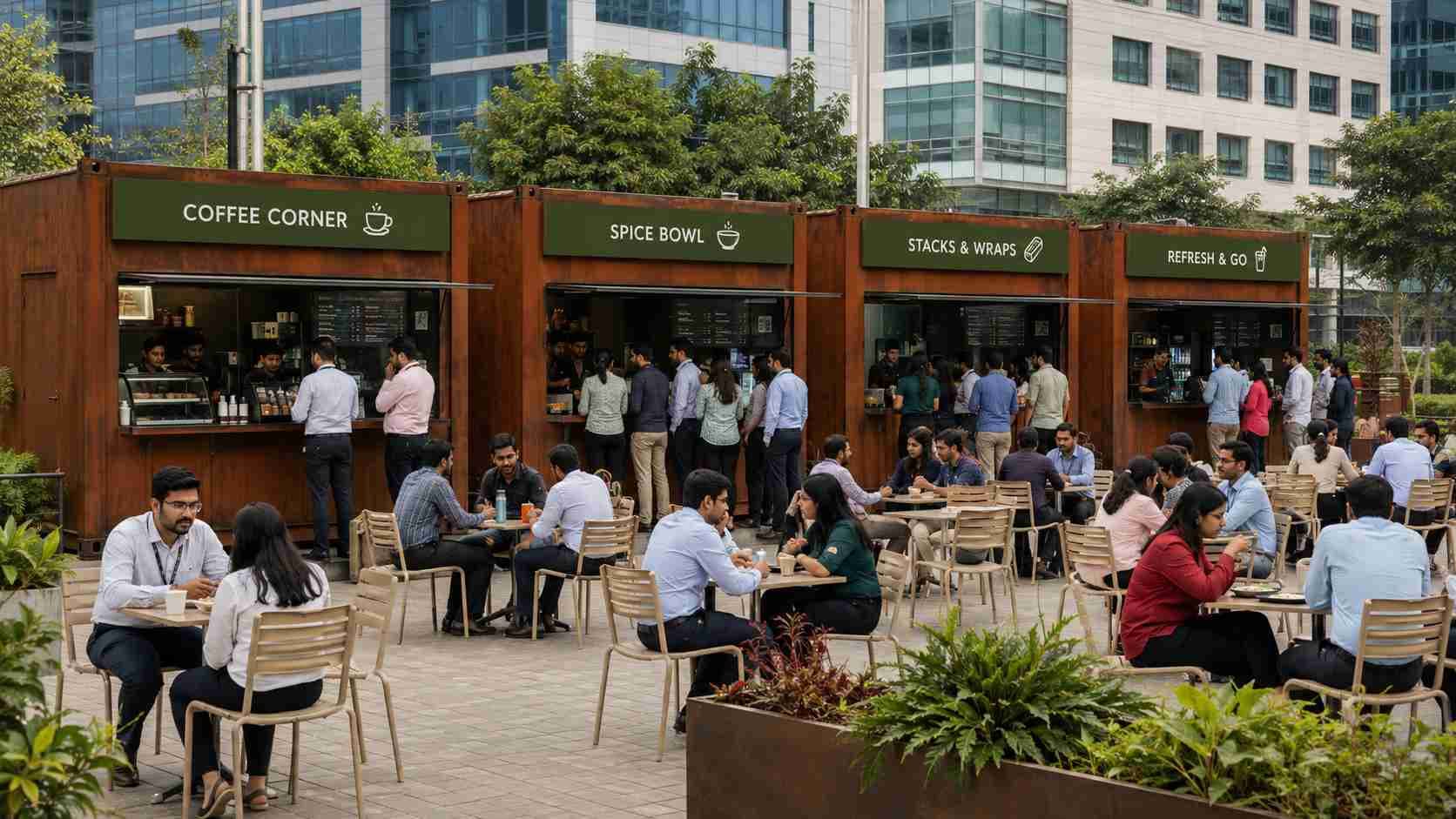
A fully-operational four-unit modular container cafe arranged as a container food court — the side-by-side multi-unit configuration in active commercial use during the lunch peak.
A modular container cafe is not the right pick for every cafe operator. If your concept is fixed and your location is settled, a single-container format may serve you better. The quick decision matrix:
| Pick a single-container format if… | Pick modular if… |
|---|---|
| Fixed location, fixed concept, no expansion plan | Brand has multi-location aspirations or you're testing a concept |
| Single-product or compact menu (coffee window, juice bar) | Multi-cuisine, food-court vision, or kitchen-plus-dining split needed |
| You want the iconic visible single-container silhouette | You need >500 sq ft to start, or want two-storey footprint efficiency |
| Budget is ₹8.5L–₹28.5L for the first unit | Budget allows ₹33L+ starter and phased addition |
| One-time investment, no further capex planned | Want capex spread across 12–24 months |
For buyers who fall into the single-container side of that matrix, the size-and-cost decision page for single-container formats walks through the 20-ft, 40-ft, and 25×20 single-storey options at the lower price points.
Modular Container Cafe Pricing — Starter to Multi-Unit
The starter modular system at ₹33,25,000 (currently on sale, regular ₹35,45,000) is the 25'×20' two-storey stacked configuration — both ground and upper units, factory-fitted, with the joining engineering, insulated dividing wall, service window framing, external staircase, kitchen fit-out (food-grade surfaces, exhaust position, LPG inlet, MCB panel), electrical panel sized for future expansion, and exterior finish ready for branding application.
What that price does not include: kitchen equipment (commercial burners, refrigeration, coffee machines), furniture and seating, signage, and FSSAI registration. These are owner-supplied per your specific F&B concept because they're either menu-specific (cooking equipment) or business-specific (brand name, FSSAI license holder).
For modular cafe expansion beyond the starter:
- Unit 3 added later is project-quoted, typically at a lower per-square-foot rate than the starter because Unit 1's electrical, foundation, and structural prep are already done. You're paying for the new unit's fabric, fit-out, and installation — not for re-engineering the system.
- A 4-unit container food court (typical: kitchen + service + dining + back-of-house) usually falls in the ₹65–95 lakh range depending on kitchen complexity and finish level.
- A 6-unit configuration (full food court with multiple F&B brands under one roof) is fully project-quoted, with itemised pricing per unit.
Get a project quote today by sharing your concept, your starting unit count, and your growth plan. We respond within 24–48 hours with a layout drawing, kitchen specification, phased timeline, and itemised price.
Frequently Asked Questions
How does the kitchen split work when I have two connected units?
The kitchen sits entirely in one unit; dining sits entirely in the other. The two units share a 100mm insulated PUF dividing wall with a double-action service window cut through the centre — plates pass from kitchen to dining through that window without staff crossing zones. This layout makes FSSAI airflow direction automatic (clean-to-contaminated zone separation happens at the sealed wall), keeps kitchen heat and cooking smell out of the dining experience, and lets each unit have its own HVAC settings. The underlying kitchen specification — exhaust sizing, food-grade surfaces, LPG inlet — uses the same standard as any SAMAN cafe build.
Can I expand from a two-unit cafe to a three-unit food court a year later — and what changes for FSSAI, structure, and operations during the addition?
Yes — this is the core use case for modular. Adding a third unit a year later takes about 10–12 working days for factory fabrication plus 2 days of on-site installation. The existing two-unit FSSAI license can be amended to cover the additional contiguous footprint (you file an amendment, not a fresh application). Structurally, no changes to the existing two units are required if Unit 1 was built to the expansion-ready spec — the connection plates and electrical capacity for Unit 3 are already in place. Operationally, you're only closed during the wall-cut and connection day; the rest of the install happens with both existing units running.
Do I need separate FSSAI applications for each unit, or one for the whole modular cafe?
One FSSAI State License (Form B) covers the full modular cafe footprint as a single fixed food establishment, provided the units are physically connected and operate as one business with one entity name. If you're running each unit as a separate F&B brand under different business entities — a true multi-brand container food court — each entity files its own FSSAI application for its allotted unit. The structural arrangement of containers is irrelevant to FSSAI; what matters is who is operating which kitchen under which licensee name.
How much ground space do I need for a 2-unit modular cafe versus a 4-unit configuration, including service circulation and outdoor seating?
For the 25×20 two-storey stacked starter, the building footprint is 500 sq ft, but plan on 800–1,000 sq ft of total site space including the external staircase landing, service approach, and basic outdoor seating. For a 4-unit side-by-side cluster, the building footprint is around 1,000 sq ft and total site space should be 1,500–2,000 sq ft including service circulation between units, a customer queue or seating area, and waste/utility access from the rear. For an L-shape or courtyard arrangement, add 300–500 sq ft for the inner outdoor dining area.
What's different about a stacked two-storey cafe versus two cafes joined side-by-side — load, foundation, customer flow?
The stacked configuration concentrates floor area on a smaller footprint — 1,000 sq ft of cafe on 500 sq ft of ground — which suits tight plots and rooftop installations. It requires a reinforced 150mm M20 concrete pad foundation across the full footprint, structural interconnection between levels (we handle this during erection), and an external staircase for customer flow between floors. The side-by-side configuration spreads the same 1,000 sq ft across 1,000 sq ft of ground, requires the same foundation as two single units (no pad upgrade), no staircase, and gives customers single-floor circulation through both units. Stacked is the right pick when ground is limited or premium; side-by-side is the right pick when ground is available and you want all dining on one level.
Ready to Plan Your Modular Cafe System?
Tell us your starting concept and your growth plan — whether that's a single two-storey starter today with a Unit 3 in mind for next year, or a 4-unit container food court delivered as one project. We come back within 24–48 hours with a layout drawing, kitchen specification, phased timeline, and itemised quote.
Manufactured at SAMAN's Bangalore and Greater Noida facilities. Delivered and installed Pan India.
Call or WhatsApp: +91 97089 89937
Customer Reviews
0 reviews
No reviews yet. Be the first to review this product.
Write a Review for Modular Container Cafe
Need Custom Requirements?
Get in touch with our experts for customized solutions and bulk orders. We're here to help you find the perfect solution.