
Related Products
Explore similar items

Mobile Container Cafe
Inclusive of all taxes
Product Information
Product Details
Comprehensive information about Mobile Container Cafe
Product Overview
Detailed information about Mobile Container Cafe
A mobile container cafe is a compact factory-built cafe unit engineered to be picked up by crane, loaded onto a truck, and re-installed at a new site — without rebuilding the kitchen, the counter, or the customer window. The SAMAN unit measures 10×10×8 ft (about 100 sq ft of cafe floor), starts at ₹2,35,000, and is meant for operators who plan to move their cafe between 2–4 sites over the next few years — market rotations, leased plots with short tenure, event-circuit deployments lasting months not weekends, or a single brand expanding to a second or third location using the same unit.
It is not a food truck. There are no wheels and no driving axle — relocation is by crane and truck, not by ignition key. It is also not a weekend pop-up. The build is FSSAI fixed-establishment grade, designed for months of continuous operation at each site, not 48-hour events.
How a Mobile Container Cafe Actually Moves Between Sites
Most "mobile" cafe pages stop at the word mobile. Here is what the move actually looks like for a SAMAN unit.
The lift points
Every SAMAN mobile container cafe is built around a reinforced base frame with corner lift points — welded to the main column-to-base joint, not bolted to the cladding. A hydraulic crane sized for the unit's loaded weight hooks onto the lift points with rated slings. The lift is single-pick: no separate dismantling of the cafe body itself.
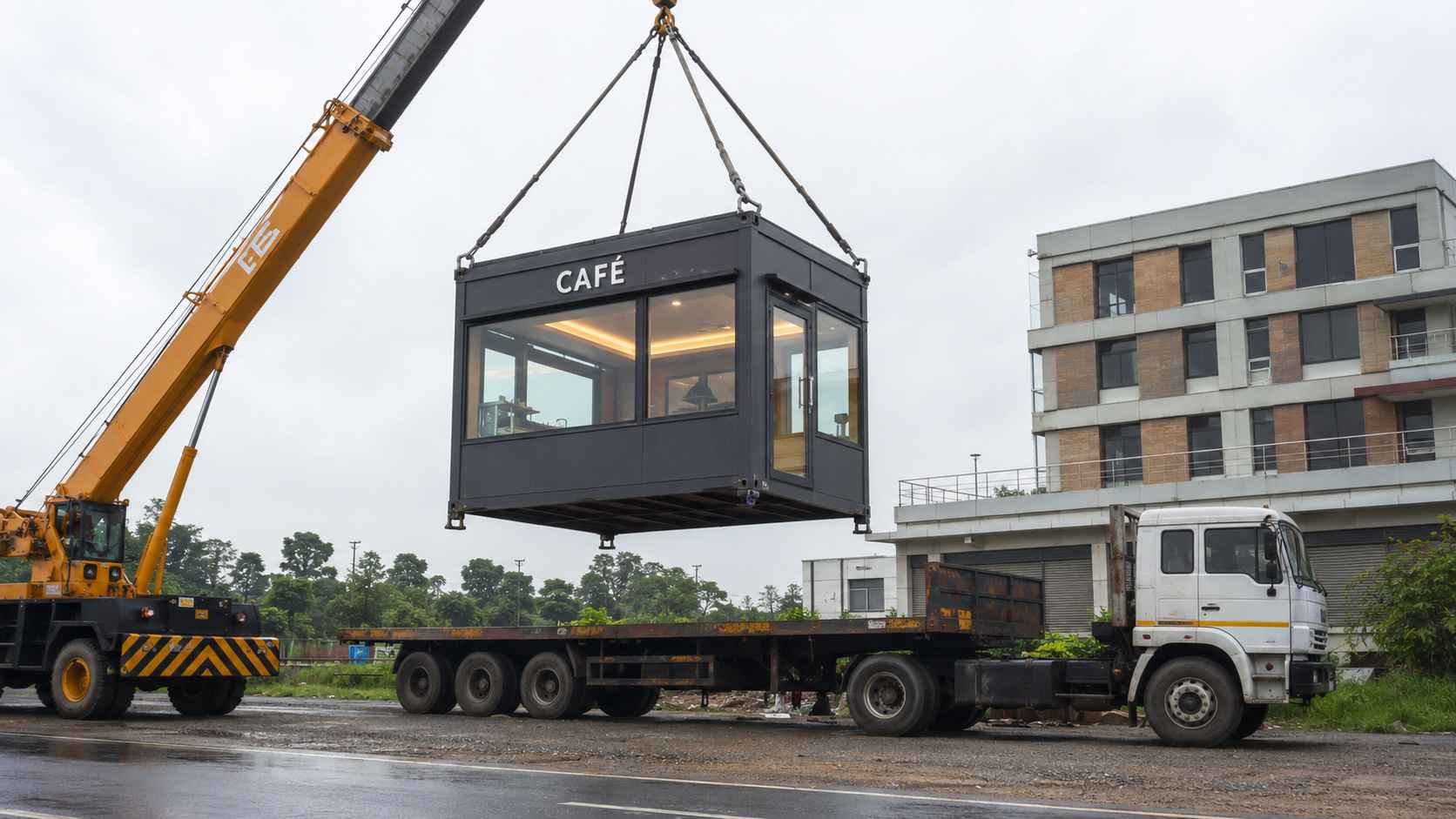
Single-pick crane lift — the four reinforced corner lift points carry the loaded unit straight onto a flatbed truck.
Day 1 — old site decommission
LPG line is closed and capped. Electrical mains are disconnected and the panel is locked. Loose kitchen equipment (commercial burner, refrigeration, coffee machine) and furniture are removed by the operator. The plumbing flexi-line is uncoupled at the inlet. Signage on removable rails comes off. The unit itself — kitchen wall fittings, exhaust hood, counter, MCB panel, food-grade surfaces — stays inside, anchored to the structure. The crane lifts, lowers onto a flatbed truck, and straps for transit.
Day 2 to 3 — new site arrival
Truck arrives, crane unloads onto the prepared ground (a level area; no concrete pad needed for the standard 10×10 unit). Plumbing and LPG are reconnected to the new site's utility points. The MCB panel is wired to the new electrical supply. Signage is re-mounted. A short FSSAI re-inspection completes paperwork. The cafe re-opens.
What survives, what doesn't
The kitchen wall, exhaust ducting, electrical conduit, food-grade lining, sink mounting, and PUF insulation envelope all stay fitted through transit. What needs re-fitting at the new site: LPG inlet seal, water inlet/outlet connections, signage rails, and any outdoor seating or deck that was site-specific. Typical re-deployment window: 3 to 5 working days from crane-lift to first customer, subject to site preparation and utility readiness at the new location.
Inside the 10×10×8 ft Unit — What Fits, What Doesn't
A 100 sq ft cafe floor sounds small until you walk into one. The standard SAMAN layout uses one long wall as the kitchen — exhaust hood position, LPG inlet, food-grade stainless steel lining, sink mounting, and the commercial-rated MCB panel are all factory-fitted along that wall before dispatch. The opposite wall has the customer-facing service window with a roll-up shutter and a counter at standing height. The remaining floor area carries the operator's prep workspace.
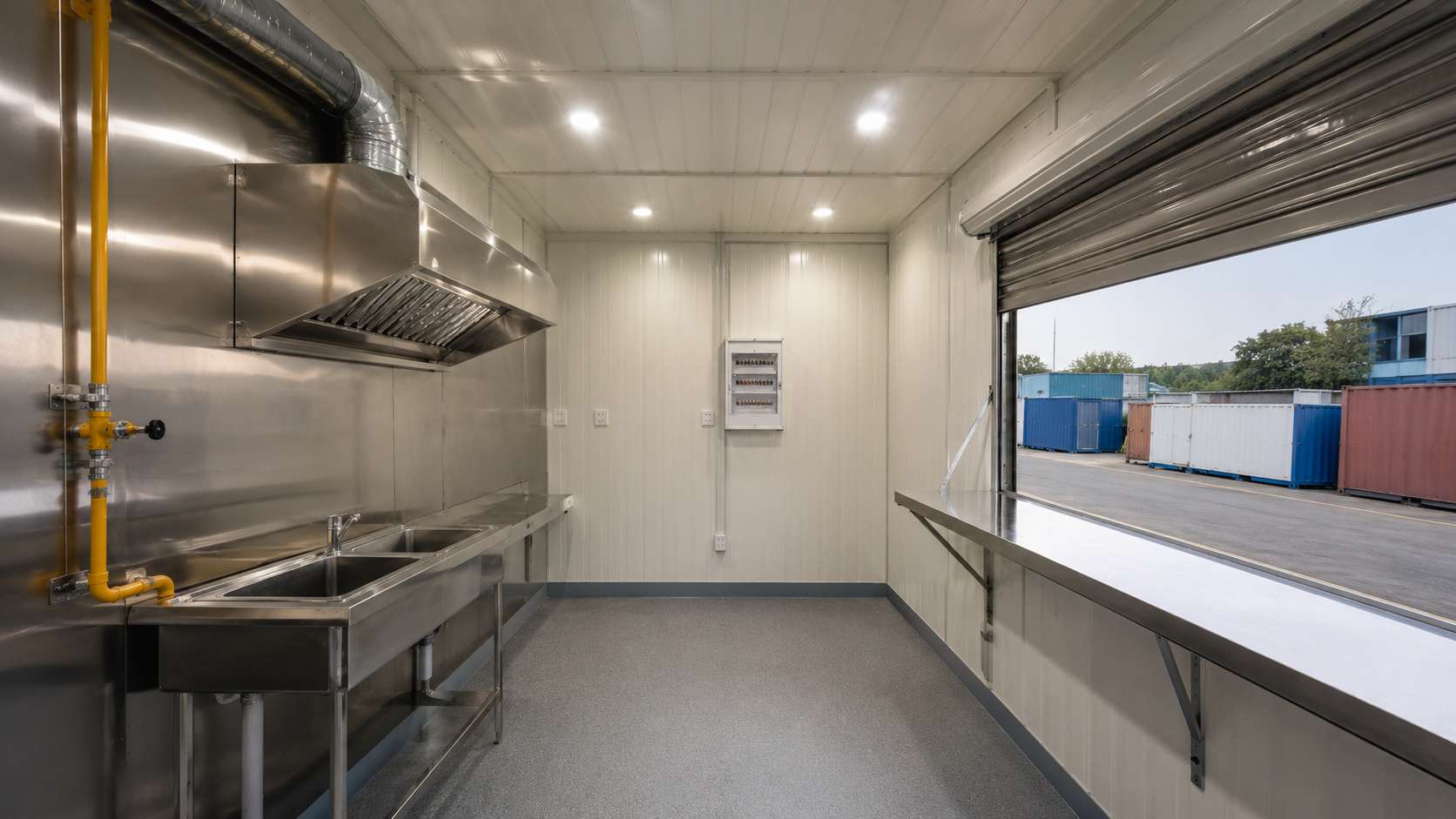
Inside the 10×10×8 ft body — kitchen wall and service-window counter, factory-fitted before the unit leaves the facility.
The unit serves a walk-up cafe model — coffee, tea, single-product brands, beverages, juice, dessert, vada pav, sandwich, breakfast counter. Standing customer service through the window scales to 30–60 customers per hour during normal traffic, higher in event-density locations. Dine-in seating does not fit inside; budget 100–250 sq ft of outdoor deck or table space alongside the unit if your concept needs covers.
If your cafe needs an internal seating area, a separate kitchen-and-dining split, or more than one F&B brand under one roof, the larger multi-unit cafe builds we make — joined side-by-side or stacked two-storey are the right starting point instead.
Mobile Container Cafe vs Mobile Cafe vs Food Truck Container — Which Mobility Format Fits You?
Three SAMAN configurations cover three different definitions of "mobile." Pick by your move pattern, not by the marketing word.
| Configuration | Mobility type | Typical move frequency | Starting price | Best for |
|---|---|---|---|---|
| Mobile Container Cafe (this page) | Crane-lift + truck — relocated to a new fixed site | Every 12–36 months | ₹2,35,000 | Land-lease rotations, brand expansion, market-site test runs |
| Mobile Cafe | Same compact format, but the business model itself revolves around moving | Variable — depends on the operator's circuit | Similar range | Operators whose business plan is mobility — the unit serves the plan |
| Food Truck Container | Trailer-mounted with wheels — drivable between locations | Daily or weekly | Higher (chassis + road-licensable build) | Daily-mobile food vending, ITP venues, drivable circuits |
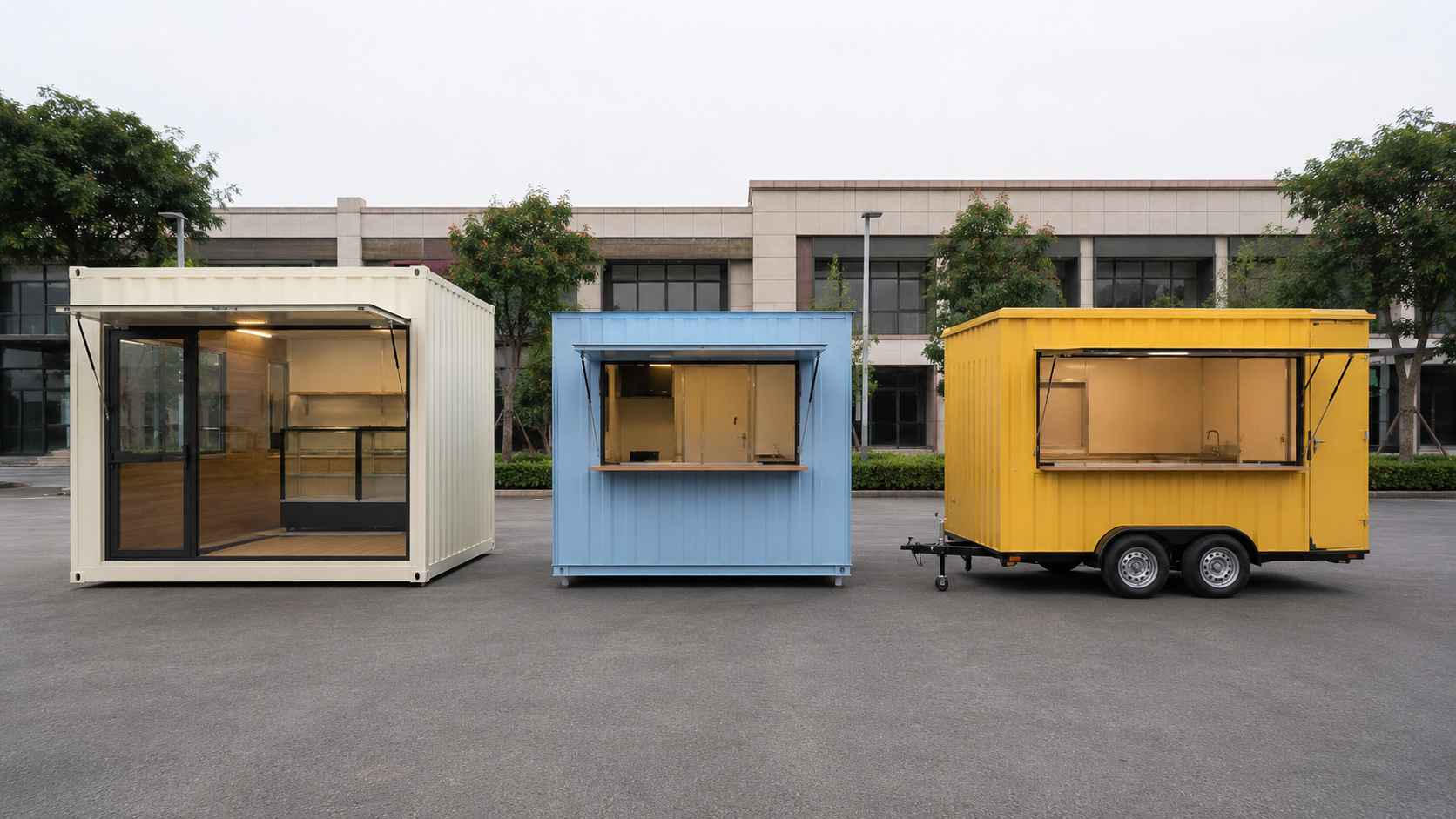
Three SAMAN mobility formats — crane-lift, business-model mobile, and trailer-mounted — each engineered for a different move pattern.
Pick a mobile container cafe if your cafe stays in one place for months at a time and then moves to a new site. Pick a mobile cafe business model where mobility is the core of how you run day-to-day. Pick a food truck container with trailer wheels if you need to drive between locations on a daily or weekly schedule.
What Drives Mobile Container Cafe Price — Starting ₹2,35,000
The ₹2,35,000 starting price (currently on sale; regular ₹2,55,000) is the 10×10×8 ft factory-fitted unit. It includes the IS 2062 Grade A steel frame, 50mm PUF wall and roof panels, food-grade stainless steel lining on the cooking wall, LPG inlet provision, MCB panel, exhaust hood opening, customer service window with roll-up shutter, factory paint finish, and reinforced corner lift points for the single-pick relocation method.
Price moves up with: custom branding paint, premium exterior cladding (corten-look corrugated steel instead of standard GI), interior LED lighting upgrades, a vinyl floor instead of standard cement particle board, premium counter material, or a second customer window cut on the opposite wall. Kitchen equipment, furniture, signage, and FSSAI registration are owner-supplied.
Re-deployment cost on subsequent moves is a one-time logistics expense per move — quoted based on origin, destination, route, and crane availability. This is paid at the time of the move, not built into the unit price.
Build Spec & Re-Deployment Lifecycle
Frame: IS 2062 Grade A mild steel, 1.2–2.0 mm thickness, with reinforced corner posts where the lift points connect to the base. Walls and roof: 50mm PUF sandwich panels with 0.50 mm PPGI steel skin both sides. Surface treatment: blast-cleaned, zinc phosphate primer, polyurethane topcoat. Floor: cement particle board with optional vinyl finish.
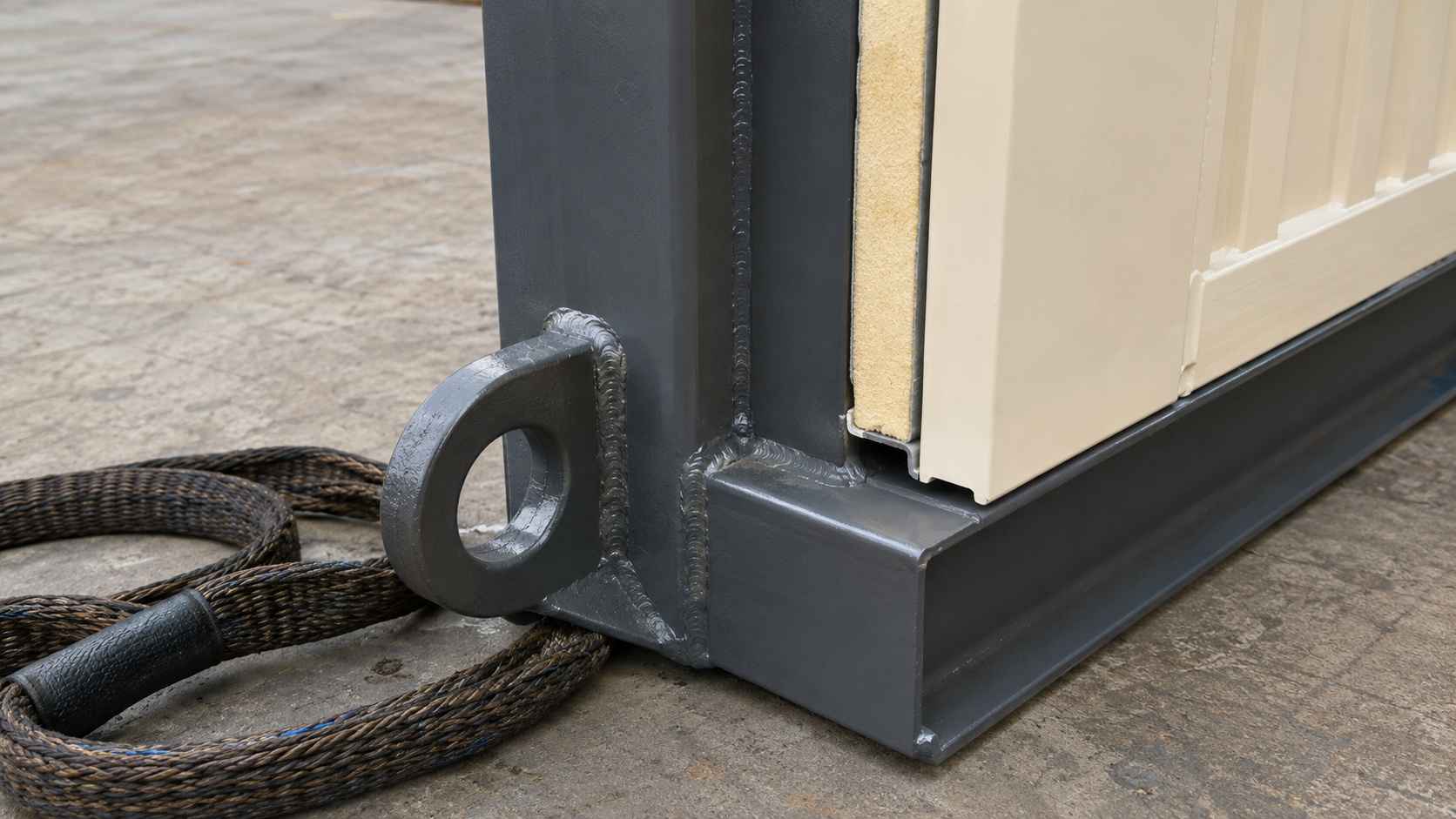
Corner lift point detail — the welded steel eye carries the unit's loaded weight on every relocation.
The unit carries a 12-month structural warranty on the new fabrication. With routine maintenance — bolt checks before every relocation, surface paint touch-up after each move, re-sealing of utility entry points — the structure has a 20-to-25-year service life and is engineered for multiple site re-deployments across that lifespan. Every build passes through 52 internal quality checkpoints before dispatch from our Bangalore or Greater Noida facility.
SAMAN Mobile Container Cafes Operating Across Bangalore and Delhi NCR
Active SAMAN mobile container cafe deployments include Brew Bliss at Hebbal, Spice Hub on Sarjapur Road, and Aroma in Whitefield — all in Bangalore — along with Bombay Style Vada Pav in Gurgaon and the Delhi Food Court installation in Dwarka, both in the Delhi NCR cluster. Manufactured at our Gopasandra (Bangalore) and Jalpura (Greater Noida) facilities; delivery and installation handled across South India from Bangalore and across North and Central India from Greater Noida.
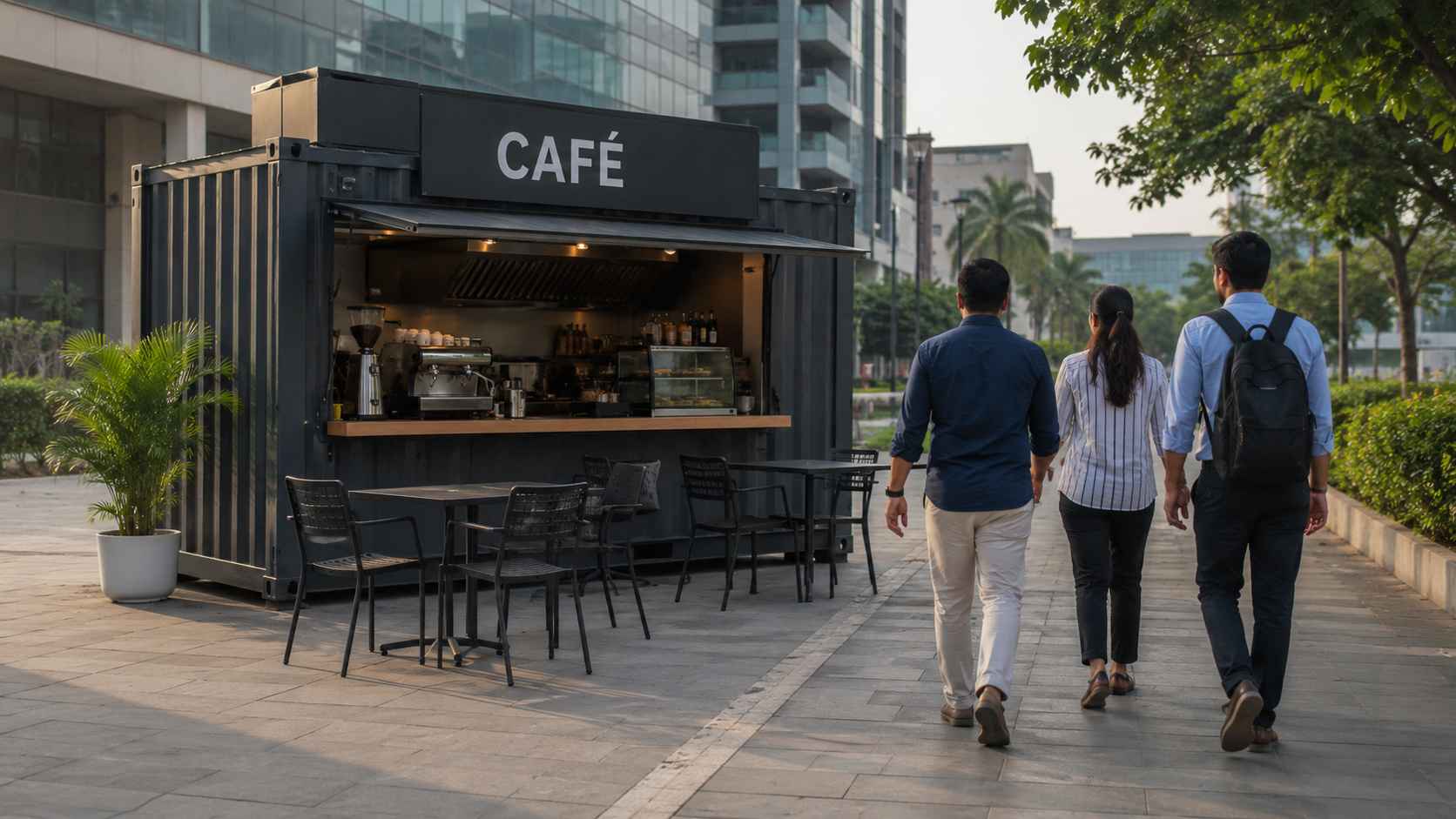
A relocatable cafe body installed and operational on a commercial-corridor forecourt — the working state of every SAMAN deployment.
Frequently Asked Questions
How many times can the same mobile container cafe unit actually be relocated?
The structure is engineered for multiple site re-deployments across its 20-to-25-year service life. The two practical limits are not structural — they are the lift points (inspected and re-certified at every move) and the utility entry seals (re-sealed at every new-site connection). Operators we have built for typically move 2–4 times within the first 7 years.
What does it cost to move a mobile container cafe to a new site after the first installation?
Re-deployment is a one-time logistics expense per move, paid at the time of relocation — not built into the cafe purchase price. The cost covers crane hire, flatbed truck, escort vehicle on highways where required, and on-site re-installation labour. Within-state moves run lower; long-haul inter-state moves push higher. We quote each move based on origin, destination, and route.
What kind of vehicle and equipment is needed to relocate a mobile container cafe?
A hydraulic crane (or hydra) sized for the loaded unit weight at both ends, and a flatbed truck for transit. The crane hooks onto the corner lift points with rated slings. No specialised low-bed trailer is needed for the standard 10×10×8 ft unit — its loaded height stays within standard road-transit limits.
When I move my mobile container cafe to a new city, do I need a fresh FSSAI license?
You file an amendment to your existing FSSAI State License showing the new premise address, not a fresh application. The licensing entity (you or your business) does not change; only the operating address does. The new location will get its own short FSSAI inspection covering the kitchen at the new site. Plan for 7–15 working days for the amendment to clear before re-opening.
Is a mobile container cafe a better fit than a food truck for someone who plans to relocate once every 12–18 months?
Yes — for the 12-to-18-month relocation interval, a mobile container cafe is the cleaner choice. Food trucks carry trailer chassis, road licensing, axle maintenance, and fuel costs that you pay continuously even when parked. A mobile container cafe carries no road-going cost between moves and gives you a fixed-establishment FSSAI license that is recognised the same as any restaurant. If you actually drive between locations weekly, the trailer-mounted food-truck container build is the right pick instead.
Ready to Plan Your Mobile Container Cafe?
For the complete cluster overview, see the full container cafe range. Share your starting site, the expected first move horizon, and any brand finish requirements. We respond within 24–48 hours with a layout drawing, an itemised quote, and a delivery and lift schedule. Standard fabrication runs 7–21 working days from confirmed order at our Bangalore or Greater Noida facility.
Call or WhatsApp: +91 97089 89937 (Greater Noida) · +91 80886 85440 (Bangalore)
Customer Reviews
0 reviews
No reviews yet. Be the first to review this product.
Write a Review for Mobile Container Cafe





Need Custom Requirements?
Get in touch with our experts for customized solutions and bulk orders. We're here to help you find the perfect solution.