
Related Products
Explore similar items

Food Truck Container
Inclusive of all taxes
Product Information
Product Details
Comprehensive information about Food Truck Container
Product Overview
Detailed information about Food Truck Container
A food truck container is a 15×8×9 ft container kitchen built onto a road-licensable trailer chassis — towed between vending pitches by the operator's own vehicle on their own daily or weekly route, not lifted by crane like a relocate-occasionally cafe build. The SAMAN unit starts at ₹4,55,000 on sale (regular ₹4,95,000).
What a Food Truck Container Is — and What It Isn't (vs Vehicle-Mount Food Trucks, Cafe Bodies, and Crane-Lift Builds)
Three things separate this build from the four Indian mobile food formats it gets confused with on the SERP.
It is a container kitchen, not a kitchen on a TATA Ace vehicle. The mid-market Indian food truck — a ₹1.5L–₹4L kitchen fabricated onto a Tata Ace, Force Winger, or Mahindra Pickup — gives you about 40 sq ft of working floor and rides on the host vehicle's RTO registration. Our food truck container gives you 120 sq ft on a chassis built specifically to carry a kitchen, registered as a trailer in its own right, towed by whatever vehicle you already own or buy separately.
It is a trailer with its own road-licensable chassis, not a cafe body lifted by crane. The shorter-format cafe builds in our range — the 10×10 crane-lift unit and the planned-circuit cafe — have no wheels and no driving axle; relocation is by hydraulic crane and flat-bed truck, costed and scheduled per move. A food truck container ships from the factory already on its travelling chassis. Every move after happens behind your tow vehicle on a state highway, not on a crane operator's calendar.
It is a single-format mobile food unit, not a flat-bed event pop-up. The event-only build we make for brand-activation agencies is engineered for 8–12 single-event deployments a year on flat-bed delivery, with storage between events. A food truck container is engineered for daily or weekly route operation across its full lifetime — different chassis grade, different lift hardware, different paperwork.
If your real move pattern is once every 12–36 months, the crane-relocate cafe body engineered for owners moving site only once every 12–36 months is a cleaner pick than this build — same kitchen wall specification, around half the cost at ₹2,35,000, no chassis you don't need.
The Trailer Chassis Underneath — Axle, Hitch, Road Licence, and Which Tow Vehicle Pulls It
The chassis is the part of a food truck container no cafe build carries — and the part most Indian SERP pages skip past in a line.
The SAMAN food truck container ships on a single-axle chassis as standard, rated for the 15×8 container body plus a fully-fitted kitchen load — typical loaded weight runs ~2,200–2,800 kg depending on options. The axle uses leaf-spring suspension; tyres are passenger-vehicle profile rated for state-highway speeds, not heavy-vehicle commercial profile. Operators who plan a heavier fitout — twin fryers, full chiller bank, dual gas — can specify the tandem-axle upgrade at quote stage, which spreads the load across two axles and adds carrying margin.
The hitch is a standard 50 mm ball coupler with a safety chain pair and a parking jack on the nose — what most Indian tow vehicles take. A 7-pin DG plug carries trailer-side electrical (indicators, brake, reverse, tail, plate light) back to the tow vehicle. The unit ships road-legal at the factory gate.
Tow vehicle compatibility lines up like this. A Mahindra Bolero Pickup, Tata Yodha, Isuzu D-Max, Toyota Hilux, or any pickup with a 2,500 kg+ tow rating will pull the standard build comfortably across a normal day's route. A full-frame SUV with a factory tow hitch — Toyota Fortuner, Mahindra Scorpio, Ford Endeavour — will tow it but feels the load on long grades; check your vehicle's manufacturer-rated tow capacity. Maruti hatchbacks, vans, and car-derived chassis don't meet the rating and shouldn't be considered.
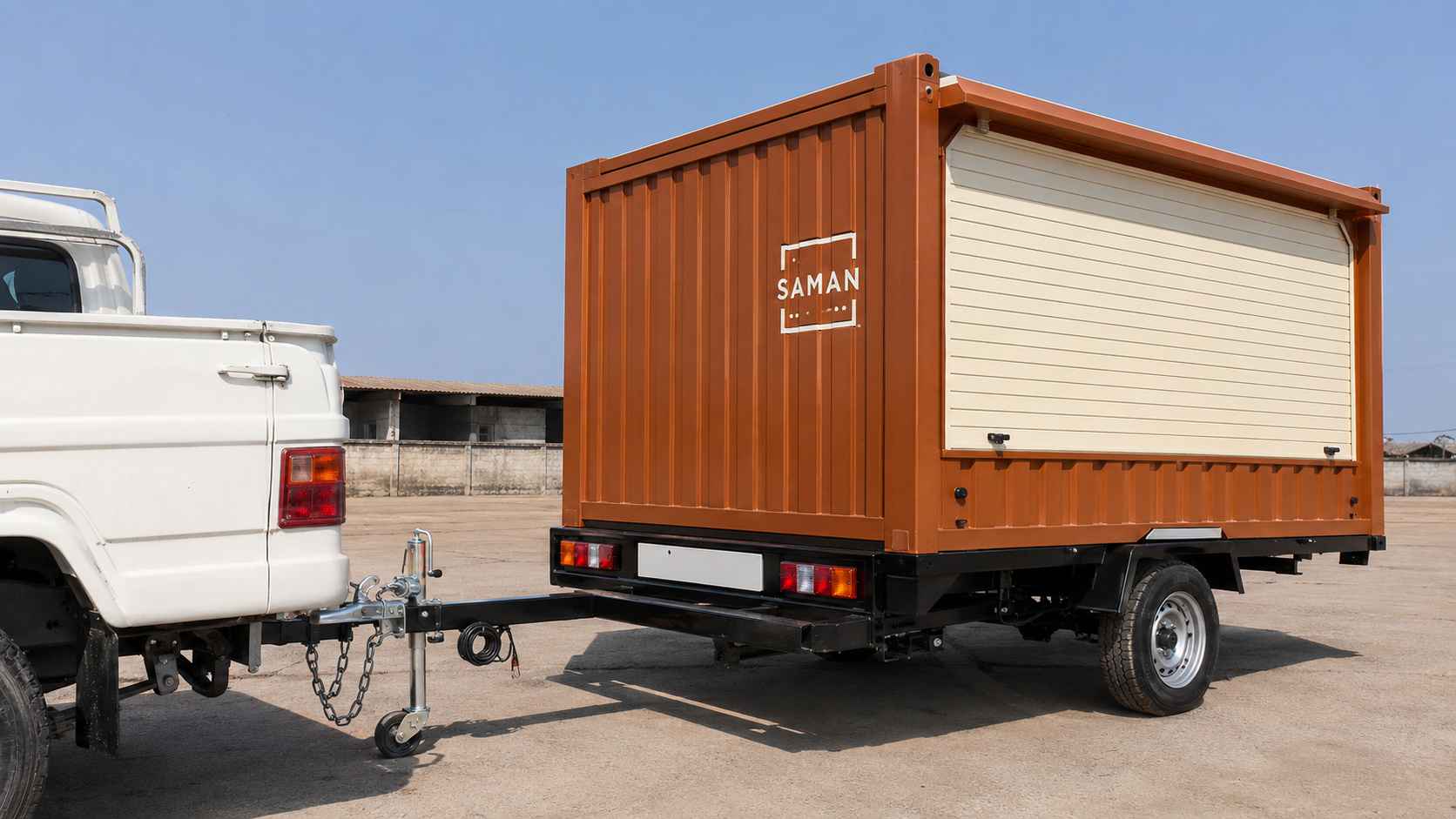
A pickup with a 2,500 kg+ tow rating couples to the food truck container's chassis hitch — the standard daily-route hand-off.
RTO trailer registration is a state-by-state filing. Most states use Form 20 for light commercial trailers, with the chassis number we stamp on the frame, the fabrication invoice, and an initial fitness inspection. The fitness certificate is renewed annually. Some states require a route permit for inter-state operation; many don't. SAMAN supplies the chassis documents and the stamp record; you file with your local RTO. Documented filing time is usually 7–15 working days — comfortably inside the 15-day fabrication window.
Inside 120 sq ft — What a 15×8 Kitchen Holds That an 8×5 Vehicle Food Truck Can't
The reason a buyer pays roughly ₹4,55,000 for a SAMAN food truck container instead of ₹2–4 lakh for a TATA Ace–class vehicle-mount food truck is not the wheels. Both formats have wheels. It is the kitchen footprint.
The 15×8 footprint gives 120 sq ft of working floor. The standard layout dedicates one long wall — typically the back, opposite the customer service window — to the kitchen. The kitchen wall comes factory-fitted: food-grade stainless steel lining for the cooking zone, four-burner LPG range position with the inlet pre-piped to the wall, a fryer bay with provision for two fryers, a prep counter at standing height with a 200-litre sink, an exhaust hood opening pre-cut and ducted to a roof penetration, and a commercial-rated MCB panel with separate cooking, refrigeration, and lighting circuits.
The opposite wall carries the service-and-customer side: a roll-up shutter service window (standard cut 1200 × 800 mm) with the counter extending the full window length, and provision for a second service slot on the short wall as an option for peak-hour double-service.
The remaining ~60 sq ft of clear interior is where this build does the work a vehicle-mount food truck can't. A two-cook operation fits with proper circulation. A larger fryer bank fits — which matters for any menu with deep-fry volume. A full prep zone fits separate from the cook line — which matters for dosa-batter ladling, chaat plating, or sandwich assembly without crossing the heat. The chiller fits as a full-height unit instead of an under-counter compromise.
A direct comparison frames it cleanly:
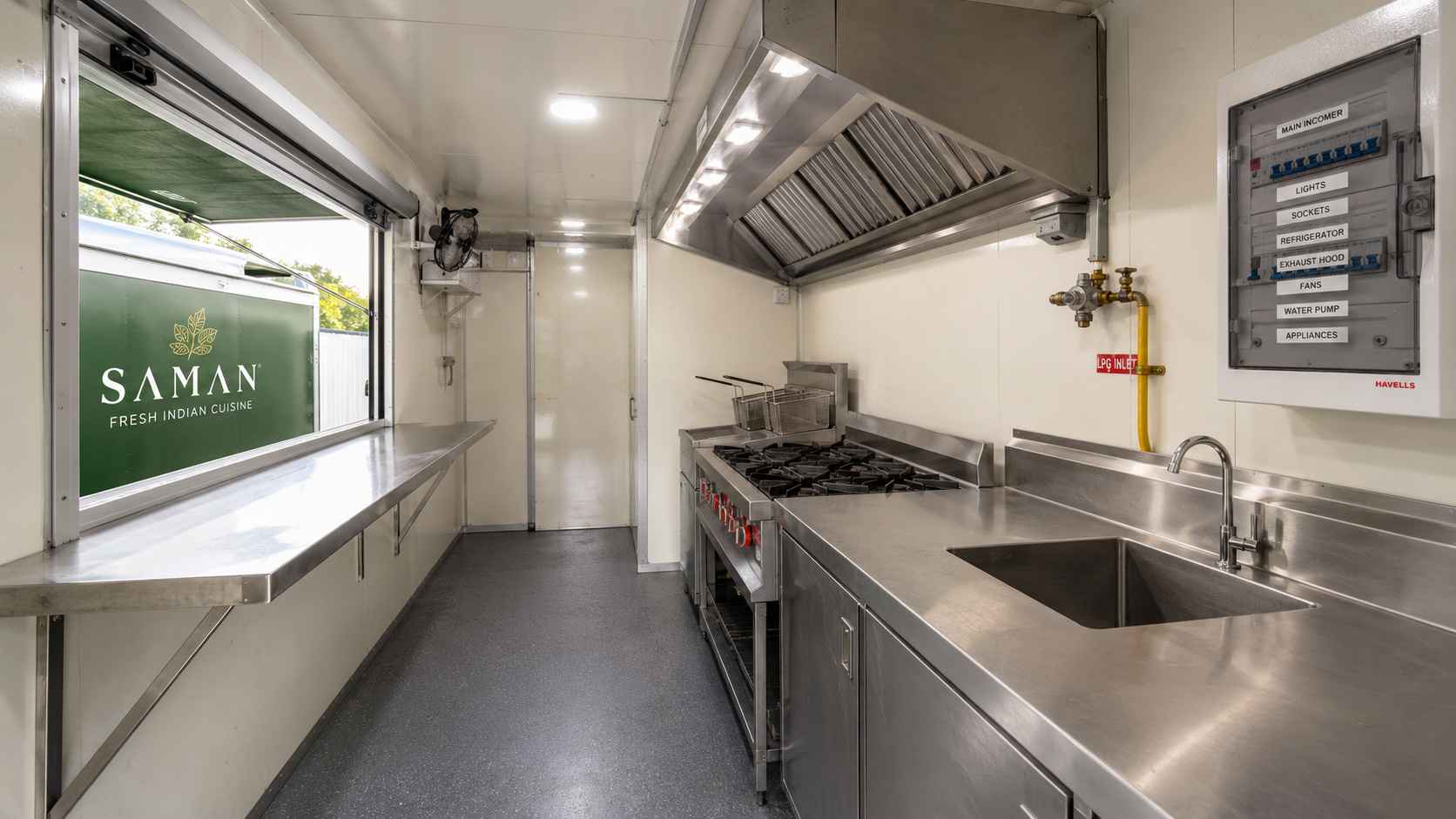
Inside 120 sq ft — the kitchen wall on one side, the customer service window on the other, and 60 sq ft of clear interior between them for a two-cook operation.
| Spec | TATA Ace–class vehicle food truck | SAMAN food truck container |
|---|---|---|
| Working footprint | ~40 sq ft (8 × 5) | 120 sq ft (15 × 8) |
| Burner capacity | 2 burners standard | 4-burner range + fryer bay |
| Cook stations | Single | Two-cook operation |
| Prep area | Cook line and prep on same counter | Separate prep zone |
| Refrigeration | Under-counter only | Full-height chiller fits |
| Exhaust | Compact extractor | Commercial hood + roof duct |
| Starting price (Indian SERP) | ₹1,50,000–₹4,00,000 | ₹4,55,000 (sale) |
For a single-product menu — coffee, juice, simple sandwich — a vehicle food truck is honest value at the lower price band. For any menu with two cooks, deep-fry volume, full refrigeration, or simultaneous prep-and-cook workflow, the container footprint is what the operation actually needs.
What SAMAN supplies and what's owner-supplied. SAMAN supplies the trailer chassis, container body, kitchen wall surfaces and exhaust hood provision, LPG inlet piping to the wall (not the burner), the MCB panel with circuits, the service window with shutter, painted GI exterior or vinyl wrap, and the 52-checkpoint quality inspection. The operator supplies commercial burners and fryer units, refrigeration, signage and 3D logo, kitchen consumables, FSSAI Mobile Vendor registration, RTO trailer registration, and the tow vehicle.
The Vinyl Food-Truck Wrap — Brand Reach Across a 10,000 km Year and Re-Skin Between Campaigns
A static cafe sees its sign once a day from a customer walking past. A food truck container sees its wrap from every driver on a state highway for the length of a tow leg, every group at a market, every commuter on the office-park lunch route, every guest at the festival ground. Exterior design is where the food truck container earns marketing reach that no fixed cafe can match for the same investment.
The base finish is painted galvanised iron (GI) in the colour you specify at order, applied at the factory after the body is welded to the chassis. The painted finish is the budget option, suitable for a single-design operation where the logo plate is enough. It lasts roughly 3–5 years before a touch-up coat is appropriate, depending on highway-tow exposure and salt-air conditions.
The vinyl food-truck wrap is the standard upgrade for any operator running a brand. A full wrap covers the long walls, the short walls, and the roll-up shutter exterior in custom-printed vinyl rated for full-vehicle wrap application, applied at the factory finish stage and good for 3–5 years of daily tow exposure. The economics work like this: a wrap on a food truck container running a city route reaches roughly the same impressions in a year as a mid-spend outdoor hoarding campaign — paid once, not monthly, and going wherever the truck goes.
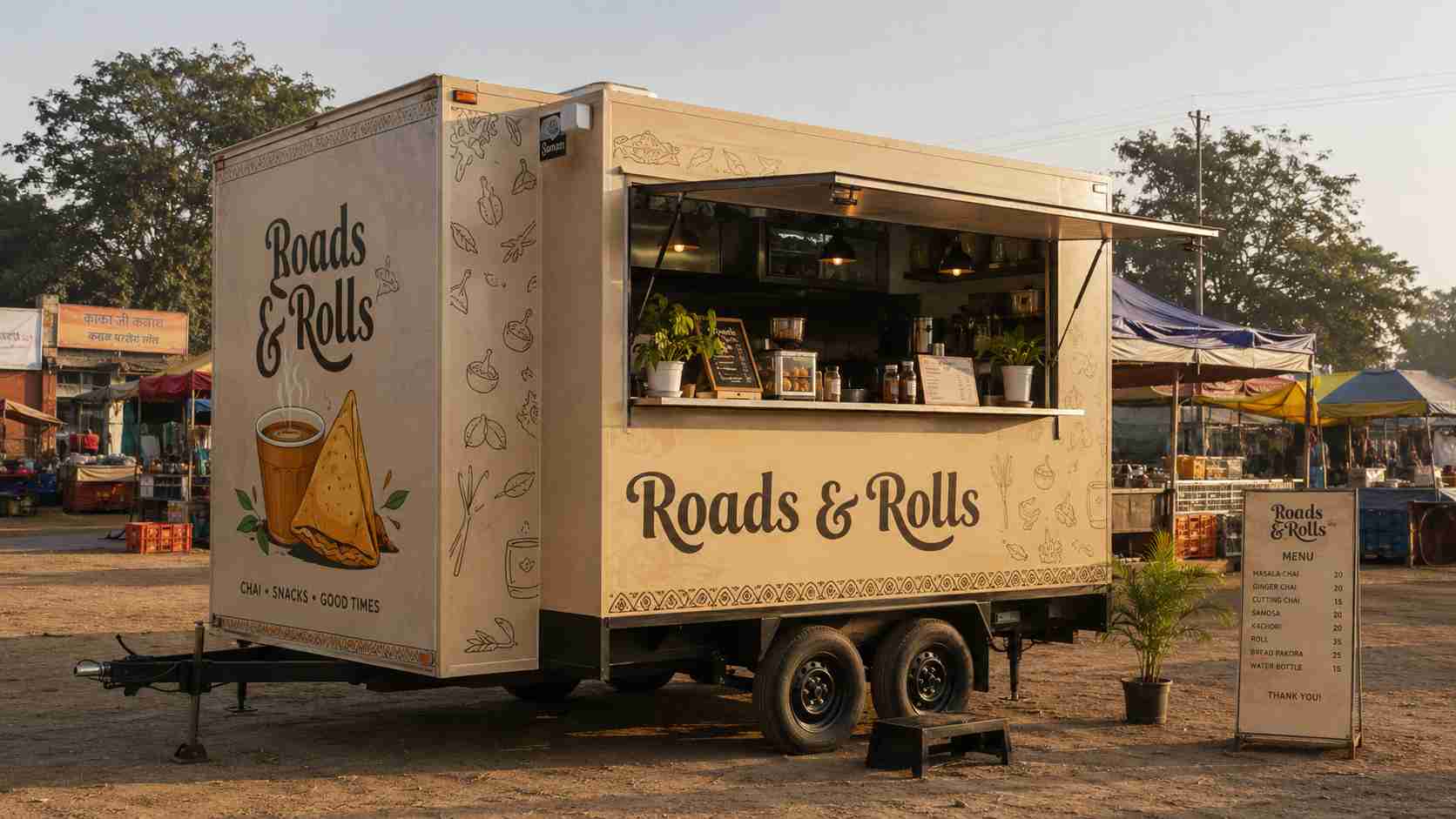
Custom vinyl food-truck wrap on a sandstone beige base — a moving brand asset that pays back across every tow leg.
Seasonal re-skin and campaign re-skin between events. Brand activation operators commonly re-wrap the unit for each campaign — the existing wrap is removed cleanly with heat-gun and adhesive solvent at our plant or the operator's own yard, and a fresh print is laid in 24–48 hours of working time. The painted GI substrate underneath is the brand-neutral base that survives swap cycles.
Exterior options operators usually layer on with the wrap: contrasting corner trim, branded service-window shutter dressing so the unit reads as branded even when closed, interior LED behind the service window for night-trade visibility, and a fold-down awning over the service counter for monsoon queue cover. Each is priced at quote stage; none affects the chassis or the road-licensable build underneath.
FSSAI Mobile Vendor Licence + RTO Trailer Registration — The Two Paperwork Tracks Running Parallel to the 15-Day Build
Both food-safety and motor-vehicle paperwork apply to a food truck container, which is the structural reason this unit takes more administrative planning than a fixed-cafe build. Both tracks can start on order Day 1, run parallel with fabrication, and finish ahead of delivery if you start on time.
FSSAI for a unit that drives daily. The Food Safety and Standards Authority of India treats a mobile food vending unit differently from a fixed food establishment, and the classification turns on whether your unit has a permanent registered address with utility connections or whether it drives between pitches without a fixed kitchen address.
If your annual food turnover stays below ₹12 lakhs and the unit moves between pitches without a fixed registered kitchen address, you register as a Petty Food Business Operator under FSSAI Registration — single-page form, lower fee, faster turnaround. If your annual turnover exceeds ₹12 lakhs (most serious food-truck operations cross this within the first year), you file for FSSAI State Licence (Form B) — the same form a fixed restaurant uses, but classified as Mobile Vendor in the application, which the inspector treats differently on premise inspection.
The grey case: parking overnight at one address. Operators running a single market site or an office-park lunch pitch often park at the same address for days at a time, with the same electrical hookup. The working test is whether the unit has a permanent electrical connection in your name at that address and whether you have a registered fixed business address there. A food truck container towed by your own vehicle, with the electrical hookup made and broken at the pitch, will usually classify as a mobile vendor — even when the operating pattern looks fixed to a passing customer. If your operation actually settles for months at one address with permanent electrical and a registered address, you're more comfortably in fixed-establishment classification — and a relocate-occasionally crane-lift cafe build is structurally a closer fit than a chassis build anyway.
Treat the above as a working guide, not legal advice. FSSAI interpretation has state-level variance, and a 10-minute conversation with your local Food Safety Officer before order will resolve uncertainty faster than any web page can.
RTO trailer registration. The trailer chassis carries a separate registration from your tow vehicle. Most states use Form 20 for light commercial trailers; the filing requires the chassis number SAMAN stamps on the frame, the chassis-fabrication invoice we provide, and an initial fitness inspection at your local RTO. The fitness certificate is renewed annually and is checked at state-border check posts if you cross states on the route. Filing time at most state RTOs is 7–15 working days, well inside the 15-day fabrication window.
What SAMAN provides for both filings: kitchen layout drawing (FSSAI), exhaust airflow specification (FSSAI), food-grade surface certification (FSSAI), chassis number stamp record (RTO), chassis fabrication invoice (RTO), electrical specification (both). What stays with you: the application filing, fee payment, inspection scheduling, and follow-up.
From Order to Tow-Away — A 15-Day Build, the Hand-Off Day, and the First 50 km on the Road
The 15-day formula across the SAMAN container cafe cluster runs to a single-day hand-off for the food truck container, where the trailer is towed away by your own vehicle rather than craned onto a flat-bed.
Days 1–2: Design confirmation. A 90-minute design call covers kitchen layout (burner positions, fryer bay sizing, prep counter length, refrigeration cutout), exterior wrap design or paint colour, chassis option (single-axle vs tandem-axle upgrade), service window placement, and your tow vehicle make and model. We use the tow vehicle spec to confirm the chassis loaded weight is within your vehicle's rated tow capacity before fabrication starts. FSSAI Mobile Vendor and RTO trailer registration are filed in parallel from this stage.
Days 3–12: Fabrication at Bangalore Gopasandra or Greater Noida Jalpura. Chassis fitted with axle hardware, hitch, parking jack, light board, DG plug. Container body welded to the chassis. Kitchen wall, food-grade stainless steel surfaces, exhaust hood opening, LPG inlet, MCB panel, service window with roll-up shutter, and electrical run go in next. Painted GI base coat or vinyl wrap goes on as the last factory step.
Days 13–14: 52-checkpoint quality inspection. Inspection covers chassis welds (every joint), hitch hardware torque (every bolt), light board wiring (every circuit), brake function where rated, kitchen seal lines, electrical isolation tests, exhaust hood draw test, service window operation cycle, and wrap or paint finish. The unit does not leave the factory until every checkpoint signs off.
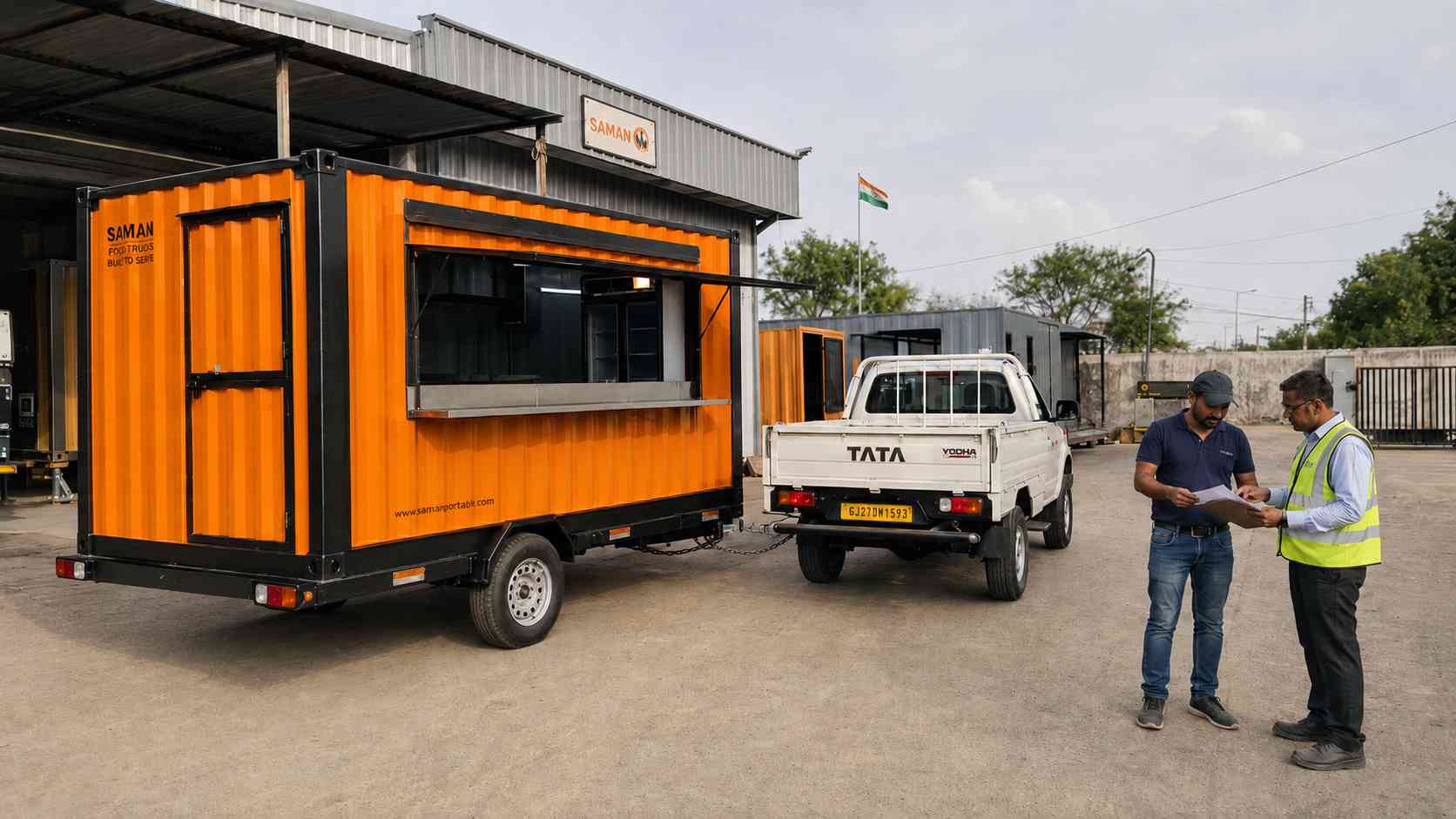
Day 15 at the SAMAN plant — chassis paperwork hand-off, safety chains crossed, light board confirmed, and the unit ready for the first 50 km road test.
Day 15: Tow-away hand-off. You arrive at the factory with your tow vehicle and driver. The chassis-fabrication invoice and chassis-stamping record are handed over for your RTO file. We hitch the trailer to your vehicle, verify all seven-pin signals under braking, confirm safety chains, walk through the parking jack, and run a short 5–10 km local road-test loop to confirm hitch hold and light synchronisation. From there, the unit is yours.
Alternative: flat-bed transport for buyers without a tow vehicle yet, or whose base city is more than 1,500 km from either factory. The unit travels on the flat-bed exactly as a crane-lift cafe build would, with the chassis providing its own loading and unloading wheels at both ends. Flat-bed transport is quoted separately by route.
₹4,55,000 Sale / ₹4,95,000 Regular — What the Chassis Premium Buys and How the Build Lifts to ₹6L+ with Options
The starting price is ₹4,55,000 on current sale (regular ₹4,95,000). The ₹40,000 sale differential applies to orders confirmed in the current promotion window.
What ₹4,55,000 covers: single-axle road-licensable trailer chassis with leaf-spring suspension, 50 mm ball hitch, safety chains, parking jack, 7-pin DG plug, and light board; 15×8×9 ft container body welded to the chassis; full kitchen wall fitout — food-grade stainless steel surfaces, 4-burner LPG inlet position, fryer bay provision, prep counter with sink, exhaust hood opening with roof duct; commercial-rated MCB panel with separate circuits; service window with roll-up shutter; painted GI exterior in your colour; 52-checkpoint quality inspection. The 5-year structural warranty starts at hand-off.
Compared to the relocate-occasionally 10×10 cafe build at ₹2,35,000 — same factory, same kitchen wall specification, same QC — the ₹2,20,000 differential pays for: the trailer chassis (axle, hitch, light board, brake hardware, parking jack, registration documentation), the road-licensable build grade (chassis welds rated for transit cycle, tow-rated lift hardware), the additional 20 sq ft of floor (15×8 vs 10×10), and the wider kitchen wall that fits the 4-burner range and fryer bay.
Option upgrades:
| Option | Adds approximately | What it gives |
|---|---|---|
| Full vinyl food-truck wrap | ₹35,000–₹65,000 | Custom-printed exterior, 3–5 year life, brand reach on every tow leg |
| Tandem-axle chassis upgrade | ₹50,000–₹75,000 | Load-spread across two axles, headroom for heavier fitouts |
| Second service window slot | ₹25,000–₹40,000 | Peak-hour double-service workflow |
| Interior LED upgrade pack | ₹15,000–₹25,000 | Service-window backlight, prep task lighting, night-trade trade dress |
| Vinyl flooring upgrade | ₹18,000–₹28,000 | Easier sanitation, longer service life |
| Premium counter material (granite, premium SS) | ₹20,000–₹40,000 | Customer-facing finish upgrade |
| Fold-down monsoon awning | ₹12,000–₹20,000 | Queue cover at the service window |
A typical fully-optioned build — vinyl wrap, second service slot, LED pack, vinyl flooring, awning — runs to around ₹6,00,000–₹6,40,000 from the ₹4,55,000 base. Brand-activation builds with custom corner trim, branded service-window dressing, and premium materials commonly land at ₹7–8 lakh.
What stays outside the quote: commercial burners and fryer units, deep freezer and refrigeration, espresso machine, blender, grinder (all owner-supplied to your menu spec); signage and 3D logo if not on the wrap track; FSSAI Mobile Vendor and RTO trailer registration fees; GST; flat-bed transport if not towing away.
When a Food Truck Container Fits — and When a Cafe Build at Half the Price Is What You Actually Need
A food truck container is the right pick when your business model requires daily or weekly drive between vending pitches on the unit's own road licence. It is the wrong pick — and an expensive wrong pick — when your real move pattern is once-a-year or less, because the chassis, the trailer-grade registration, and the tow-vehicle requirement are paying for mobility you won't use.
The four-way mobility decision for SAMAN container cafe buyers, side by side:
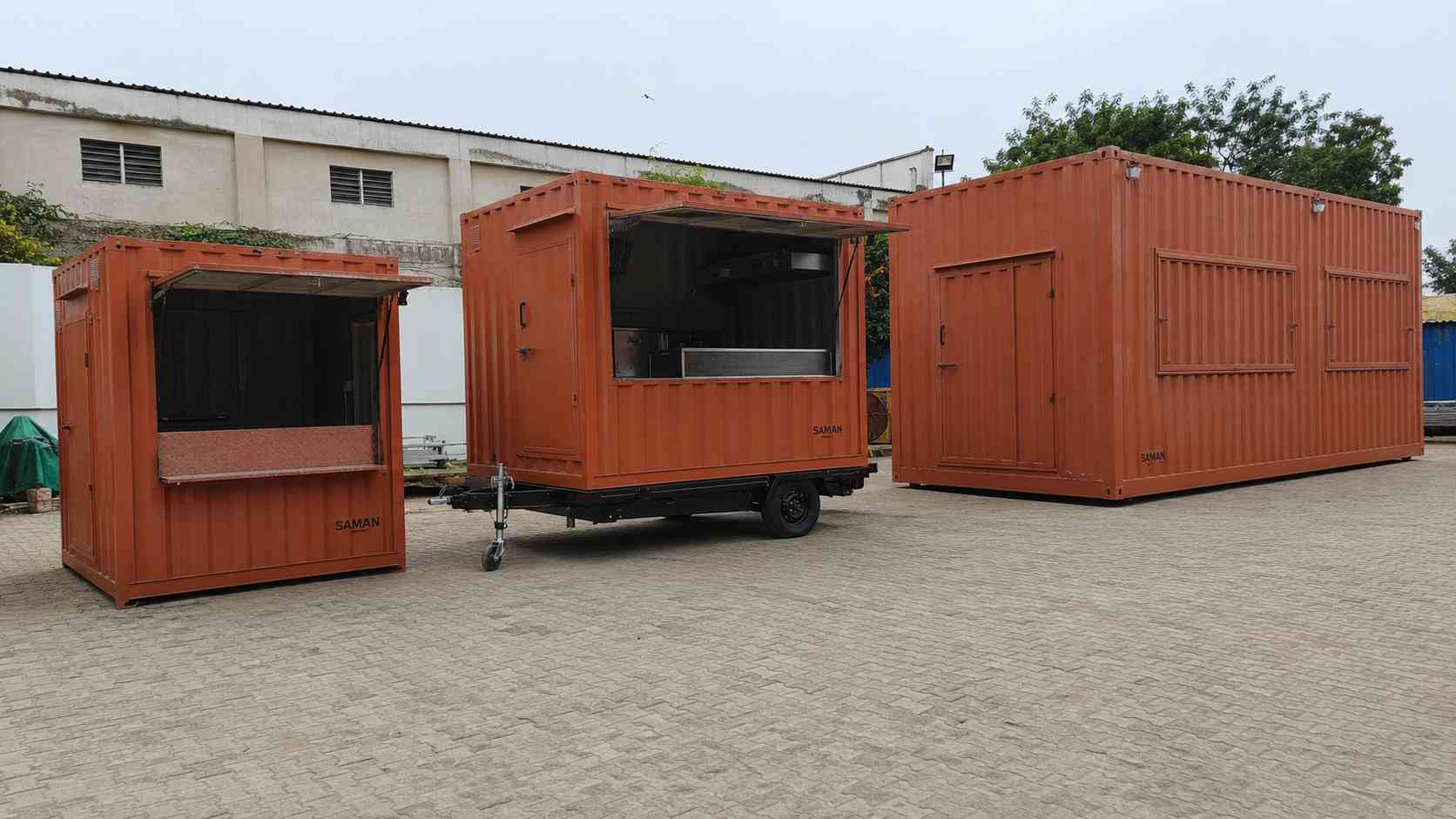
The four-way mobility decision in one frame — only the food truck container in the middle ships with its own road-licensable trailer chassis.
| Build | Move pattern | How it moves | Starting price | Best for |
|---|---|---|---|---|
| Food truck container (this page) | Daily or weekly drive between pitches | Trailer wheels + your tow vehicle + your road licence | ₹4,55,000 (sale) | Daily mobile food vending — markets, ITP venues, office-park lunch routes, festival drive-between circuits, brand-activation roadshows |
| Relocate-occasionally cafe build | Every 12–36 months on location change | Hydraulic crane + flat-bed truck | ₹2,35,000 | SAMAN's 10×10×8 ft cafe body that ships on crane and flat-bed, not on its own wheels — operators with stable monthly footfall in one spot for a year-plus, occasional site change |
| Planned-circuit cafe build | 6+ planned moves a year | Hydraulic crane + flat-bed truck | ₹2,25,555 | the 10×10×9 ft cafe body engineered for high-cycle redeployment on an operator's planned circuit — operators whose business plan itself is the circuit: weekend markets, festival weekends, college terms, seasonal towns |
| Flagship-scale relocatable restaurant | Between flagships, infrequently | 25-tonne crane + low-bed trailer | ₹11,25,000 | SAMAN's 264 sq ft mobile restaurant container that moves between flagships, not between weekends — multi-flagship brand operators moving 22×12 restaurant builds across flagship sites |
A fifth option for buyers thinking event-only: the event-only 15×10 build at ₹2,85,000 (sale) is engineered for brand-activation agencies running 8–12 single events a year with storage between events, not daily routes.
The decision rule of thumb is move-frequency. If you would be driving the unit more than once a month, the chassis cost pays back in saved per-move crane charges within the first year. If you would be lifting less than once a year, a crane build at half the price gives you the same kitchen surfaces and the same factory build quality without paying for a chassis that sits unused.
Daily-drive economics, with real numbers. A single crane-and-flat-bed move on a 10×10 cafe runs roughly ₹15,000–₹40,000 depending on origin, destination, and crane availability. A daily tow on your own vehicle, by contrast, runs to fuel and driver hours — typically ₹500–₹2,000 per move within a city, ₹3,000–₹8,000 for an inter-city tow leg. An operator moving 30+ times a year recovers the food truck container's chassis premium against a crane-build alternative inside one year of operation. An operator moving 2–3 times a year recovers nothing.
SAMAN Food Truck Container Builds on the Road — Bangalore Cluster to Greater Noida
Active SAMAN food truck container deployments are operating across two metro clusters today. In the Bangalore cluster — HSR Layout, Whitefield, and Hosur Road — multiple food truck container builds run daily routes between office-park lunch pitches, weekend market sites, and college-area trade. In the Delhi NCR cluster — Gurugram and Greater Noida — food truck container operators run similar daily-and-weekly cycles across the wider NCR ring road and the office-belt routes.
Both clusters are served by SAMAN's own manufacturing plants. The Bangalore-cluster builds come from the Gopasandra facility off the Anekal–Hosur road; the Delhi NCR-cluster builds come from the Jalpura facility in Greater Noida. Every build runs through the same 52-internal-quality-checkpoint inspection before chassis dispatch.
Pan-India delivery works two ways. Tow-away is the default — the buyer's tow vehicle collects from either plant on Day 15. Flat-bed transport from either plant covers buyers who don't have a tow vehicle yet or whose base city is far enough from the factory that flat-bed is the more practical first leg; flat-bed is quoted separately by route. South India catchment is served from Bangalore; North and Central India catchment from Greater Noida.
Structural warranty runs 5 years from hand-off on the structural frame and base of new fabrication — chassis welds, container body welds, kitchen wall surfaces, and roof. Component warranties on chassis hardware (axle, hitch, light board, brake hardware) carry the supplier's own warranty per part, documented at hand-off.
Frequently Asked Questions
Is a food truck container the same as a TATA Ace food truck or a vehicle-mount mobile kitchen?
No — they're related categories on the Indian food-truck SERP but structurally different builds. A TATA Ace–class food truck is kitchen fabrication mounted on a registered light commercial vehicle; your kitchen rides on the LCV's RTO registration, fitness, and insurance, with about 40 sq ft of working footprint on an 8×5 deck. A SAMAN food truck container is a container kitchen on a road-licensable trailer chassis, registered as a trailer in its own right, towed by your own separate vehicle, with 120 sq ft of working floor — three times the kitchen footprint. The right pick depends on menu complexity and cook-line workflow, not on which one is more food truck — both are.
Should I buy a food truck container or the 10×10 cafe build at half the price?
If your business plan involves driving between pitches more than once a month, the chassis pays back the ₹2,20,000 differential within the first year — every monthly move saves roughly ₹15,000–₹40,000 in crane and flat-bed charges. If your business plan parks at one site for a year or more between moves, you're paying for a chassis you won't use; the 10×10 crane-build cafe at ₹2,35,000 gives you the same kitchen wall specification and the same factory build quality, without the chassis. The rule of thumb: move-frequency is the answer.
Can my SUV pull a SAMAN food truck container, or do I need a pickup truck?
Most full-frame SUVs with a factory-rated tow capacity of 2,500 kg or more will pull the standard build — Toyota Fortuner, Mahindra Scorpio, Ford Endeavour where still on the road, and similar. Pickup trucks (Mahindra Bolero Pickup, Tata Yodha, Isuzu D-Max, Toyota Hilux) pull it more comfortably and are the more common operator choice for daily routes. Maruti vans, hatchbacks, and car-derived chassis don't meet the tow rating and shouldn't be used. Tell us your tow vehicle make and model at the design call (Days 1–2) — we confirm the chassis loaded weight is within your vehicle's rated tow capacity before fabrication starts.
Do I register for FSSAI as a mobile vendor or a fixed establishment if the container parks overnight at one location?
The classification turns on whether you have a permanent electrical connection in your name at that address and whether you have a registered fixed business address for the food operation at that location. A food truck container towed by your own vehicle, with the electrical hookup made and broken at each pitch, usually classifies as a mobile vendor — even when the operating pattern looks fixed to a passing customer. If you operate from one address with a permanent registered connection for months, you may end up in fixed-establishment classification, and a relocate-occasionally crane-lift cafe build is structurally a better fit anyway. A 10-minute conversation with your local Food Safety Officer before order clears this faster than any web page can.
Does the trailer need its own RTO registration separate from my tow vehicle?
Yes. The trailer is a separate vehicle in RTO classification — most states file it under Form 20 for light commercial trailers, with the chassis number SAMAN stamps on the frame, the chassis fabrication invoice we provide, and an initial fitness inspection at your local RTO. The fitness certificate is renewed annually and is checked at state-border check posts if you cross states on the route. Filing typically takes 7–15 working days at most state RTOs, which fits comfortably inside the 15-day fabrication window if you start on order Day 1.
Can I fit a full Indian street-food kitchen — chaat, dosa, Chinese — in a 15×8 footprint, or do I need a larger build?
Yes — the 15×8 footprint takes a full chaat-and-dosa kitchen with the standard four-burner range, fryer bay, prep counter, and chiller, with floor space for a two-cook line working without crossing. Multi-cuisine Chinese with the wok burner setup also fits, with the exhaust hood sized for sustained wok output specified at quote. If your concept needs internal customer seating in addition to the kitchen, you've outgrown a food truck container — the 30×20 single-floor flagship cafe build for fixed-site operators is the right reference at 600 sq ft of single-storey container floor. For operators planning to scale beyond a single unit altogether — a side-by-side or stacked multi-container layout — the multi-unit modular cafe build that starts at a 25×20 stacked two-storey starter covers the expansion path.
Can I order a custom food-truck wrap in time for a brand launch event?
Yes — the full vinyl wrap is applied as the last factory step in the 15-day build. If you confirm wrap artwork by Day 4 of the order, the wrap goes on with the build and ships out with the unit on Day 15. Wrap artwork delivered late shifts wrap application to a post-delivery slot, either at the SAMAN plant within 5–7 working days of artwork sign-off, or at the operator's own yard with a SAMAN-arranged wrap applicator. For brand launch event timing, lock the artwork early.
Plan Your Food Truck Container — Quote, Branded Layout Drawing, and Tow-Pickup Date in Two Working Days
To quote your food truck container build accurately, share six details: the cuisine your menu centres on (so the kitchen wall fitout matches the cook line), your expected daily covers at peak (so the fryer bay and chiller are sized right), your tow vehicle make and model — or whether you're buying one for this purpose (so we confirm chassis loaded weight within rated tow capacity), your wrap design brief or paint colour preference, your base city (for tow-away pickup or flat-bed transport quote), and any variations from the 15×8×9 standard footprint you've thought about.
Our project coordinator comes back within 48 working hours with an itemised quote, a kitchen layout drawing, an FSSAI Mobile Vendor document checklist, an RTO trailer registration document pack, and a build-and-tow-pickup calendar matched to your launch date.
For buyers comparing the wider container cafe range before deciding on the food-truck format, SAMAN's complete container cafe and restaurant range lays out every build we make in the cluster.
Customer Reviews
0 reviews
No reviews yet. Be the first to review this product.
Write a Review for Food Truck Container
Built by a verified manufacturer: ISO 9001:2015 certified, Udyam registered, NSIC-enlisted, GST registered.
View manufacturer credentials




Need Custom Requirements?
Get in touch with our experts for customized solutions and bulk orders. We're here to help you find the perfect solution.