
Related Products
Explore similar items
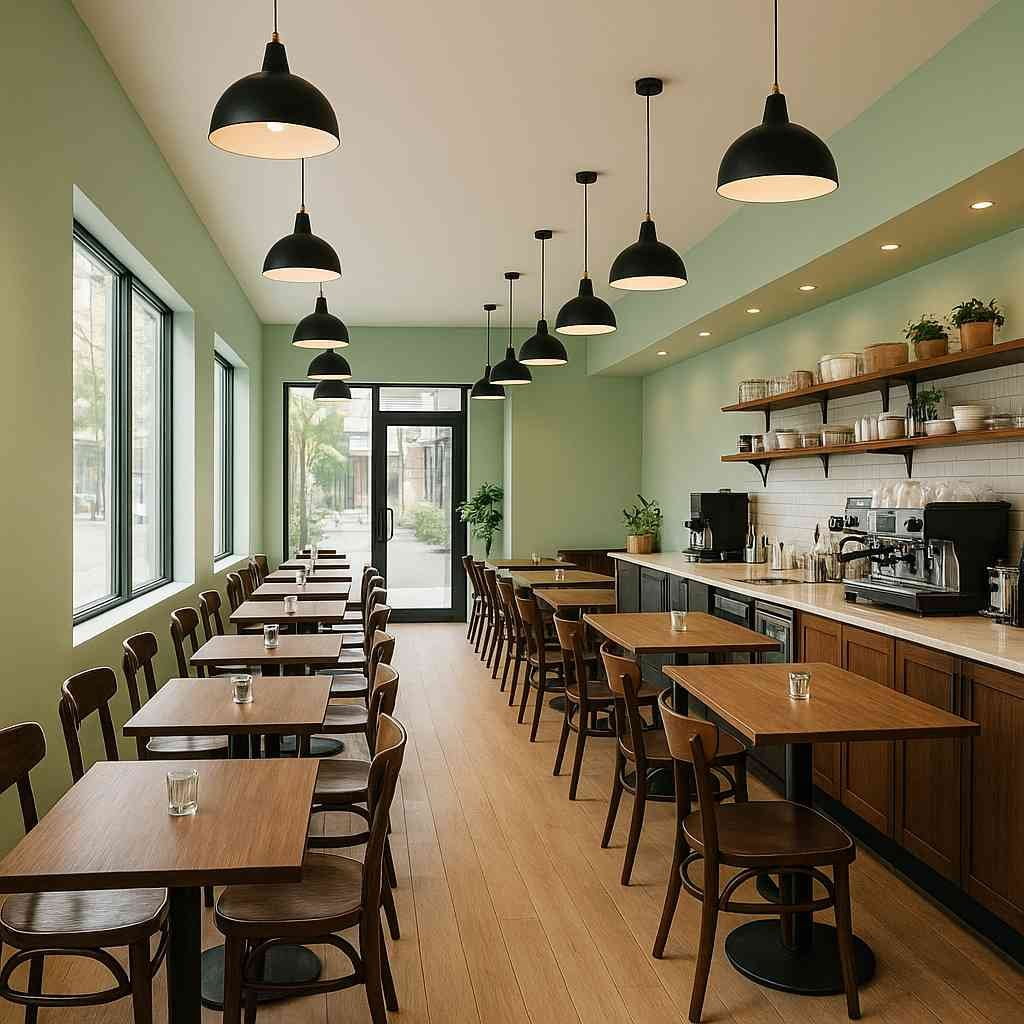
Container Restaurant
Inclusive of all taxes
Quantity
Product Information
Product Details
Comprehensive information about Container Restaurant
Product Overview
Detailed information about Container Restaurant
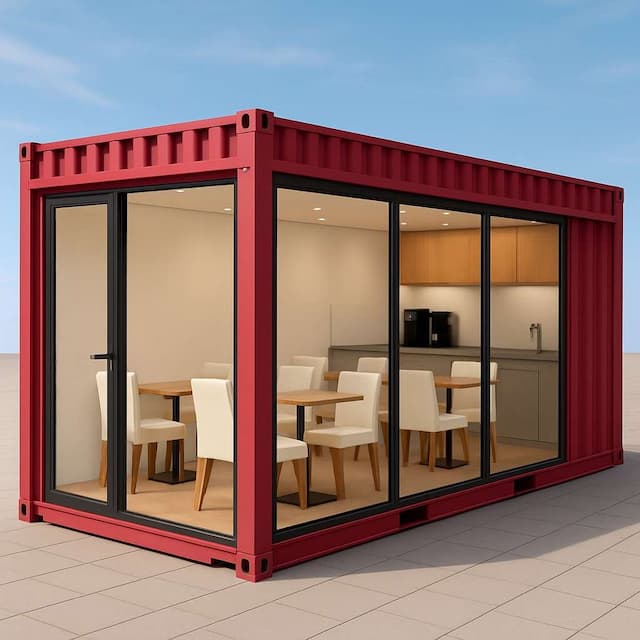
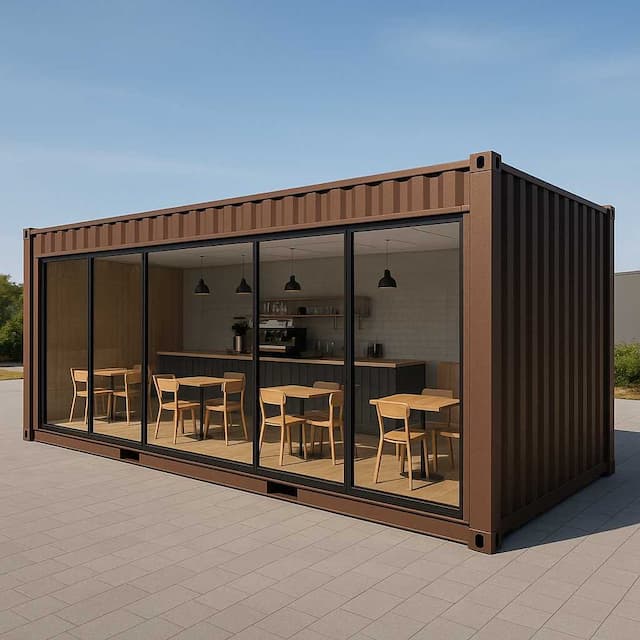
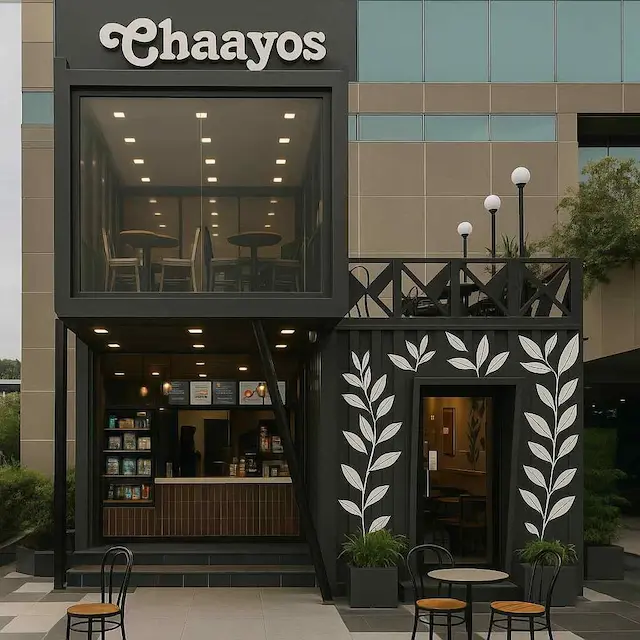
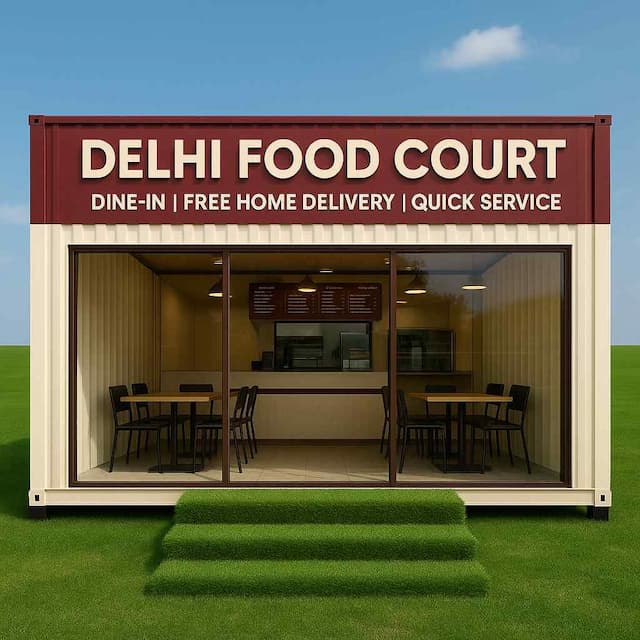
A container restaurant is what you build when your concept needs sit-down dining — full menu, table service, a customer who stays 45 minutes rather than 4. The SAMAN build at ₹15,55,000 (regular ₹16,95,000) is the single 40' × 10' × 9' unit configured for that operator: kitchen zone at one end, table-service dining in the middle, optional restroom at the back. It's what "restaurant in a container" actually means at full-service scale — not a coffee window, not a kiosk, not a food truck.
Inside a 40×10 Container Restaurant — How the Floor Splits Between Kitchen and Dining
Most operators think of 400 sq ft as small until they see the floor plan. The SAMAN dining-led layout uses three zones along the 40-ft length.
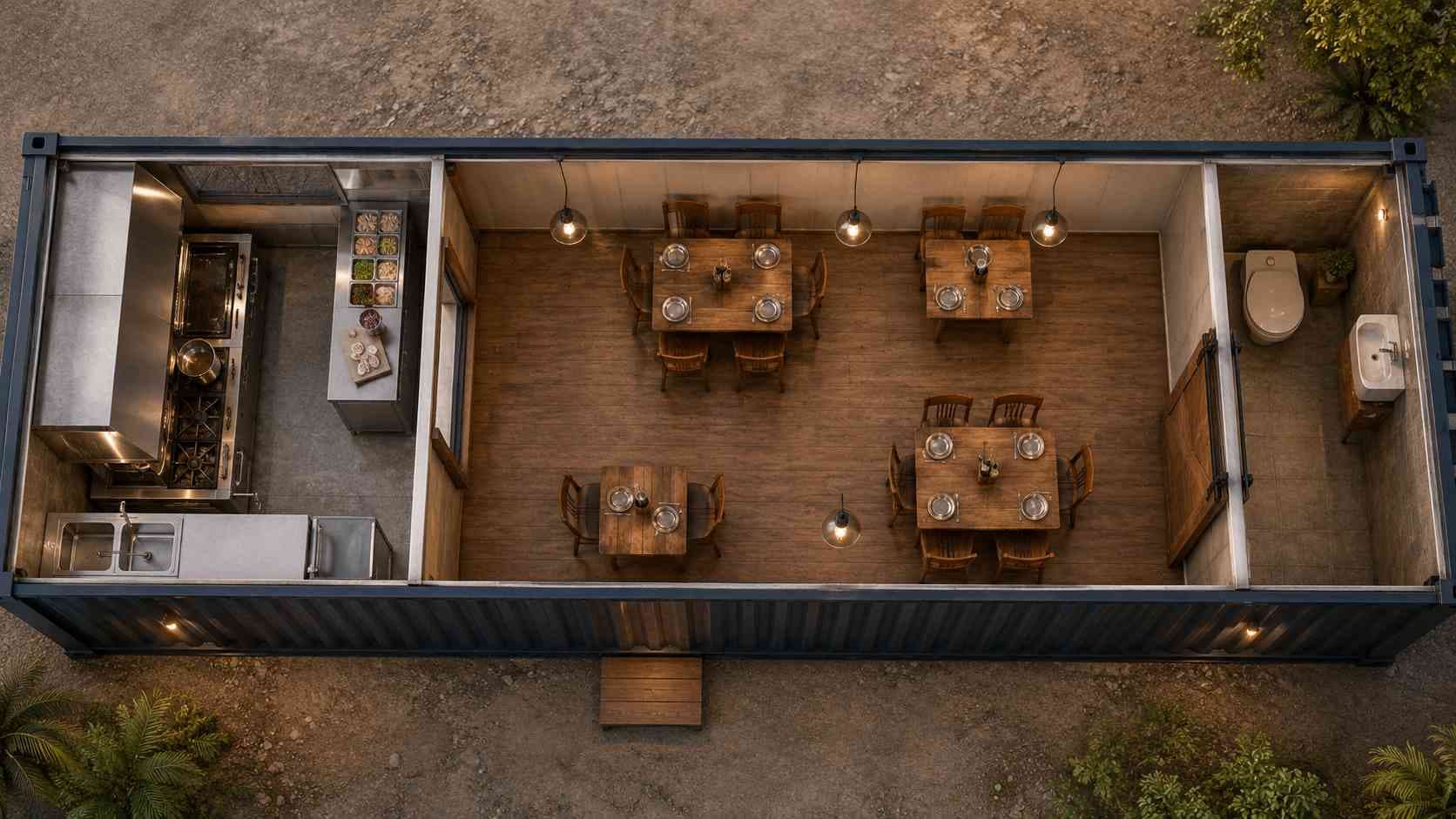
How the 40-ft single-unit container restaurant divides into kitchen, dining, and optional restroom
Kitchen zone (~10 ft of length, ~100 sq ft)
Exhaust hood position, LPG inlet, food-grade stainless steel lining on the cooking wall, prep counter, sink, and a commercial-rated MCB panel. This is the back-of-house, sealed from the dining floor by the service pass — staff stay back, plates move out.
Service pass and dining zone (~22–24 ft of length, ~220 sq ft)
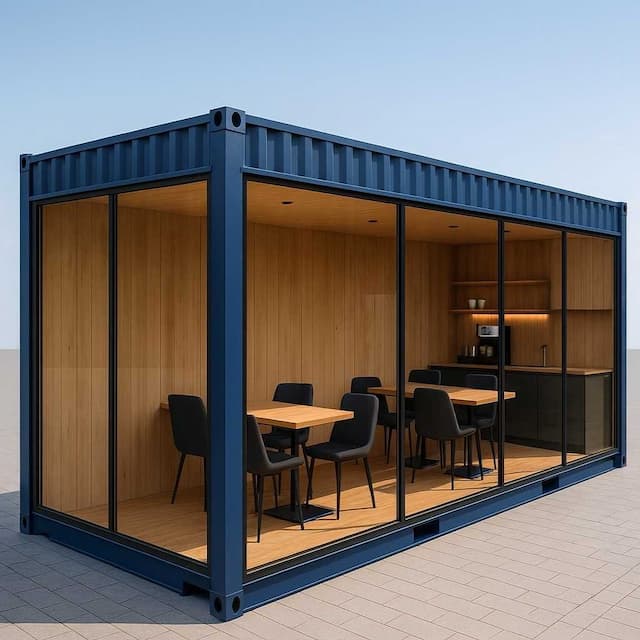
The bulk of the floor, configured for table seating. The service pass cuts the kitchen-dining wall at a finished framed opening. Tables and chairs sit on a cement particle board floor finished in vinyl or wood-look laminate, depending on the brand. Customer-facing wall finishes — plaster, panelling, or branded cladding — frame the dining experience.
Restroom and back-of-house (~6–8 ft, optional)
A compact restroom at the far end with a single WC and wash basin, or this footage is folded back into dining to push covers higher. The decision is concept-driven: table-service dwell times tend to push for an in-unit restroom, faster-service formats often skip it and rely on the property restroom.
Cover Capacity in a 40-ft Container Restaurant — 16 to 24 Seats Depending on Table Mix
In a single 40-ft container dining space, cover capacity runs from 16 seats at fine-dining spacing to 24 seats at faster-tempo restaurant spacing. The honest math:
4 × four-tops = 16 covers, generous spacing, slow-tempo service.
2 × four-tops + 4 × two-tops = 16 covers, flexible for couples and small groups.
3 × four-tops + 6 × two-tops = 24 covers, denser, café-restaurant tempo.
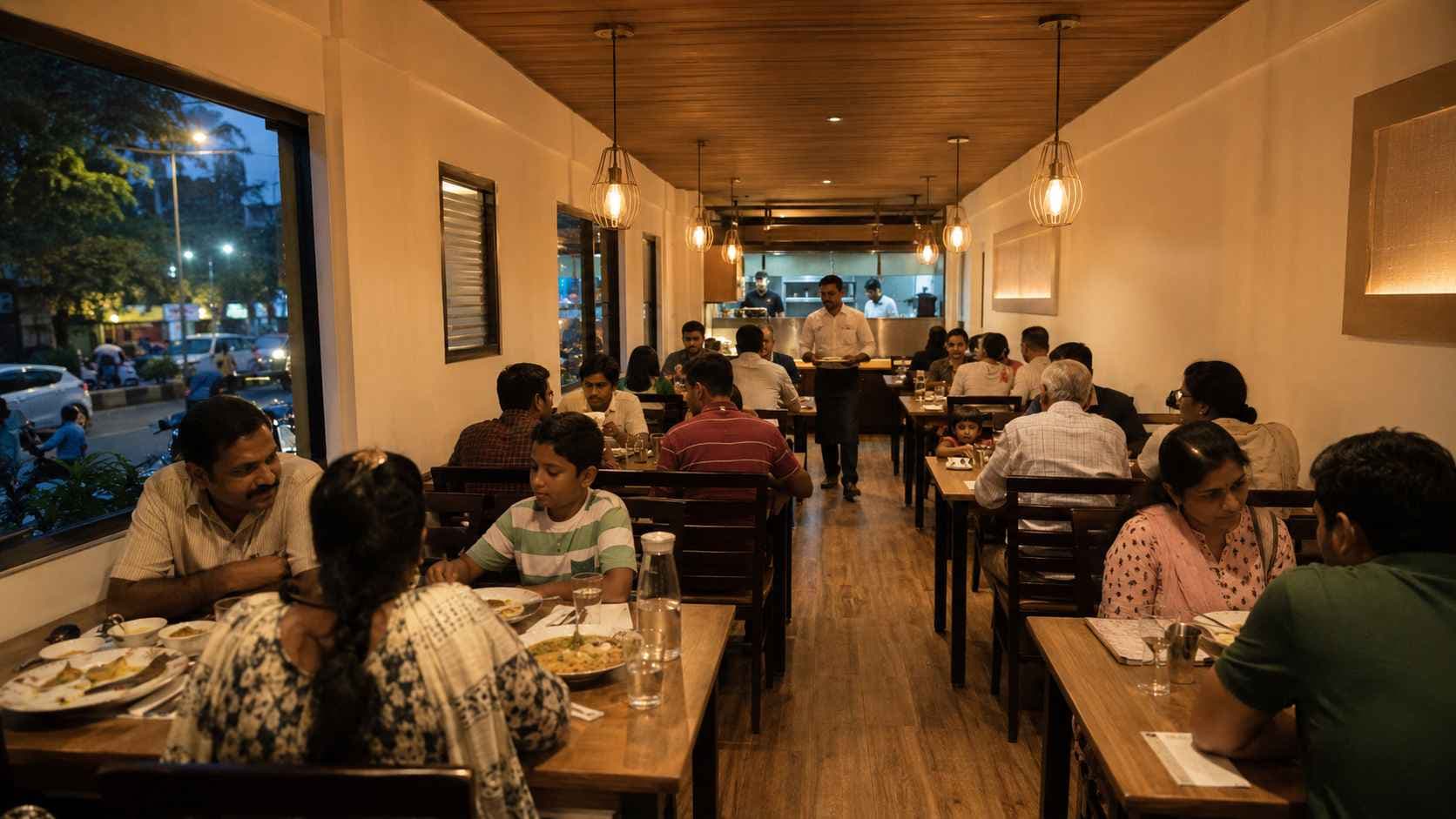
Table-service dining in operation inside a SAMAN 40-ft container restaurant build
The table-turn × ticket-size math is for the operator to work out per concept. What SAMAN can say is that 16–24 covers in 400 sq ft fits the seat-density of most Indian standalone full-service restaurants. Growing past 24 covers usually means an outdoor deck for table extension or moving to a multi-container layout — not a different 40-ft unit. Operators evaluating a low budget small container restaurant design at single-unit scale should plan in this 16–24 band; trying to push higher inside one 40-ft unit makes the floor uncomfortable.
What Makes a Container "Restaurant" Different from a Container "Cafe"
If you're comparing a 40-ft cafe build at the cluster's lower end with this container restaurant at ₹15,55,000, the price gap is genuine — and it sits in three places.
Customer-facing fitout
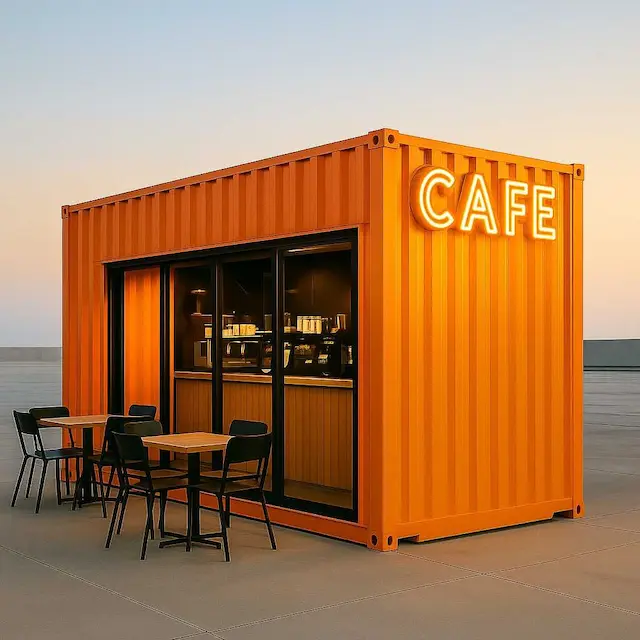
A cafe optimises for counter service — customer walks up, orders, takes the cup, leaves in seven minutes. A container restaurant is built for the opposite — customer sits down, orders from a menu, eats two or three courses, dwells. That means table seating laid out for the dwell time, warm-light fixtures and wall plastering or panelling instead of industrial-chic exposed steel, and a customer-facing wall that's finished — wood cladding or branded panelling — not just painted GI sheet.
Kitchen depth
The cafe kitchen is usually one product deep — coffee, juice, sandwich, vada pav. The restaurant kitchen handles a full menu — fryer, tawa, burner, chiller, a real prep area, exhaust hood sized for sustained cooking volume. The cafe might run a domestic-grade burner; the restaurant runs commercial grade. Same 10-ft kitchen length, different fitout density.
Restroom and dining hygiene
A walk-up cafe rarely needs an in-unit restroom — customers don't stay long enough. A dwell-time restaurant usually does, which is why this build includes the restroom option (footprint cost: 6–8 ft of length traded off against covers). Container restaurant design at this grade also includes proper plate-return circulation and a sealed kitchen-to-dining boundary that satisfies FSSAI for sit-down food service.
That's the price difference in plain terms: more interior fitout, deeper kitchen, restroom-ready, table-service layout. Same 40-ft container shell, different build commitment.
Restaurant-Grade Finishes — What the ₹15,55,000 Build Looks Like on the Inside
The live product page lists the material spec as "Steel & Wood." Here's what that translates to once it's built out.
Exterior: the 40-ft container shell finishes in factory-painted GI sheet over the steel frame, in your brand colours. Buyers who want the visible corrugated-steel look as a brand statement opt for corten-style cladding on the front-facing walls — same shell, different exterior finish.
Interior ceiling and dining walls: wood-look panelling or genuine wood cladding on the ceiling and the dining-side walls is the standard SAMAN restaurant finish. It's what shifts the unit from "industrial container" to "restaurant" within the first two minutes of customer eye contact.
Kitchen wall: food-grade stainless steel lining on the cooking wall (FSSAI-compatible). Exhaust hood mounted at the cooking line. This part of the unit looks like a working commercial kitchen — by design.
Floor: cement particle board substrate with vinyl or wood-look laminate finish on the dining side, anti-skid finish on the kitchen side.
Lighting: pendant fixtures over the dining zone, recessed task lighting at the service pass, bright cooking-line illumination over the kitchen. Wired for warm-white in dining (2700K–3000K) and neutral-white in the kitchen.
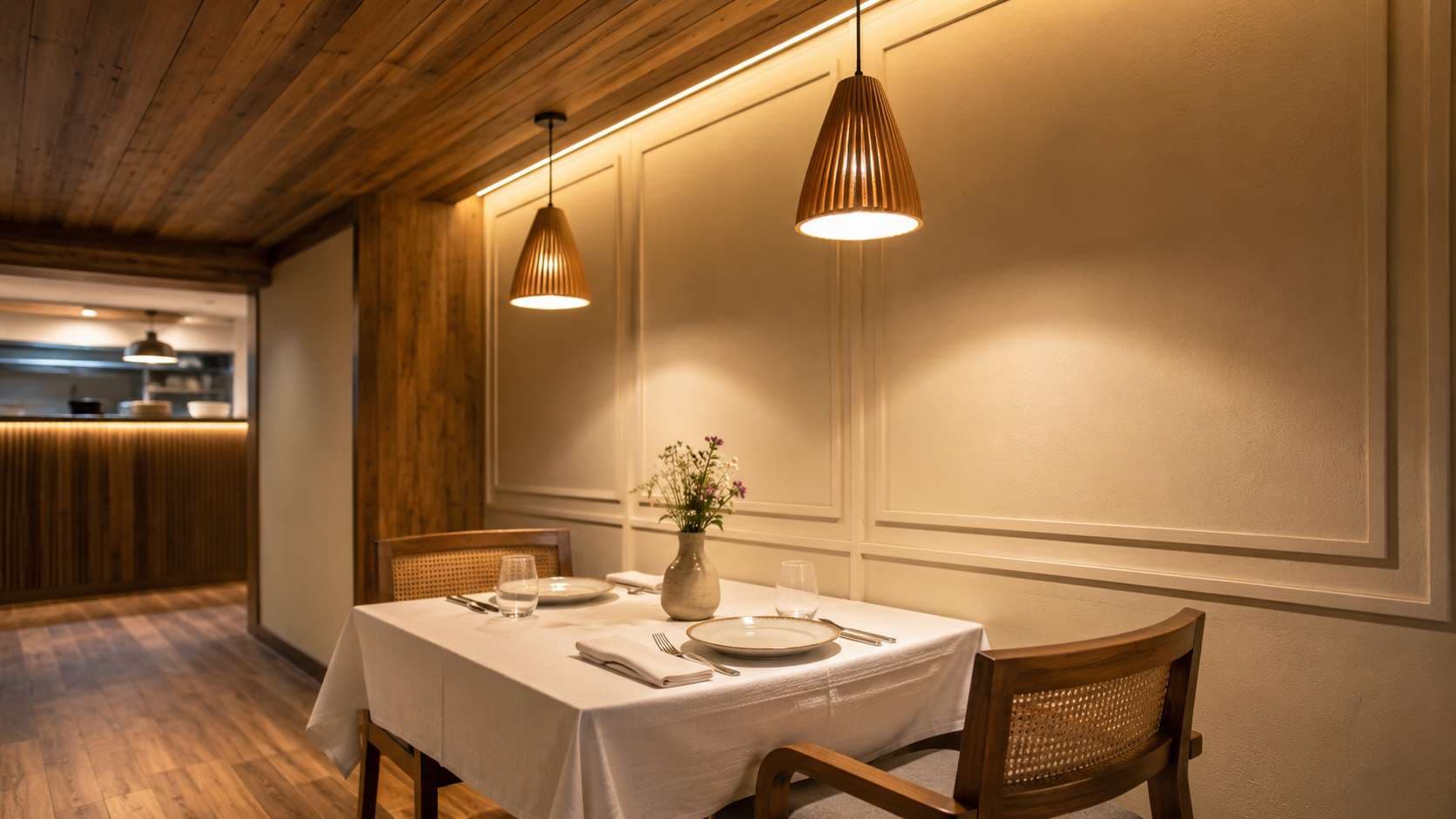
Restaurant-grade interior detail — wood ceiling, warm pendant lighting, set 2-top table
That's the restaurant-grade fitout that the container restaurant design at this price point delivers. Customers don't see the steel frame or the panel build-up. They see wood, warm light, and table service.
What ₹15,55,000 Includes — and What the Operator Buys Separately
The ₹15,55,000 price (regular ₹16,95,000) published on this page is the factory-finished 40-ft container restaurant for sale as a buildable SKU — not a bare shell with a quote-for-everything caveat. Here's the line.
Included in the ₹15,55,000 build: 40' × 10' × 9' container shell with steel frame and 50mm PUF wall and roof panels; factory exterior paint or GI cladding in your brand colour; interior fitout covering wood ceiling and dining wall panelling, kitchen-side food-grade stainless steel lining, dining floor finish, and lighting fixtures wired to plan; kitchen exhaust hood sized to spec, LPG inlet, sink, commercial-rated MCB panel; customer-facing service pass with finished framing; optional restroom shell with WC, basin, plumbing, fixtures-ready; doors and windows per approved layout; delivery within India and crane unloading at site.
Owner-supplied (separate budget): commercial kitchen equipment — burners, fryers, refrigeration, coffee or espresso machine — bought to your menu spec; dining furniture (tables, chairs, soft furnishing); signage and outdoor branding; FSSAI State License application (we provide layout documentation, you file); fire NOC and local municipal approvals at your site; outdoor seating or deck if your concept needs covers above 24.
SKU SP-CC-40-2024, delivered from our Bangalore (Gopasandra) or Greater Noida (Jalpura) facility on a 21–35 working day fabrication window.
Container Restaurant vs Shipping Container Restaurant — Which Build to Pick
SAMAN makes both a container restaurant (this page, ₹15,55,000) and a shipping-container conversion build (₹11,85,000) — and the ₹3,70,000 gap is where some buyers stop and ask which one fits their concept. The answer turns on what you're optimising for.
The container restaurant at ₹15,55,000 leads with the dining experience. The 40-ft unit is configured restaurant-first: deeper interior fitout, restroom-ready, table-service layout, restaurant-grade finishes. The buyer is operating a sit-down concept where the customer-facing impression matters as much as the kitchen.
The structure-led shipping-container conversion build at ₹11,85,000 leads with the container-as-restaurant proposition — open in a tighter timeline, lighter interior commitment, the ISO container silhouette as the brand statement. Same 40-ft footprint, simpler fitout, lower entry price. The buyer is optimising for speed-to-revenue and capex efficiency.
If your concept is full-service table dining with brand identity in the customer-facing finish, this page is the right build. If your concept is fast-service, lower-touch, or you want the visible shipping-container look as the headline with the saving in your back pocket, the structure-led conversion build is the better economic call.
When a Container Restaurant Is the Right Pick — and When Another SAMAN Build Fits Better
Three operator profiles tend to land cleanly on this 40-ft single-unit container restaurant: a hotel or resort adding an F&B annexe at a guest-stay property, a plot-corner family restaurant operator going modular instead of brick, and a highway dhaba operator upgrading from an open kitchen to a fitted-out building. The 40-ft footprint, the restaurant fitout, and the ₹15,55,000 entry hit those use cases without overshooting.
If you're outside that profile, another SAMAN configuration in the cluster usually fits better. An operator chasing a low budget fast food container shop design — QSR formats, take-away dosa, vada pav counter, biryani-bowl service — is better served by the structure-led conversion build covered above: same footprint, simpler fitout, lower entry. If you want to grow into a multi-unit footprint with kitchen, dining, and bar separated across containers (food-court style), the multi-container layout we cover separately starts at a larger footprint and ₹33,25,000+. If your business model itself requires relocating the build every 12–24 months across sites, the smaller mobile build is engineered for that lift cycle, not this one. And if you're operating a kitchen-only commercial container with no dining floor — a back-of-house or cloud-kitchen build — the kitchen-only food-grade container we make is purpose-fitted for that.
The 40-ft container restaurant is the right pick when the dining floor is the product. If it's a footnote to your concept, the right SAMAN build sits elsewhere in the cluster.
Where SAMAN Container Restaurants Are Already Operating Across Bangalore and Delhi NCR
Deployed SAMAN container restaurant projects include sites in Whitefield, Hosur, and HSR Layout across Bangalore, and Greater Noida and Gurugram in the Delhi NCR cluster. These are restaurant-grade builds — table-service operators running fitted-out 40-ft units, not cafes or kiosks. Photographs of these deployments sit in the product gallery at the top of this page.
Manufacturing happens at two SAMAN facilities: Gopasandra (Bangalore) serving South India deliveries, and Jalpura (Greater Noida) serving North and Central India. Pan-India delivery and on-site crane unloading are handled from whichever facility is closer to your site.
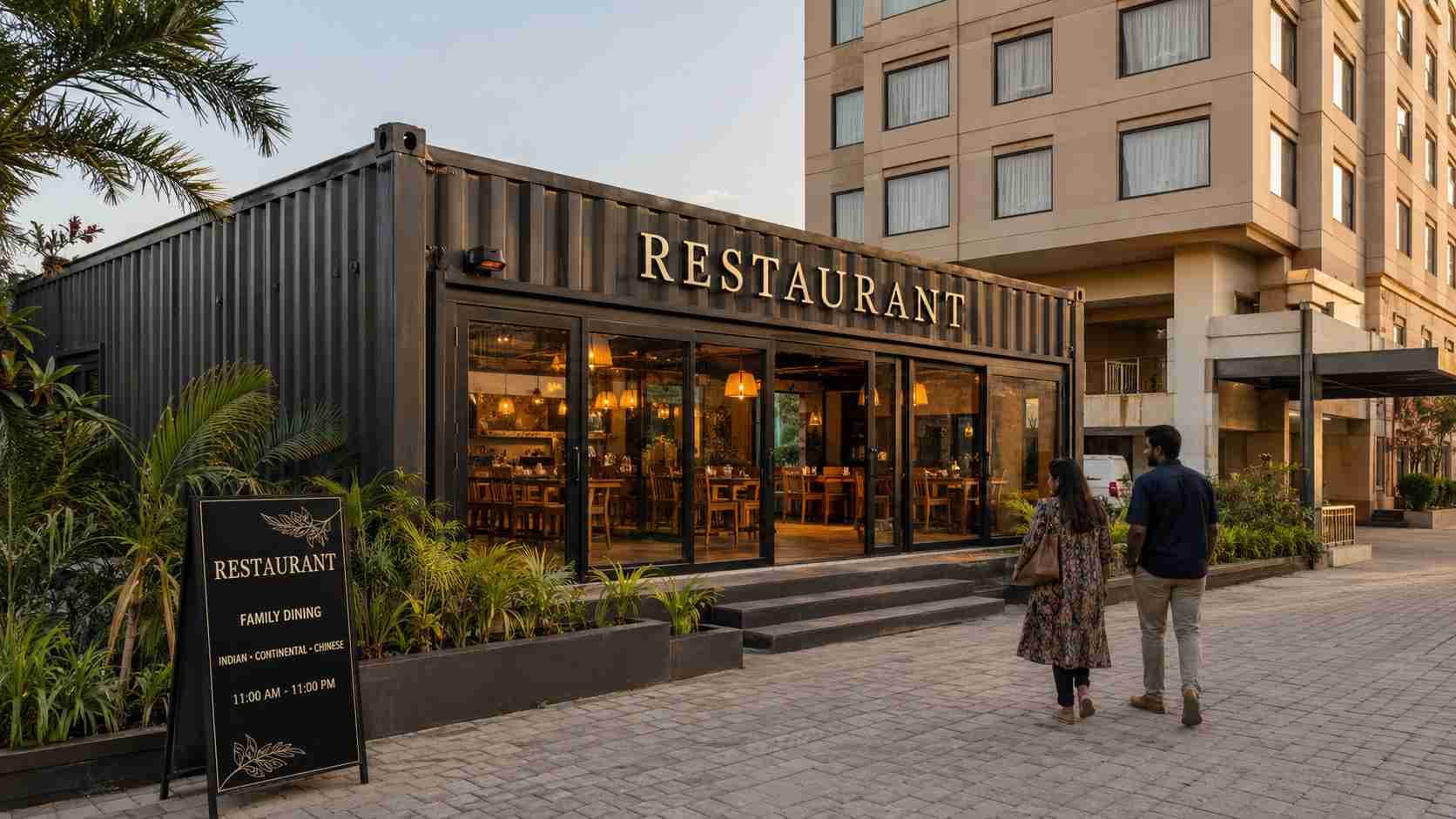
Container restaurant deployed as a hotel F&B annexe — Indian commercial hospitality use case
FSSAI and Site Planning for a Fixed-Establishment Container Restaurant
A 40-ft container restaurant operates under FSSAI as a fixed-establishment food business — same regulatory category as any standalone brick-and-mortar restaurant, regardless of whether the structure is brick or steel. The license tier depends on annual turnover: FSSAI State License (Form B) for annual revenue between Rs 12 lakh and Rs 20 crore, FSSAI Central License above that. The application is made in the operator's name at the site address, separate from any SAMAN documentation.
Site prep for a fixed installation runs in parallel with fabrication: ground levelling and a 150mm M20 concrete pad sized for the 40-ft footprint, three-phase electrical supply, water connection with drainage to the municipal line, an LPG bank or pipeline gas connection, and a fire NOC where the local municipality requires one for sit-down food service. Most sites clear prep in 5–10 working days; the SAMAN fabrication window of 21–35 working days runs alongside.
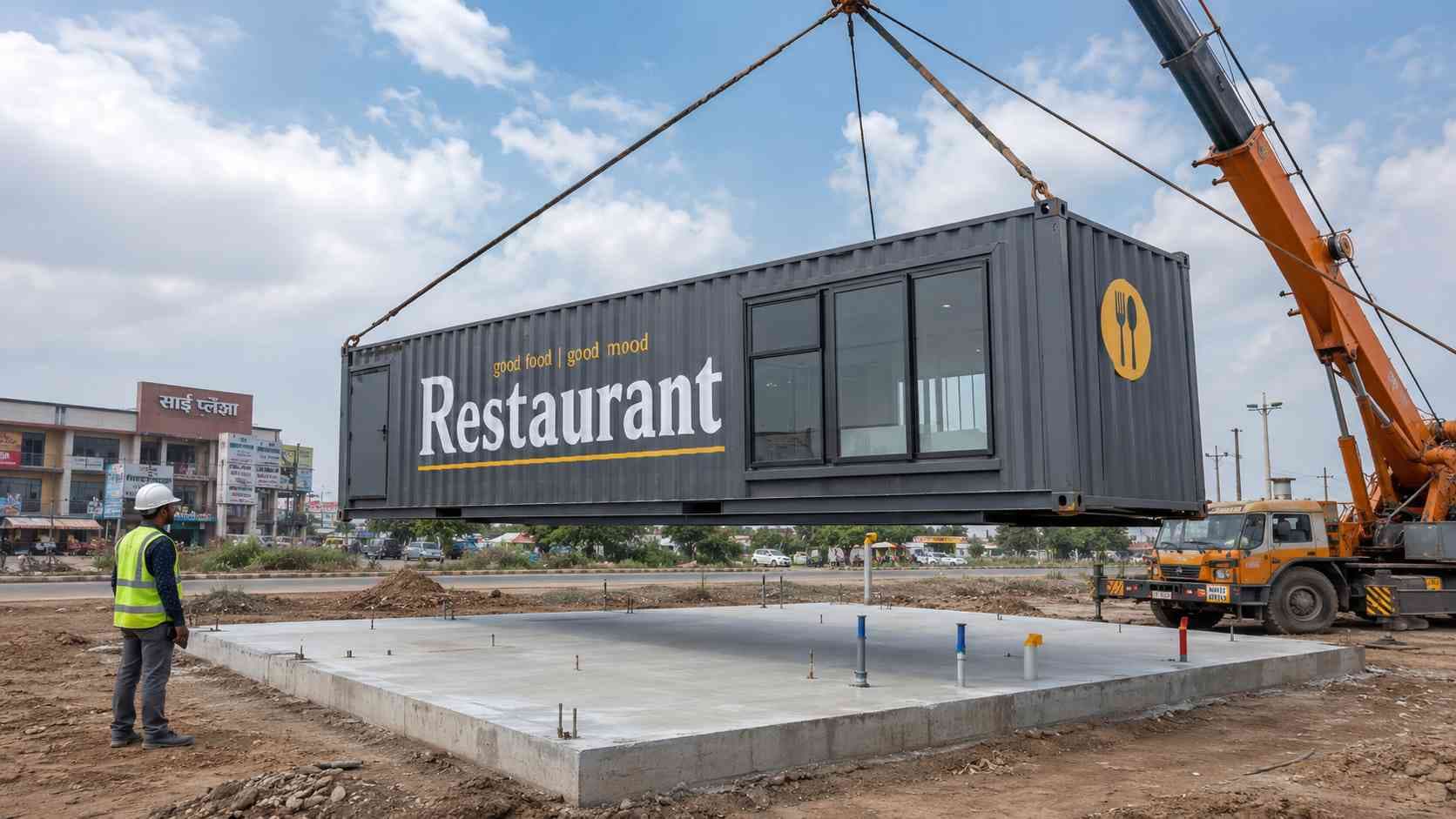
Installation moment — 40-ft container restaurant lifted onto site concrete pad with utilities pre-staged
For operators evaluating multiple sites — a plot-corner family restaurant comparing two locations, say — site readiness (utility connections, FSSAI inspection availability, municipal approvals) is usually the longer pole than the build itself. A container restaurant for sale and delivered from factory in five weeks doesn't help if the site can't accept it for ten.
Frequently Asked Questions
How many covers can a single 40-ft container restaurant actually seat at table service?
Plan for 16 covers at fine-dining table spacing or up to 24 covers at faster-tempo restaurant spacing using a mix of 2-top and 4-top tables. Growing past 24 covers usually means adding an outdoor deck for table extension (workable in most Indian climates seven to nine months a year) or moving to a multi-container layout. The 16–24 band fits the seat-density profile of most Indian standalone full-service restaurants.
Can the kitchen and the dining area really share one 40-ft container without FSSAI airflow issues?
Yes — the FSSAI airflow direction (clean-to-contaminated zone separation) is built into the fitout. The kitchen zone is sealed at the service pass by a finished partition wall; cooking exhaust draws upward and out through the hood, not laterally into the dining area; the kitchen-side and dining-side ventilation are designed as separate paths from the start. The principle is the same one used by every standalone Indian restaurant with an open kitchen visible to diners. What changes here is just that the partition runs the width of a 40-ft container instead of the width of a brick room — physics is identical, FSSAI compliance is identical.
What's the difference between this container restaurant at ₹15,55,000 and the shipping-container conversion build at ₹11,85,000?
The ₹3,70,000 difference is fitout. The structure-led build at ₹11,85,000 is configured for speed-to-revenue and capex efficiency — lighter interior finish, simpler dining setup, the visible ISO container as the brand statement. The container restaurant build at ₹15,55,000 is configured for full-service dining — wood-clad ceiling and dining-side walls, restaurant-grade lighting, restroom-ready, table-service layout. Same 40-ft container shell on both. Different commitment on the inside.
Can I add an outdoor seating deck around the container to grow my cover count beyond 24?
Outdoor decks are how most container restaurant operators in India scale covers past the in-unit ceiling. Budget 200–400 sq ft of outdoor space alongside the container — a wooden deck, paved area, or a tensile shade structure depending on your site climate — and you can add 20–40 outdoor covers to the 16–24 inside, giving operating capacity of 40–60 total at peak. Outdoor covers add to your FSSAI footprint declaration and may need a separate municipal NOC for outdoor service depending on local rules. The container is the building; the deck is your expansion option.
Is a 40-ft container restaurant a good fit for highway operators, or is it more suited to resort and hotel F&B?
Both work, for different reasons. Highway and plot-corner family-restaurant operators tend to value the speed to open (five to seven weeks from order vs nine to fourteen months for a brick build), the fitted-out interior arriving complete, and the table-service capacity in a small footprint. Resort and hotel F&B operators tend to value the design freedom on the customer-facing finish — wood cladding, branded panelling — and the option to install a second unit later for a sister concept without rebuilding the first. Both profiles land cleanly on the 40-ft build at ₹15,55,000. Operators outside these two are usually running a different concept — a coffee kiosk, a food truck, a back-of-house kitchen — and a different SAMAN build fits better.
Ready to Plan Your Container Restaurant?
Share four things and we come back within 24–48 hours with a layout drawing, an itemised quote, and a delivery and crane schedule: your starting site location, your target cover count (or your menu and table mix if you'd prefer us to back into the count for you), brand-finish preferences (wood interior, exterior colour, signage zone), and your target opening date. Standard fabrication runs 21–35 working days at our Bangalore (Gopasandra) or Greater Noida (Jalpura) facility — the closer-located factory ships to you to minimise transit. Crane unloading and on-site installation are included in the build price within India.
For everything else we make in the same cluster — kiosks, mobile builds, multi-container layouts, hotel rooms in containers — see the rest of our container cafe range.
Call or WhatsApp: +91 97089 89937 (Greater Noida) · +91 80886 85440 (Bangalore)
Customer Reviews
0 reviews
No reviews yet. Be the first to review this product.
Write a Review for Container Restaurant
Need Custom Requirements?
Get in touch with our experts for customized solutions and bulk orders. We're here to help you find the perfect solution.