
Porta Cabin Durability Guide: What Determines 20-Year Lifespan in India
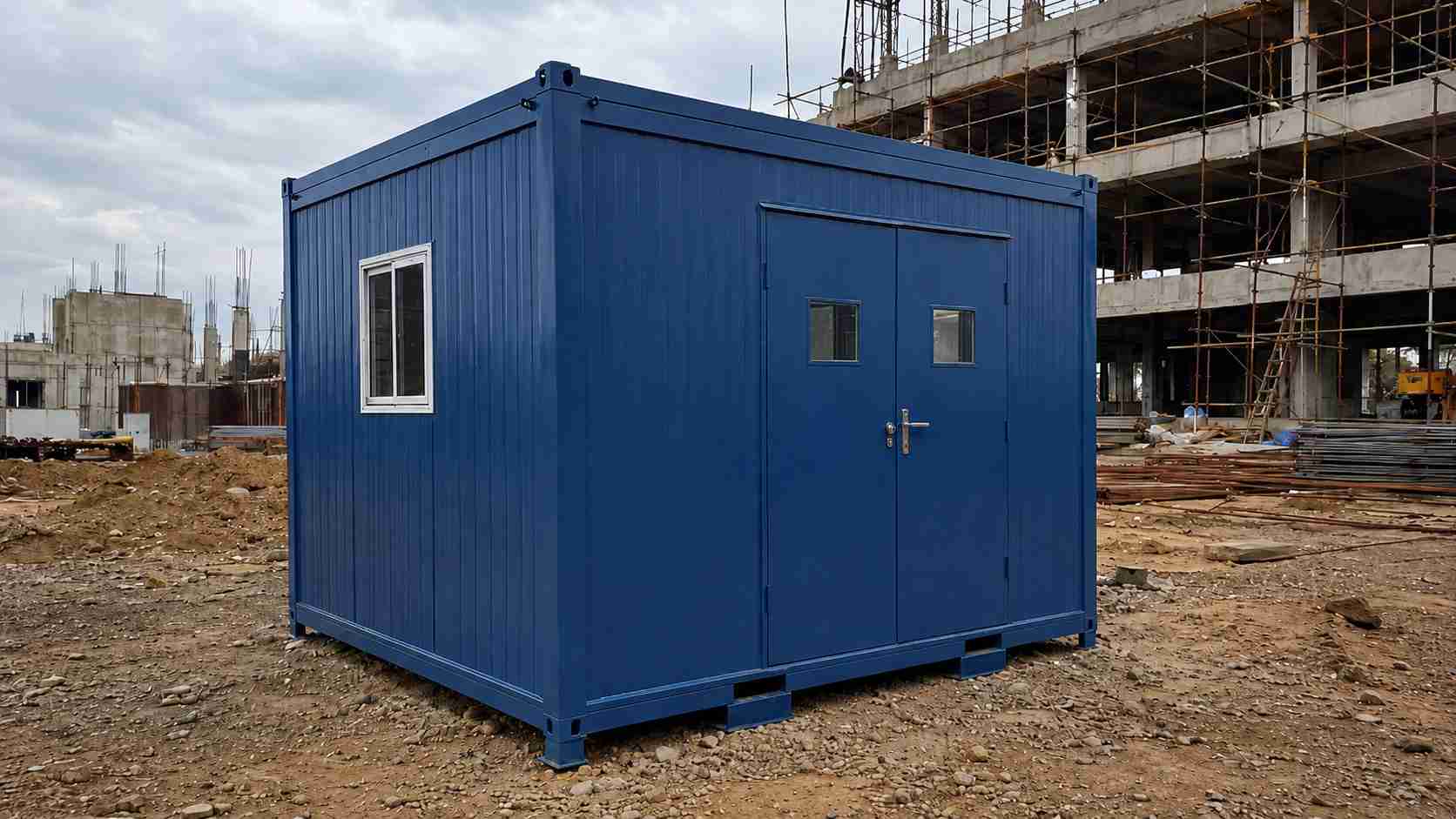
A porta cabin is a steel-frame prefab structure, not a sanitation unit — and this porta cabin durability guide explains what actually determines whether yours lasts five years or twenty-five. The “10 to 25 years” figure repeated across the search results hides five variables that decide where in that band your unit lands: frame material grade, factory surface treatment, deployment climate, use intensity, and maintenance discipline. This guide quantifies all five.
How Long Does a Porta Cabin Actually Last in India — And What Determines the Answer
In India, a porta cabin with a correctly specified mild steel frame (IS 2062 Grade A) and factory-applied surface treatment — zinc phosphate primer plus polyurethane topcoat at 100 to 125 micron total dry film thickness — lasts 20 to 25 years on inland sites and 15 to 18 years on coastal sites, provided the exterior is repainted every 24 to 36 months.
The number nobody quotes in concrete terms is the deployment context. A porta cabin in a Rajasthan inland project does not face the same corrosion load as the same unit in Kerala or near a fertilizer plant. A unit that supports 8 site engineers daily does not wear the same way as one used as a weekend storeroom. And a cabin that is repainted every 30 months reaches its 20-year mark; one that is never repainted shows substrate steel exposure by Year 4.
The five variables this guide quantifies in order are: the structural material grade, the factory surface-treatment specification, the climate band of your site, the use intensity, and the maintenance schedule. Each is independently capable of cutting the rated lifespan by 30 to 50 percent if specified wrong. Get all five right and the cabin meets or exceeds its engineered lifespan. Get any one wrong and the porta cabin lifespan claim fails — usually quietly, between Years 5 and 10, when the warranty has already lapsed.
The rest of this guide takes each variable in turn.
The Frame — Why IS 2062 Grade A Mild Steel Sets the Floor for 20-Year Service
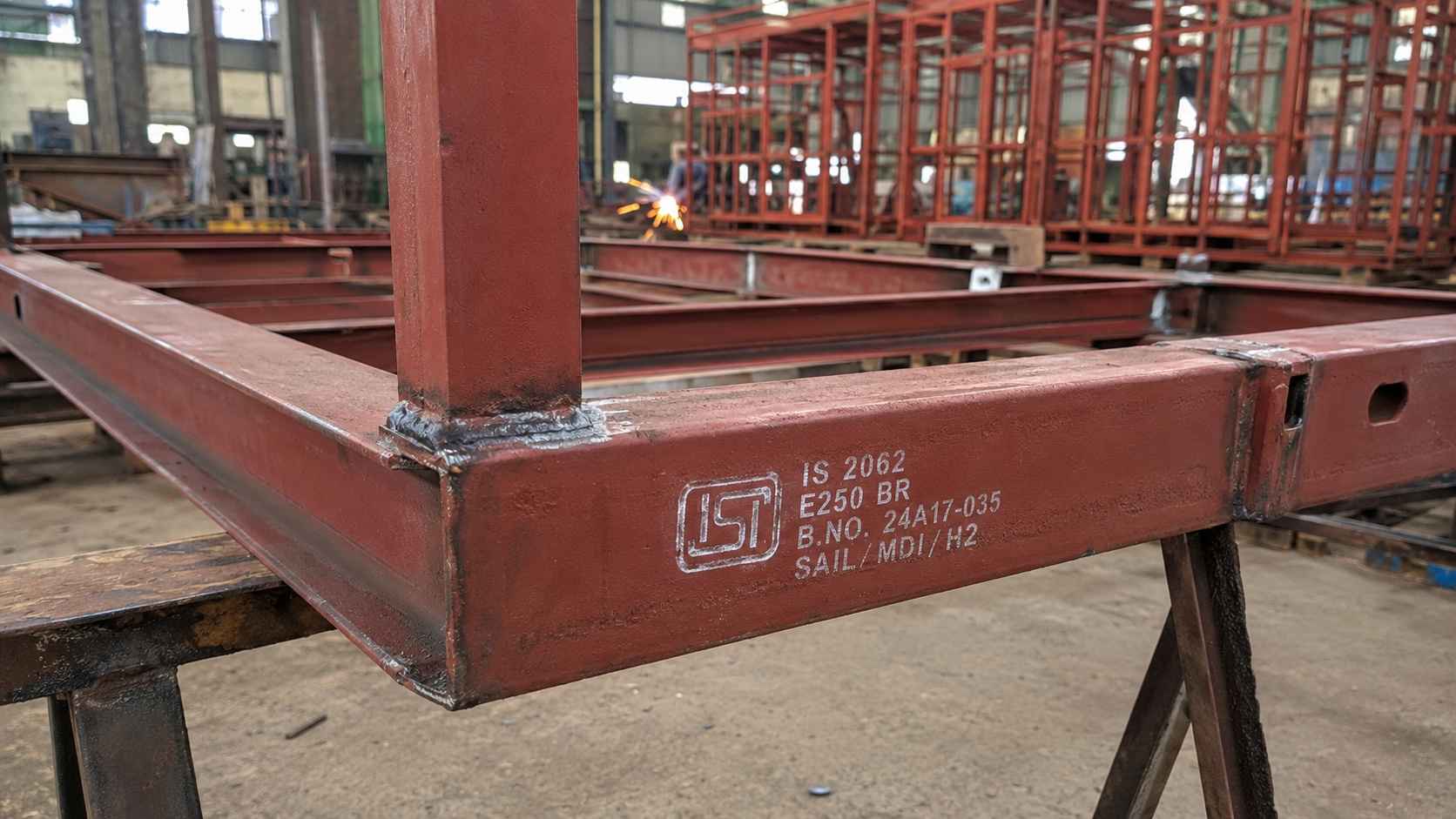
Every claim about porta cabin durability begins at the base frame. Not the cladding, not the insulation — the structural steel that carries the entire cabin’s load through transport, erection, and 20 years of weather. The relevant procurement standard in India is IS 2062 Grade A, the Bureau of Indian Standards specification for structural mild steel with a minimum yield strength of 250 MPa. This is the same grade specified in project procurement documents, government site contracts, and industrial-zone supplier qualifications.
The phrase “high-quality steel” appears on every competitor’s website. It carries no test certificate, no mill traceability, no procurement defensibility. IS 2062 Grade A carries a mill test certificate, batch-level steel composition data, and a yield-strength test result that an EPC procurement manager can submit with a bid package. The distinction matters not because Grade A steel is mysteriously better, but because it is documented — and the documentation is what makes the 20-year service claim defensible when a structural inspector audits your site five years from now.
For most deployments — inland sites, dry-to-humid climates, standard use intensity — IS 2062 Grade A with correct surface treatment is the right specification. The exception is industrial-chemical environments where a galvanized iron structural frame may be warranted; that upgrade is covered in the climate-band section below.
For the full material specification — frame dimensions, panel system, and the IS 2062 Grade A mill certificate process — see the IS 2062 Grade A frame specification we use on our MS cabins.
Surface Treatment — The 100-Micron Coating System That Determines Whether You Hit Year 20
Surface treatment is the single biggest factory-stage lever on porta cabin lifespan. It is also the one specification no competitor publishes — every search result mentions “weatherproof coatings” as a feature, none specify the system.
The treatment that delivers 20-plus years of service on a correctly framed cabin follows four steps before the unit leaves the factory. First, blast cleaning of every fabricated steel surface to Sa 2.5 standard — a profile cleanliness specification that removes mill scale, rust, and contamination so the primer bonds to bare metal. Second, two coats of zinc phosphate primer at approximately 40 microns combined dry film thickness; zinc phosphate creates the passivation layer that resists rust formation even when the topcoat is later damaged. Third, a polyurethane topcoat at 60 to 85 microns in the specified colour. Fourth, the cabin is quality-inspected for film thickness uniformity using a calibrated DFT gauge before dispatch.
Total dry film thickness across the system: 100 to 125 microns minimum. This is the figure to ask for on any quote. Anything below 80 microns is a budget cabin with a service ceiling around 5 to 8 years on coastal sites. Anything above 125 microns is overkill on standard inland deployments and adds cost without measurable lifespan benefit.
For coastal and high-humidity deployments, a pre-galvanized cladding upgrade — wall and roof panels factory-galvanized before the polyurethane topcoat is applied — adds 8 to 12 percent to the cabin cost and 3 to 5 years to the corrosion-driven service life. For the cladding upgrade detail see our full steel porta cabin specification with pre-galvanized cladding.
Four Indian Climate Bands and What Each Does to Your Cabin’s Lifespan
The single biggest gap in every search result for this query is climate-band specificity. India is not one corrosion environment — it has at least four, and the gap between the kindest and the harshest is roughly a decade of service life.
Inland-dry sites — Rajasthan, Madhya Pradesh, the dry zones of Uttar Pradesh and inland Gujarat — see low humidity, hot summers, cold winter nights, and minimal corrosion load. A standard MS cabin with correct surface treatment delivers the full 22 to 25 year rating here. No cladding upgrade justified.
Inland-humid sites — Assam, Meghalaya, West Bengal, Odisha, the entire Northeast and high-rainfall inland zones — combine 70-plus percent year-round humidity with monsoon water exposure. MS frame corrosion accelerates at panel joints and base-frame welds. Pre-galvanized cladding is recommended and brings the lifespan back into the 18 to 22 year band.
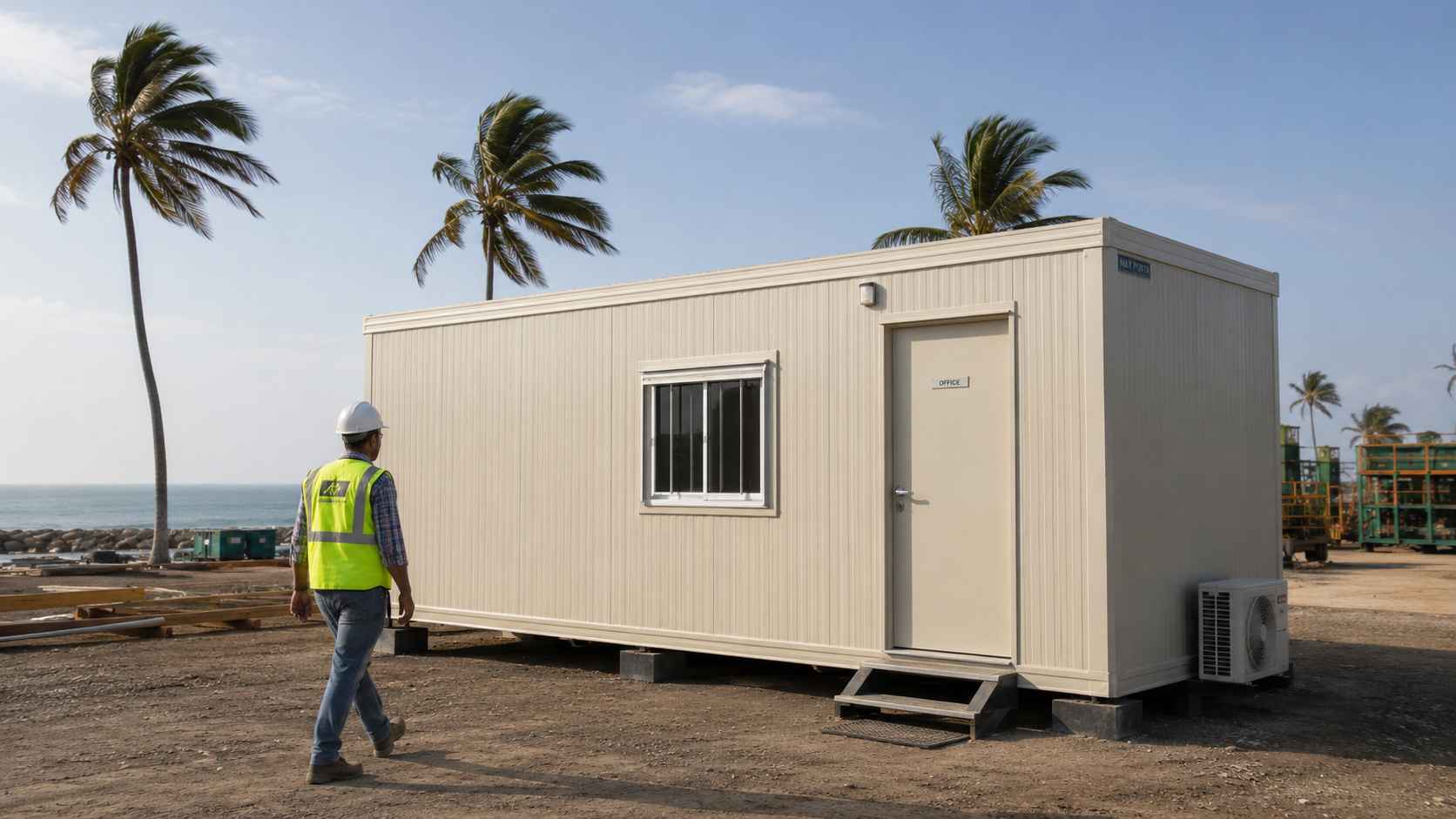
Coastal sites — Kerala, Goa, the coastal strips of Tamil Nadu, Andhra Pradesh, Karnataka, and Maharashtra — face salt-air chloride attack on every exposed metal surface. A standard MS cabin sees rust at exposed bolt heads within 18 months and panel-edge corrosion by Year 5. Pre-galvanized cladding plus 24-month repainting brings coastal service life into the 20-year band.
Industrial-chemical adjacencies — sites within 500 metres of fertilizer plants, dye works, battery storage, or chemical processing — see corrosion rates three to five times higher than coastal MS exposure. A galvanized iron structural frame is the procurement specification, adding 15 to 20 percent to base cost and preserving 12 to 15 year structural life in environments where standard MS would fail in 5 to 7.
| Climate Band | Example Regions | Standard MS Lifespan | Recommended Upgrade |
|---|---|---|---|
| Inland-dry | Rajasthan, MP, UP-inland, Gujarat-inland | 22-25 years | None — standard MS adequate |
| Inland-humid | Assam, Meghalaya, Bengal, Odisha, NE India | 18-22 years | Pre-galvanized cladding |
| Coastal | Kerala, Goa, TN/AP/Karnataka coast, coastal MH | 15-18 years | Pre-galvanized cladding (+8-12%) |
| Industrial-chemical | Adjacent to fertilizer, dye, battery, chemical plants | 12-15 years | GI structural frame (+15-20%) |
The Maintenance Schedule That Achieves the Rated 20-Year Life — Not the Adjectives
Every competitor’s “tips for longevity” listicle says the same four things — clean regularly, inspect for damage, lubricate locks, maintain ventilation. None of this tells a site manager what to actually schedule on the operations calendar. Here is the schedule that achieves the rated porta cabin lifespan.
Year 1 — Settling inspection. Three months after installation, check that the cabin has settled evenly on its skid supports. Re-shim any corner where the floor has dropped more than 5 mm. Inspect the seal at door and window frames after the first monsoon for any water ingress trace.
Years 2 to 3 — First exterior repaint. This is the single most important porta cabin maintenance event. Use a PU-compatible topcoat at 50 to 75 micron dry film thickness over light-sanded existing topcoat. Repaint before the original topcoat shows surface chalking or fading — chalking means UV degradation has reached the primer layer, and substrate steel is exposed within 6 months from that point.
Annual base-frame inspection. Every year before the monsoon, check the four corner skid feet for water pooling, check the base-frame weld joints for hairline cracks (especially at the load-bearing corners), and confirm the drainage channels under the floor are clear. Address any rust spot under 25 mm² with a primer touch-up the same day. Larger rust requires the surface-treatment cycle to be repeated locally.
Years 5, 10, and 15 — Major inspection points. Year 5 — second exterior repaint due, panel-joint sealants checked. Year 10 — internal floor inspection for moisture damage, electrical fitting integrity check. Year 15 — third repaint and structural weld audit by a fabricator.
What voids the rated lifespan: skipped repaint cycles past 36 months, water pooling at skid feet through more than one monsoon, and unsupervised field modifications that breach the surface-treatment envelope.
What to Ask Your Manufacturer Before You Sign the PO — A Procurement Checklist
A 20-year durability claim is only as defensible as the documentation behind it. Before signing the purchase order, ask for these six items in writing — and treat the absence of any one as a red flag.
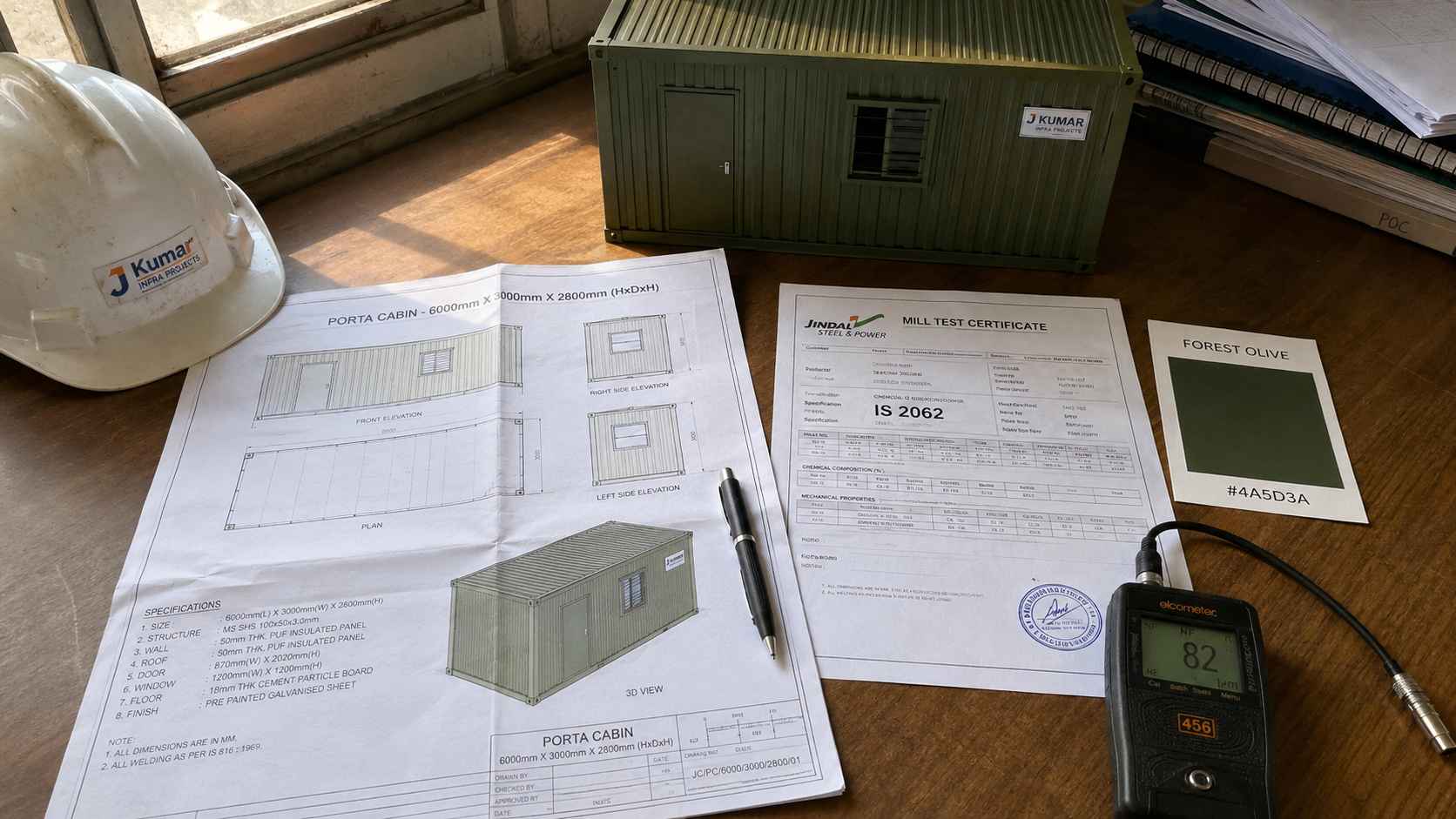
The IS 2062 mill test certificate. This is a batch-level document from the steel mill confirming the chemistry and yield strength of the structural steel used in your specific cabin. A manufacturer who cannot produce this on request is using untraceable steel — and the 20-year service claim has no foundation.
A structural drawing and design calculation summary. The drawing shows frame member sizes, weld points, and load paths; the calculation summary confirms the design accommodates the floor load you specified. Both are required for industrial-zone building plan approval (KIADB, GIDC, SIDCO and their state equivalents) and for any government tender submission.
The surface-treatment specification sheet. This document states the blast-cleaning grade (Sa 2.5), the primer system and dry film thickness, the topcoat system and dry film thickness, and the total DFT. Without this, the only durability evidence is the visible paint colour — which tells you nothing about service life.
The pre-dispatch inspection report. A manufacturer who quality-inspects each cabin before dispatch produces this report — film thickness gauge readings, weld inspection results, dimensional verification. A manufacturer who does not produce this is not running QC.
Warranty terms in writing — structural and accessory bands. A SAMAN porta cabin warranty has two bands: structural (the frame and base) at 5 years, and accessory (panels, doors, windows, locks, electrical fixtures, plumbing, roof system) at 1 to 2 years. These bands are written into the purchase order at the quote stage, not added verbally after delivery. The 20 to 25 year engineered service life this guide quantifies is a separate figure — it is what the cabin physically delivers with correct surface treatment and the maintenance schedule above, not a contractual warranty term. Any manufacturer claim of “long warranty” without these bands written down is unenforceable.
The repaint and maintenance schedule. The manufacturer should be willing to specify what maintenance is required to keep the structural warranty valid. If they cannot, the warranty is unenforceable.
For buyers also evaluating used units against new ones, the structural inspection method we cover in our used porta cabin guide complements this new-build checklist with a year-by-year failure-mode inventory. For the full SAMAN range of pre-assembled site cabins with the documentation set above as standard, see our porta cabin catalogue.
Frequently Asked Questions
How long does a porta cabin last in India?
A correctly specified porta cabin — IS 2062 Grade A frame, 100 to 125 micron factory surface treatment, repainted every 24 to 36 months — lasts 22 to 25 years on inland-dry sites, 18 to 22 years on inland-humid sites, 15 to 18 years on coastal sites with standard MS, and 20-plus years on coastal sites with the pre-galvanized cladding upgrade. The variable is not “porta cabin quality” in general — it is the specification match to your deployment climate.
Does a coastal climate reduce porta cabin lifespan?
Yes — coastal salt air drives chloride-ion attack on exposed steel surfaces, and a standard MS cabin specified for an inland site will show panel-edge corrosion at Year 5 if deployed coastally. The pre-galvanized cladding upgrade — wall and roof panels factory-galvanized before the polyurethane topcoat — adds 8 to 12 percent to the cabin cost and recovers the full 20-year service band on coastal deployments in Kerala, Goa, the Tamil Nadu coast, coastal Andhra Pradesh, Karnataka, and Maharashtra.
What is the warranty on a porta cabin?
A SAMAN porta cabin carries a 5-year structural warranty on the frame and base, and a 1 to 2 year warranty on accessories (panels, doors, windows, locks, electrical fixtures, plumbing, roof system). These two bands are written into the purchase order at the quote stage. The 20 to 25 year engineered service life is a separate figure — it is what the cabin physically delivers with correct surface treatment and the maintenance schedule covered in this guide, not a contractual warranty term. Always ask for the warranty document in writing before signing the PO; verbal warranty claims are unenforceable.
What’s the difference between MS frame durability and PUF panel durability claims?
MS frame durability refers to the structural steel that carries the cabin’s load — its lifespan is 20-plus years with correct surface treatment. PUF panel durability refers to the polyurethane insulation foam between cladding sheets — its insulation performance lasts 8 to 12 years before thermal efficiency degrades, but the panel as a structural element is not load-bearing. A “PUF panel lifespan” claim is not a porta cabin lifespan claim. The cabin’s structural life is set by the frame, not the panels.
Can a porta cabin be relocated multiple times without losing its lifespan?
Yes, with two caveats. First, the base-frame weld joints take stress at every crane lift — three to five relocations over the structural life is standard; ten-plus relocations need a weld inspection after every fifth move. Second, each relocation requires re-shimming on the new site within 30 days; a cabin that sits unevenly settled accelerates floor-frame stress and shortens lifespan independent of the relocation count itself.
For specifications, the IS 2062 mill test certificate, and project pricing, call +91 88616 22859 or use Send Enquiry and SAMAN will respond within 24 hours.
Bangalore: Call +91 88616 22859 / WhatsApp +91 88616 22859
Delhi NCR: Call +91 88616 22859 / WhatsApp +91 88616 22859